
Indoor plants
Zamia
Zamia
The genus Zamia (Zamia L.) includes 26 species of the family Zamiaceae. They occur along riverbanks in the tropics and subtropics of the Americas — north to Florida, south to the state of Pará, Mato Grosso in Brazil, and Cuba.
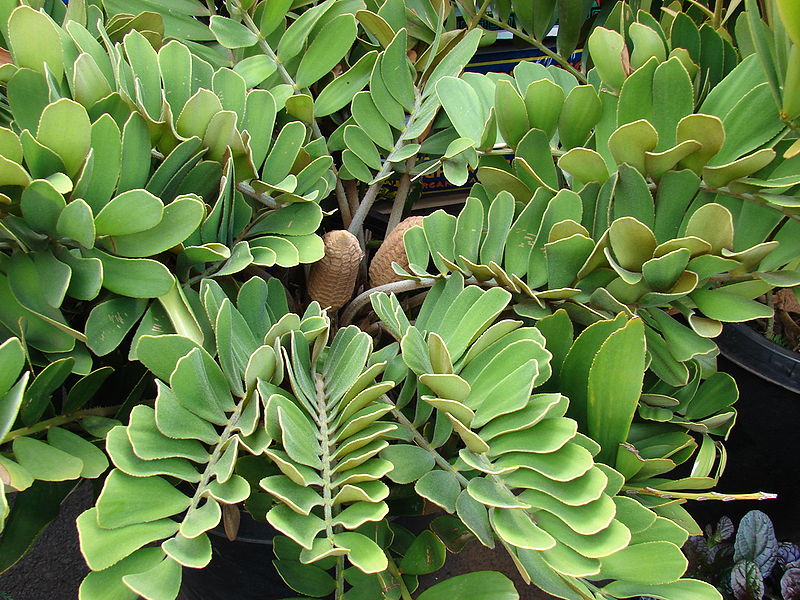
Members of the genus are evergreen plants, low-growing, with a short, smooth, subterranean, elongate tuberous or low stem covered with leaf scars from fallen leaves. Leaves are few, loosely pinnate, and do not appear simultaneously (one after another). The petiole is smooth or covered with a few spines. Leaflets are oval or lanceolate, divided at the base into two segments — a broad and a narrow one; margins entire or toothed, sometimes with sharply prominent parallel veins on the underside; leaflets are hard and coriaceous.

The name “Zamia” comes from a Latin word meaning damage, loss, or harm. It was used for damaged and empty cones of conifers. Zamia is a dioecious plant. Its reproductive organs, called strobili, resemble conifer cones.

Upon reaching maturity it forms rosettes among the leaves; in female specimens there are megastrobili consisting of verticillately arranged peltate sporophylls (spore-bearing leaves), each of which bears on the lower surface of the peltate part two pendulous ovules, while male specimens have microstrobili.
Zamia is a popular houseplant. Especially common is Z. furfuracea, which has a palm-like appearance.
Pseudoparasitic Zamia (Zamia pseudoparasitica).
These occur in tropical forests on the ground and on tree trunks (as an epiphyte) in Colombia, Ecuador, Peru, and Panama. The stem can reach up to 3 m in height. Leaves up to 2 m long (in mature plants); the leaf petiole has sparse spines. Leaflets are linear, 30-40 cm long and 2.5-3.5 cm wide, with sharply prominent longitudinal veins on the underside and toothed margins.
.JPG)
Powdered Zamia (Zamia furfuracea).
The species' native range is Mexico, Veracruz. The plant's popularity is such that in pot culture it is grown not only in countries of the American continent but also at the opposite end of the Earth — in Southeast and East Asia — in Thailand, Japan, and Singapore. This is a stemless plant with a turnip-shaped trunk, almost completely hidden underground and bearing a rosette of remarkably beautiful pinnate gray-blue leaves 50-150 cm long. In the oldest specimens the trunk sometimes rises slightly above the soil surface — no more than about 20 cm.

The leaf pinnules are oblong or oblong-ovate in shape, numbering 12-13 pairs, very dense, leathery, with several clearly visible parallel veins underneath of equal strength, densely “powdered” with whitish scales — on young leaves on both surfaces, on mature leaves only on the underside.
Location: from spring to autumn Zamia prefers temperatures around 25-28°C. In winter it is desirable to lower the cultivation temperature to 14-17°C. When growing Zamia, bear in mind that the plant does not tolerate stagnant air well.
Lighting: prefers bright illumination; the plant can tolerate direct sunlight, however at summer midday it is better to shade Zamia from direct sun. It is suitable for cultivation on south-facing windows and can grow on west- and east-facing windows. On north-facing windows the plant may lack sufficient light for normal growth. Keep in mind that the plant should not be exposed to direct sunlight immediately; it should be acclimated to direct sun gradually to avoid sunburn. To grow an attractive plant with an evenly developed leaf rosette, rotate the pot from time to time so different sides face the light.
Watering: from spring to autumn water Zamia abundantly as the top layer of the substrate dries, using soft settled water. From autumn watering is reduced, and especially with cool cultivation, in winter water sparingly, avoiding both waterlogging of the root ball and its complete drying.
Air humidity: can tolerate the dry air of apartments. Additional measures to increase humidity are not required. However, in the spring-summer period the plant can be misted with soft water at room temperature.

Care: feed Zamia in the spring-summer period every three to four weeks. A balanced houseplant fertilizer is suitable. Stop fertilizing from autumn; do not fertilize in winter.
Repotting: carry out in spring and summer as needed, but the optimal time is before the start of new growth. The plant is grown in a fertile, well-structured soil mix of medium density composed of equal parts garden soil, leaf mold, humus, peat and sand with the addition of fine granite grit. Ensure good drainage at the bottom of the pot.
Propagation: by seed. Sow seeds in a light mix, covering them only to half the seed diameter. Keep the sowings moist and warm. When the first roots appear, seedlings are immediately potted singly into separate pots, taking care not to damage the roots.
Possible difficulties:
If the plant receives bright midday sun in summer, its leaves may bleach (lose color) from excess light.
Zamia grows slowly. Often plants do not produce new shoots for several years.
Water the plant carefully, since excessive watering causes plant disease.