
Indoor plants
Yucca
Yucca
Family Agavaceae. Native to North America. An evergreen ornamental plant with linear, sharply pointed, spiny leaves. The leaves are arranged in an ornamental rosette at the end of the stem.
In appearance, yucca is very similar to the green-leaved dracaena (although it is not related) and is equally hardy, presenting no problems in cultivation.
Aloe-like yucca - Yucca aloifolia - has a dense rosette of sword-shaped leaves up to 55 cm long. The leaves have very sharp tips. It has a pronounced trunk.
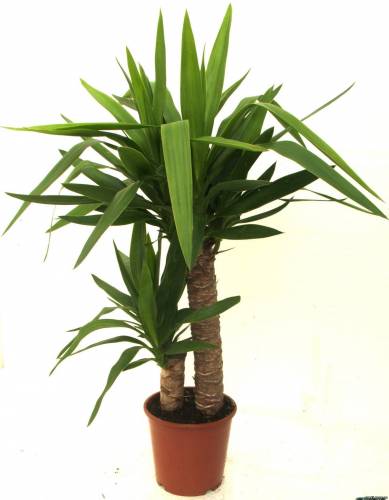
Elephant yucca - Yucca elephantipes - similar to the previous species, but the tips of its leaves are not sharp. The most common species available for sale. It is usually sold as a rooted thick treelike cutting with several leaf rosettes. It grows slowly, reaching about 1.5 meters in height.
Temperature: Moderate, cool in winter - preferably 16-18°C, but not below 8°C. In winter, when yucca is kept under normal room conditions, ventilate the room but avoid cold drafts.
Light: A bright, sunny location. In summer yucca prefers being kept outdoors - on a balcony, in the garden, etc. In winter you will have to move the yucca as close to the window as possible, since these plants particularly suffer from lack of light in winter - the leaf fan will not be lush and dense.
Watering: Abundant from spring to autumn, but water should not remain in the saucer; in winter watering is moderate. If kept in cool conditions in winter, water rarely but do not allow the root ball to dry out completely. Yucca tolerates waterlogged soil poorly - this can lead to root rot and the formation of stem rot.
Air humidity: Does not require leaf misting, but occasional washing is necessary so the plant does not get dusty and lose its attractiveness. In summer outdoors, natural rain rinsing is sufficient. If yucca is kept in a room with central heating in winter, misting is desirable at least once a day.
Repotting: The soil should be fertile. For young plants - 2 parts turf soil, 2 parts leaf mold, 1 part humus, and 2 parts sand. For adult and old plants - 3 parts turf soil, 2 parts leaf mold, 2 parts sand. Repot yucca every two years in spring. Plant yucca in a large pot or tub. Good drainage is essential. From April to August apply fertilizer every two weeks to significantly accelerate growth.
Propagation: In spring by rooting the stem tip, as well as by stem pieces (at least 10 cm long). Propagation by seeds and offsets is also possible. When propagating yucca by offsets - cut a daughter rosette from the main stem with a sharp knife, and dust the cut on the stem with sulfur. Root the cut rosette in moist sand, and after rooting plant it in a potting mix to which pieces of charcoal (for example birch charcoal) are added. It is best to cut daughter rosettes for propagation in spring or summer, as at other times of year they will not root or will root very slowly; moreover, this may harm the parent plant.
When propagating yucca by seed, it is important that the seeds are fresh. Soak the seeds for a day in warm water, then sow them in a mixture of light leaf soil and peat. Cover the pan with glass or a bag and ventilate several times a day. Usually seeds germinate within a month.