
Climbing plants
Wisteria floribunda (Japanese wisteria)
Wisteria floribunda
Synonyms: вистерия многоцветковая, вистерия обильноцветущая, глициния многоцветковая, глициния флорибунда, вистерия флорибунда, Glycine floribunda Willd, Wisteria floribunda (WiUd.) DC., японская глициния, японская вистерия, Rehsonia floribunda (Willd.) Stritch
Wisteria floribunda – a species of flowering dicotyledonous plants of the genus Wisteria (Wisteria) in the Fabaceae family. It was introduced from Japan to the USA in the 1830s and later brought to Europe. Lives for more than 50 years.
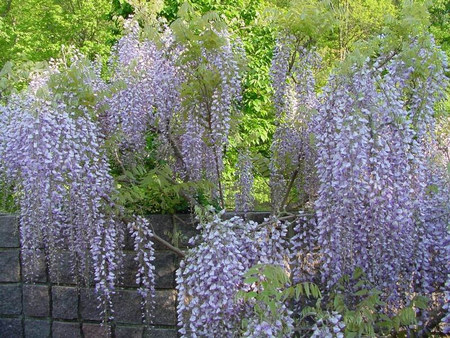
Plants of the species are woody climbers, reaching 8-10 (30) m in height. Stems twine clockwise, reaching up to 25 (40) cm in diameter at the base. Young shoots are covered with whitish pubescence, later becoming bare.
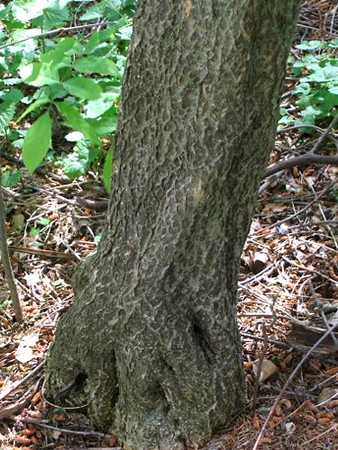
Bark dark gray, fissured; young shoots light green, covered with silky short hairs directed backward.
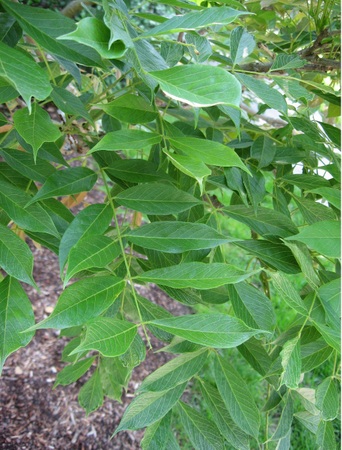
Leaves alternate, petiolate, odd-pinnate, compound, up to 25-35 (40) cm long, composed of 11-19 ovate-oblong or ovate-elliptic leaflets, 4-8 cm long and 2-4 cm wide, with a rounded or broadly cuneate base and an acuminate apex, densely green, glossy, pubescent and then abruptly becoming glabrous.
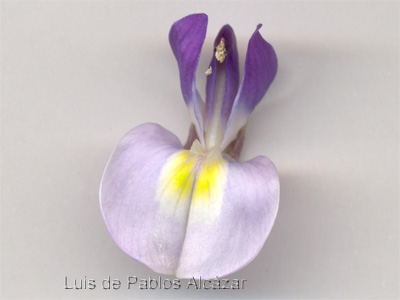
Flowers bloom in spring, in March-May, with possible repeat flowering in July-September. Flowers are pendent racemose inflorescences of conical shape, composed of numerous violet-blue flowers, reaching 50-60 cm in length. They grow at the tips of short leafy shoots. They open gradually from the base of the raceme. The corolla is papilionaceous, 1-2 cm long, purple-blue, violet, lilac, purple-blue, red, white. Calyx with triangular teeth, up to 0.8 cm long.
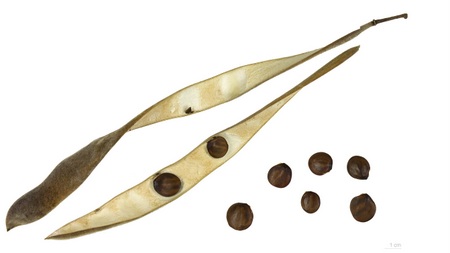
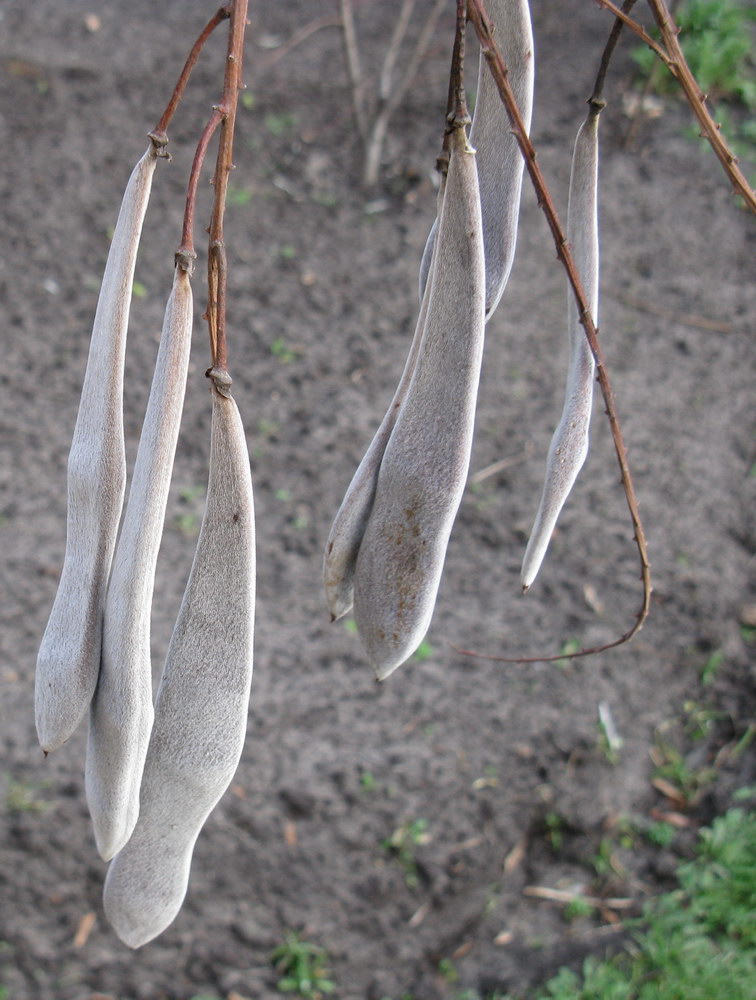
Fruits are pods 6-15 cm long and 1.5-2 cm wide, from greenish-brown to golden, covered with dense white pubescence, narrowing at the base and constricted between the seeds, dehiscing and then twisting. Seeds 2-3 per pod, kidney-shaped to rounded, brown, shiny, 1.5-2 cm in diameter, ripen from July to November. Fruits persist on the plants for a long time, sometimes almost all winter.
Chromosome number 2n = 16.
Hybrids: Wisteria × formosa — hybrid of Chinese wisteria and Wisteria floribunda.
Forms:
- 'Shiro Noda', 'Snow Showers', 'Longissima Alba' or 'Alba' - long white flowers
- 'Kuchibeni' or 'Carnea' - pink flowers
- 'Honbeni' or 'Rosea' - pale pink flowers with purple tips, reaching 18 cm in length
- 'Issai Perfect' - lilac-violet flowers
- 'Jako' or 'Ivory Tower'
- 'Lawrence' - blue flowers, a cold-hardy form
- 'Macrobotrys' or 'Longissima' - reddish-violet flowers, reaching 1 m and more
- 'Macrobotrys Cascade' - white and pink-violet flowers, a reliable plant
- 'Multijuga' - violet flowers
- 'Nana Richins Purple' - pink flowers
- 'Nishiki' - with variegated foliage
- 'Plena' or 'Violaceae Plena' - double blue flowers in dense inflorescences
- 'Praecox' or 'Domino' - pink flowers
- 'Royal Purple' - pink flowers
- 'Rubra' or 'Rubrum' - deep pink or red flowers
- 'Texas Purple' - may be Chinese or a hybrid, short violet racemes
- 'Violacea Plena' - double violet flowers in a rosette form
- 'White with Blue Eye' or 'Sekines Blue' - a very elegant cultivar with white and violet-blue flowers
- 'Purpurea' – may be Wisteria sinensis, flowers purple
Hardiness zone: 5-9 (°C) (-23°C), some cultivars may tolerate down to -28°C. Young plants require winter protection.
Location: sun-loving, demanding on soil. Needs sheltered sites protected from cold winds; should receive at least 6 hours of sun a day. Ideal location is a south-facing wall of a house or fence; southeast or southwest aspects are also suitable. In open exposed sites it generally does not flower. In maturity plants are drought- and heat-tolerant. Tolerates urban conditions well.
Soil: prefers light, well-drained, fertile soil; does not like very wet or strongly calcareous soils.
Planting: recommended soil mix at planting: topsoil, peat, humus and sand in the ratio 3:1:1:1. Planting hole size – 60x60x50 cm.
Care: requires a good and reliable support, as well as constant tying of shoots. In winter the plant is removed from the support and laid on the ground for protection.
Pruning: to control growth side shoots can be cut in mid-summer by 20-40 cm. Standard forms can be created. Flowers are produced on older wood or on last year's shoots, as well as on short flowering shoots of the current year. For abundant flowering it is recommended to prune last year's shoots annually at the end of May to no more than 30 cm. In August the current year's growth is shortened to 4-5 buds. Early in spring after removing winter protection and tying to the support, last year's shoots are shortened by 2-3 buds.
Propagation: can be propagated by seed, but cultivar traits are not retained and flowering is later and less abundant. Seeds are stored in bags in an unheated dry room. Viability under such conditions is preserved for 3-4 years. Soil germination of seeds 80%, laboratory - 90%. If seeds are not fully ripe they rot quickly. In autumn sowing is done immediately after harvest; in spring - without stratification, scarification is desirable. Sowing depth 2-3 cm. Propagates well by layering and cuttings.
Pests: green aphid, clover mite, leafhoppers, caterpillars.
Diseases: bud pyriculariosis
Companion plants: at the base of Japanese wisteria one can plant white (yellow) daffodils and dark red Darwin-hybrid tulips, dark purple hyacinths, Fritillaria imperialis, Daphne mezereum.
Uses: More ornamental and more cold-hardy than Chinese wisteria. Used to decorate arbors, pergolas, trellises, fences, houses, terraces, balconies, and lattices. Indoors it can be grown as a bonsai. Can also be grown in large pots and tubs in greenhouses and conservatories.