
Flowering shrubs
Flowering weigela (Weigela florida)
Weigela florida)
Synonym: Calysphyrum floridum Bunge, Enum. Pl. Chin. Bor. 33. 1833; Diervilla florida (Bunge) Siebold & Zuccarini; D. florida f. alba Nakai; D. praecox Lemoine; D. rosea (Lindley) Walpers; Weigela florida f. alba (Nakai) C. F. Fang; W. florida f. albiflora Y. C. Chu; W. florida var. praecox (Lemoine) Y. C. Chu; W. pauciflora Candolle; W. rosea Lindley.
Weigela florida – a species of flowering shrubs in the genus Weigela. It was first described in 1839 by the German-Russian botanist A.A. Bunge in his Ann. Sci. Nat., Bot. sér. 2, 11:241.
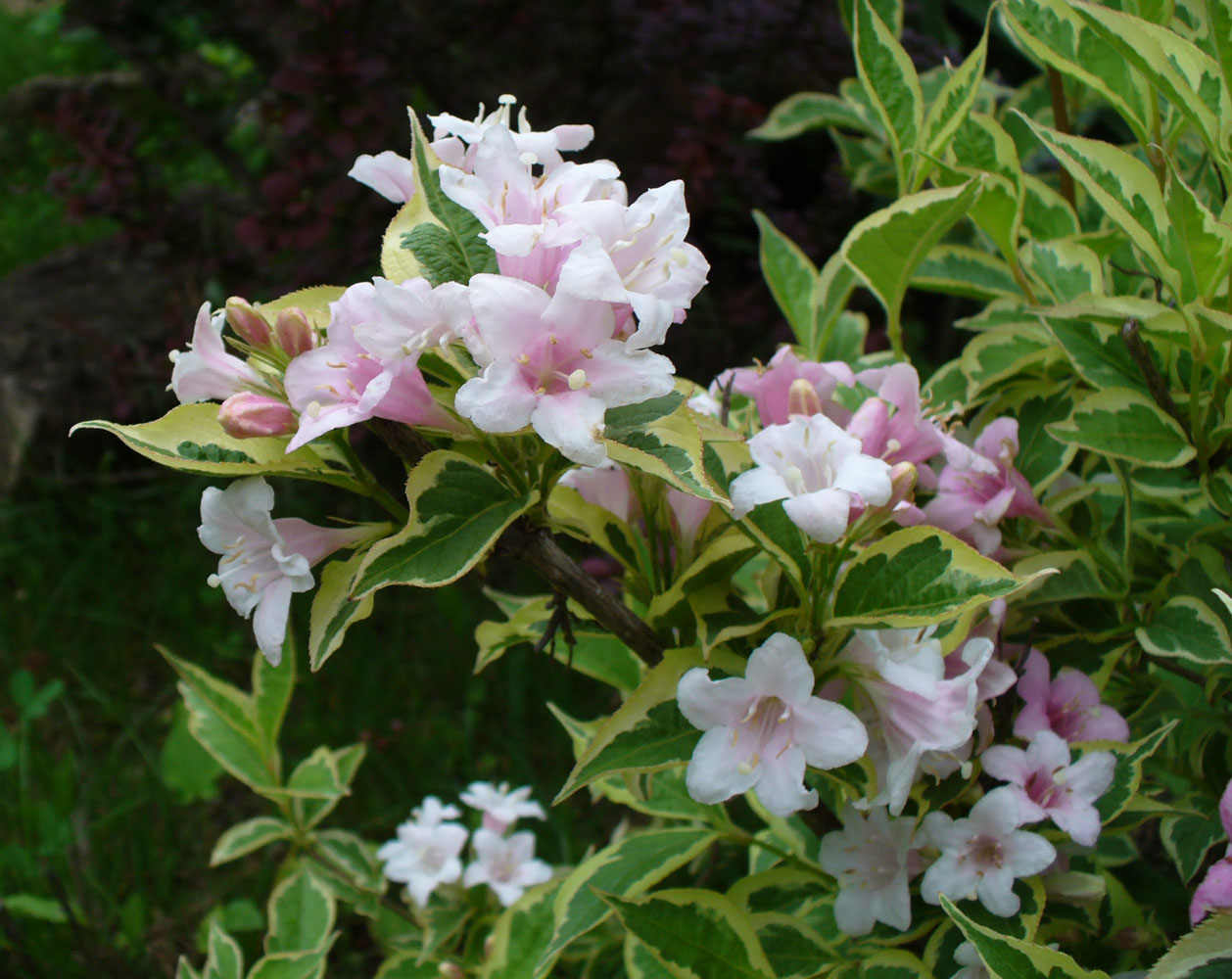
Grows in mixed forests and shrub steppes at altitudes of 100-1500 m above sea level. Occurs in the provinces Hebei, Heilongjiang, Henan, N Jiangsu, Jilin, Liaoning, Nei Mongol, Shaanxi, Shandong, Shanxi (Japan, Korea).
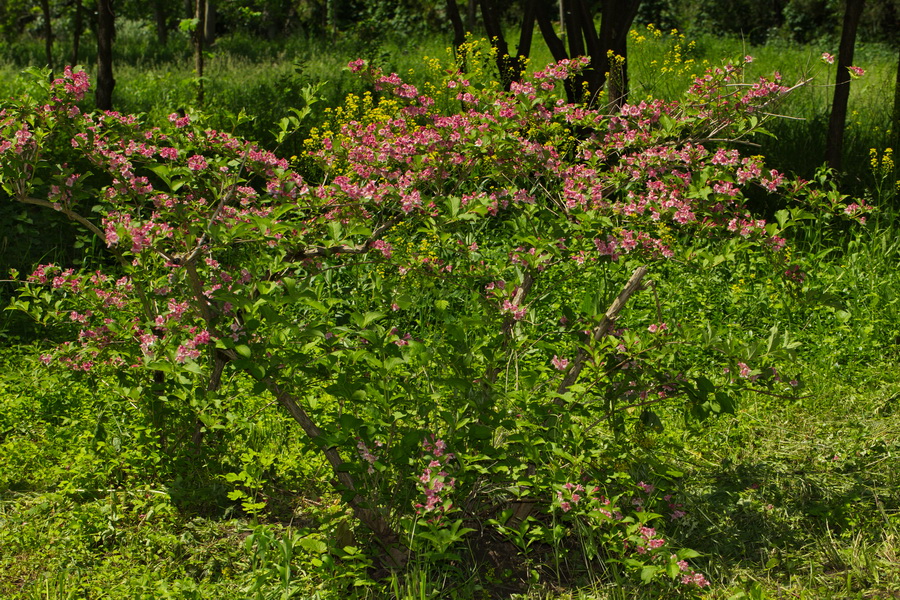
A deciduous shrub up to 3 m tall. Young branches with two bilateral lines of short, fast-growing hairs along the internodes. Bark gray. Buds acute, with 2 or 3 scales.
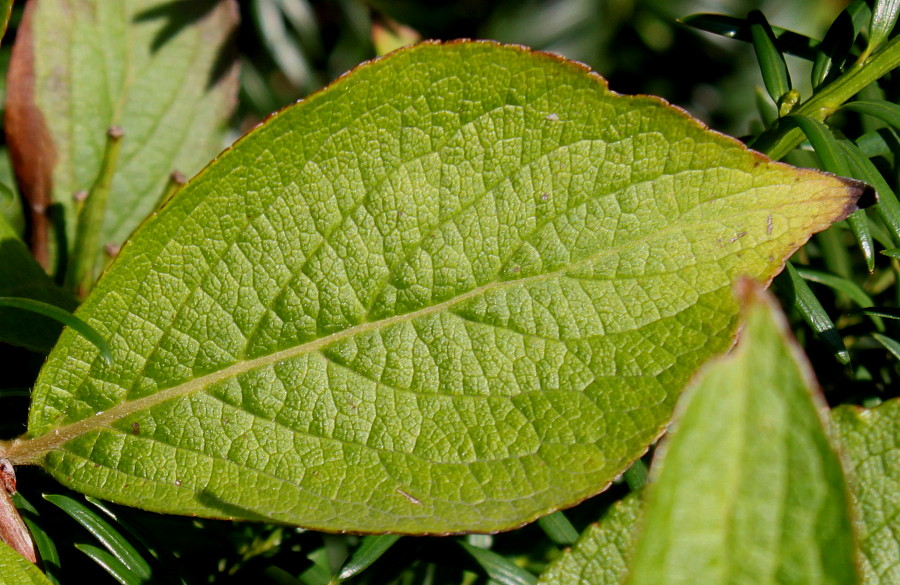
Leaves short-petioled or nearly sessile, elliptical to oblong-ovate, sometimes obovate, 5—10 cm long, acute at the apex, with a rounded or cuneate base, serrate, glabrous above except for the midrib, pubescent or tomentose on the veins beneath.
Flowers in inflorescences of 3—4, less often 1—6 flowers on short lateral shoots. Sepals nearly glabrous, fused to half their length; corolla broadly campanulate, abruptly narrowed below the middle, 2.5—3 cm long, pink, with rounded, somewhat unequal, spreading lobes. Ovary slightly pubescent, stigma two-lobed. Flowers from April to June, for about 20 days, sometimes in August.
Fruits are woody or cartilaginous capsules, from narrowly cylindrical to ovoid-ellipsoid, narrowed at the top into a beak formed by the upper part of the ovary, opening with two valves, with a seed-bearing axis remaining as a central column. Seeds angular, small, often winged. Fruits in October.
Hardiness zone: zone 4-8 (−28°C).

Location: can grow in both full sun and partial shade, but variegated forms lose variegation and the leaves turn green in partial shade. Flowers and leaves are easily damaged by wind, therefore it should be planted in sheltered locations, especially from north winds. In shade, weigelas flower poorly; seed maturation and wooding of shoots are delayed.
Planting and care: It can be covered for winter with conifer branches, but even then plants may partially freeze back. However, the plant quickly restores its crown during the season, becoming a compact bush that usually manages to bloom, although often in the second half of summer. Prefers moist, fertile and preferably slightly acidic soils. Does not tolerate waterlogging. Grows quickly. Requires watering during drought.
Light: sun-loving, they develop best in open, well-lit sites. Some species tolerate slight shading and develop well under the canopy of light, permeable crowns.
Soil: demands good soil. A soil mixture is made of humus or leaf mold, sand and sod soil (2:2:1). Grows well on loose fresh soils, but flowers poorly on waterlogged soils.
Planting: spacing between bushes at least 1.5 - 2 m, preferably 2.5 - 3 m. Planting depth 50 - 60 cm, root collar at ground level. It is best to plant three-year-old seedlings in spring. Drainage is mandatory, a layer of sand and gravel 15 cm.
Care: early in spring while snow is present, apply a complete mineral fertilizer to improve the condition of plants after low winter temperatures: urea, superphosphate, potassium fertilizer (20, 10 and 10 g/m²); the second feeding in early June – during the formation of flower buds: double superphosphate and potassium sulfate – 30 g per bush or per 1 m². In spring, water abundantly during drought and if the winter was low in snow and severe shoot freezing was noted. Rate 8-10 L per bush. Loosening is done after watering and when the soil becomes compacted after weeding; keep the planting circle (diameter at least 2 m) loose to a depth of 5-8 cm. Mulch with wood shavings up to 10 cm thick. Every spring remove frost-damaged shoots. Prune once every 2-3 years. Best pruning time is immediately after flowering. For winter, after leaf fall, tie and bend the bushes to the ground. In low-snow winters, varieties are covered with conifer branches.
Propagation: by seeds. Sowing is done in spring without pre-treatment of the seeds. You can sow at home in pots, covering them with film or glass. Seedlings are usually uniform. After the second pair of leaves appears, seedlings are pricked out. Seeds collected from garden forms and hybrids produce heterogeneous offspring. Therefore, cultivars are better propagated vegetatively: by winter and summer cuttings. Green cuttings are best taken in mid-June, before the formation of flower buds.
Uses: Used in solitary, group and edge plantings.