Weigela was named in honor of the German professor of chemistry, pharmacy and botany Christian Ehrenfried von Weigel (1748—1831).
The genus comprises 15 species native to East Asia. Three species are distributed in the southern Far East: early Weigela, Middendorff's Weigela, and the pleasant Weigela.
Ornamental flowering deciduous shrubs, prone to repeat blooming (remontancy), with large flowers up to 5 см in size, having a tubular-bell or funnel-shaped, two-lipped corolla, white, cream and various shades of red or pink that change during the flowering process. Flowers are solitary, but more often gathered in inflorescences located in the leaf axils and at the tips of short shoots. During repeat flowering, flowers develop at the tips of young growth shoots. The fruit is a two-valved capsule with numerous small, angular, often winged seeds.
In addition to abundant showy flowering, some Weigela cultivars are valued for the beauty of unusual leaves – green with white margins or purple. However, a densely leaved Weigela shrub is very attractive even with ordinary green, soft and velvety leaves, especially when covered with many bell-shaped flowers that stand out effectively against the green foliage.
Weigela hybrida — Weigela hybrida Jaeg.
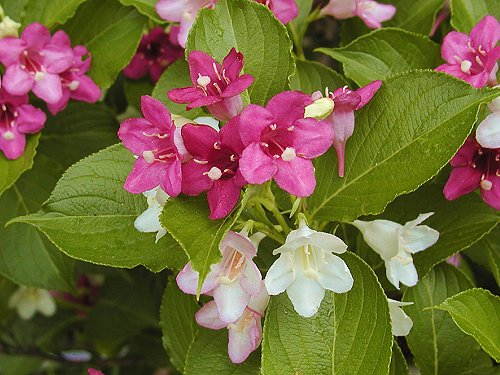
It has a graceful spreading crown and luxurious flowering. A shrub up to 1,5 м high. It is especially beautiful during flowering. Flowers are tubular-funnel-shaped, solitary or gathered in loose inflorescences. They open on young leafy shoots. They can be pink, purple, white, pinkish-violet and violet-carmine of various shades, and have a delicate pleasant fragrance.
Under this name several hybrid forms are grouped, differing in flower and leaf color. They were obtained by crosses between the species Weigela florida, Weigela garden (Weigela florida), Weigela coraeensis and Weigela floribunda. In horticulture hybrid forms are used more often than wild species.
Among hobbyists in the CIS the following cultivars are popular:
'Bristol Ruby' ('Bristol Ruby') — the cultivar was obtained in the USA in 1941. Shrub height 2.5-3 м, crown diameter up to 3,5 м. Leaves bright green, 6-10 см long. Flowers are ruby-red at the edges, sometimes with an orange-red center. Flowers in June—July, grows rapidly.
'Desboisii' ('Desboisii') — a hybrid between W. florida and W. floribunda, with small dark carmine flowers. Blooms abundantly in the second half of May for about 20 days. Shrub 2.5-3 м high. One of the early-flowering cultivars.
'Eva Rathke' ('Eva Rathke') — a hybrid between W. coraeensis and W. floribunda. Obtained in 1890 in Poland (Gdańsk). A low shrub (0.7-1 м high), compact, crown diameter 2-3 м. Leaves elliptic, pointed, 6-10 см long, bright green. Flowers red-carmine, tubular, glossy, paler inside. Flowers June—August, grows moderately fast. In Moscow it survives winter with shelter.
'Feerie Lemoine' ('Feerie Lemoine') — a shrub up to 1 м high, flowers fairly large, light pink. Origin of the cultivar unknown.
'Rosea' ('Rosea') — a hybrid between W. florida and W. coraeensis. Has very large flowers with a reflexed limb, pink, slightly variegated with white. Shrub height up to 1,5 м, crown spreading. Leaves turn mottled-red in autumn. This cultivar winters better than the aforementioned ones, requiring only a light leaf cover.
Abroad, the following cultivars are widely known:
'Candida' ('Candida') — a hybrid between W. florida and W. coraeensis with pure white flowers. Shrub up to 2 м. Flowers retain their purity of color even as they fade. Blooms in the third decade of May. Flowering lasts three weeks.
'Styriaca' ('Styriaca') — a hybrid between W. coraeensis and W. floribunda with light green leaves and pink flowers 2,5 см long, resembling strawberry blossom. Blooms abundantly in May—June; flowers become carmine as they fade. Flowering continues 16–18 days. Shrub height 2-2,5 м, crown diameter 3 м. Grows rapidly. Winters with shelter. Unlike other Weigela, cut flowers retain freshness for a long time. In the State Botanical Garden since 1948 г. 1 specimen (2 ex.) grown from seedlings obtained from Germany. Height 1,5 м, trunk diameter 150 см. Vegetation from late April to October. Growth rate average. Flowers from mid-June to early July. Fruits do not set. Partially winter-damaged. Roots 100% from cuttings when treated with phytohormone.
'Newport Red('Newport Red') — a cultivar with bright green leaves and large flowers. The height and crown diameter of the shrub about 3 м. Leaves bright green. Flowers range from carmine-red to purple. Corolla length 3 см. Flowering time: June—July. Flowering duration — about three weeks. Grows fast, overwinters with shelter.
'Marc Tellier' ('Marc Tellier') — a shrub up to 3 м high. Flowers very large up to 5 см in diameter, carmine-pink. Blooms from late May. Flowering duration 20 days. Flowers do not fade in the sun.
'Pierre Duchartre' ('Pierre Duchartre') — a shrub up to 1,5 м high. Buds are dark. Flowers of medium size, dark brownish-red with a purple edge. Blooms late May for about three weeks.
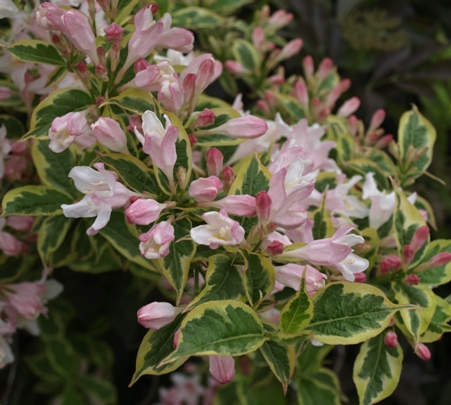
Among the group of Weigela with variegated foliage are of interest: f. sieboldii argenteo-marginata — with white-margined leaves and pink flowers; f. kosteriana variegata — dwarf, with yellow-margined leaves and pink flowers; f. nana variegata — white-variegated, dwarf, with nearly white flowers, etc.
'Looymansii Aurea'. A small shrub about 1 м high, slightly wider. Leaves 5-8 см long. In early summer they are pale yellow, then they green up. The plant is also striking in spring when covered with pink flowers borne in panicles. This Weigela is best planted in light partial shade; in full sun it often suffers from heat. In light shade it may not look as golden but appears more attractive as it does not "burn" in sun.
Most hybrid forms can be cultivated in the southern and central zones of Ukraine. They are not sufficiently frost-hardy and require winter shelter in the northern part of Ukraine. Prefers moist, fertile soils.
Weigela coraeensis — Weigela coraeensis
Native to southern and central Japan.
Grows as a shrub up to 5 м tall, in cultivation up to 1,5 м, with bare shoots; large (up to 12 см), broadly elliptic, pointed leaves, with a cuneate base and coarsely serrate margin. Upper surface of the leaves shiny, glabrous, underside sparsely hairy. Most notable in this species are the flowers up to 3,5 см long, gradually changing color from pale pink to bright carmine by the time they fade. Flowering lasts from 15 to 30 days, from late May to late June, and depends strongly on weather conditions. Fruit is a capsule. Seeds have a narrow wing. Leaf discoloration appears in early October. Then leaves darken after frosts but do not fall. Leaf mulch is necessary for winter protection.
Its growing season coincides with that of other species. In cultivation since 1850. A good ornamental shrub for the middle and southern regions of Ukraine.
Weigela maximowiczii — Weigela maximowiczii
Native to Japan.
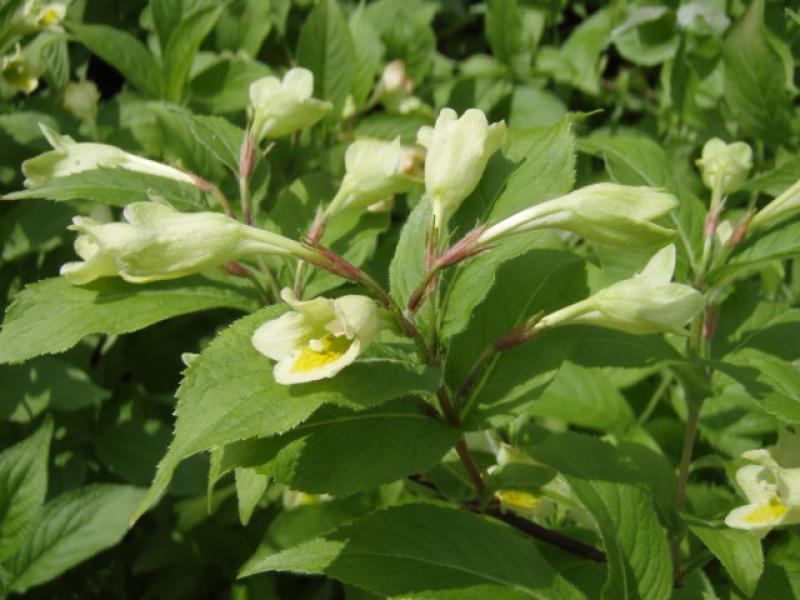
A shrub about 1,5 м tall. Leaves obovate or oblong-ovate, 4-8 см long, pointed at the tip, pubescent, almost sessile. Flowers pale yellow, funnel-bell-shaped, 3,5 см long. They are borne on short shoots, 1–2 per shoot. Fruit — a capsule. Seeds with a wing.
In the Kyiv area it blooms from the second half of May to mid-June. Individual flowers may be found at the end of June. Abundant flowering is not observed and few fruits set. They ripen by mid-October. At the same time autumn leaf coloration and the start of leaf fall occur. In winter W. maximowiczii retains its foliage.
Weigela floribunda — Weigela floribunda
Occurs wild in the mountains of Japan.
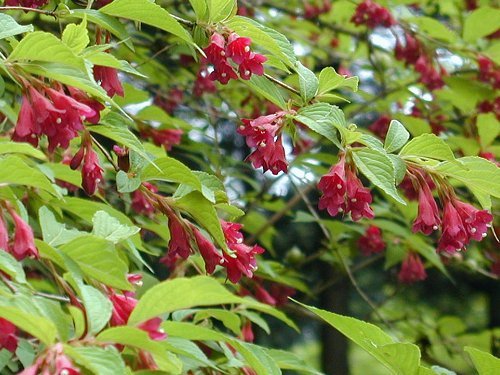
A shrub up to 3 м tall, with pubescent young shoots. Leaves elliptic or oblong-ovate up to 10 см long, pointed, with a broad cuneate base, serrate margin, sparsely pubescent above, pubescent beneath along the veins, petioles up to 5 см long. Flowers sessile, dark red, later light pink, up to 3 см, pubescent. Fruit — pubescent capsule. Hardy but less frost-resistant than Weigela florida. Grows quickly. Moisture-loving and demanding of soil.
Thanks to gracefully curved branches densely covered with bright pink and red flowers, it is very decorative in solitary plantings, loose groups, and is very effective as a tall underplanting under tall trees and in rows along paths. In cultivation since 1860. Has a large-flowered form (f. grandiflora) — with larger brownish-red flowers.
Weigela florida — Weigela florida
Occurs in Primorsky Krai, Japan and northern China.
A shrub up to 3 м tall. Young shoots with two rows of hairs. Annual shoots red-brown, later grey. Leaves shortly petiolate to almost sessile, elliptic, pointed, serrate, glabrous above except for the midrib, pubescent or velvety-pubescent along the veins beneath. Flowers in 3–4-flowered inflorescences on short lateral shoots, bright pink, abundant. Flowering time: third decade of May – early June. Flowering duration 20 days. Capsules glabrous. Weigela florida can grow in sun or partial shade, but variegated forms green up in shade. Plants can be winter-covered with conifer boughs, but even then they partially suffer frost damage. However, the plant quickly restores its crown during the season, becoming a compact shrub that usually has time to flower again in the second half of summer. Prefers moist, fertile and preferably slightly acidic soils. Does not tolerate waterlogging. Grows quickly. Needs watering in drought. Very colorful during flowering. Used in solitary, group and edge plantings.
Location: flowers and leaves are easily damaged by wind, so plant in sheltered locations, especially away from northern winds. In shade Weigelas bloom poorly, seed ripening and shoot lignification are delayed.
Light: light-loving, reach best development in open, well-lit locations. Some species tolerate slight shading and develop well under the canopy of sparse crowns.
Soil: demanding of soil. The soil mix is composed of humus or leaf mold, sand and topsoil (2:2:1). Grows well on loose fresh soils, but flowers poorly on waterlogged soils.
Planting: spacing between shrubs at least 1.5 - 2 m, preferably 2.5 - 3 m. Planting depth 50 - 60 см, root collar at ground level. It is better to plant three-year-old seedlings in spring. Drainage is mandatory, a layer of sand and gravel 15 см.
Care: early spring, on the snow, apply a complete mineral fertilizer to improve plant condition after low winter temperatures: urea, superphosphate, potassium fertilizer (20, 10 and 10 g/sq.m); second feeding in early June — during formation of flower buds: double superphosphate and potassium sulfate — at 30 г per shrub or per 1 кв. м. In spring water abundantly during drought and if the winter was low in snow and severe shoot frost was observed. Norm 8-10 л per shrub. Loosen after watering and when soil becomes compacted after weed removal; keep the root circle (diameter at least 2 м) loose to a depth of 5-8 см. Mulch with wood shavings to a layer up to 10 см. Each spring remove frost-damaged shoots. Prune once every 2–3 years. Best time to prune — immediately after flowering. In winter, after leaf fall, tie and bend shrubs to the ground. In low-snow winters cover cultivars with conifer boughs.
Propagation: by seed. Sow in spring without prior seed treatment. You can sow at home in pots, covering them with film or glass. Seedlings are often uniform. After the appearance of the second pair of leaves seedlings are pricked out. Seeds collected from garden forms and hybrids give variable offspring. Therefore cultivars are better propagated vegetatively: by winter and summer cuttings. Softwood cuttings are best taken in mid-June, before the start of flower bud formation.