
Indoor plants
Washingtonia robusta
Washingtonia robusta H.Wendl.
Synonyms: Brahea robusta Voss, Neowashingtonia robusta (H.Wendl.) A.Heller, Neowashingtonia sonorae (S.Watson) Rose, Pritchardia robusta (H.Wendl.) Schröt., Washingtonia filifera var. gracilis (Parish) L.D.Benson, Washingtonia filifera var. robusta (H.Wendl.) Parish, Washingtonia filifera var. sonorae (S.Watson) M.E.Jones, Washingtonia gracilis Parish, Washingtonia robusta var. gracilis (Parish) Parish ex Becc., Washingtonia sonorae S.Watson, Washingtonia robusta, Mexican palm
Washingtonia robusta (Washingtonia robusta H.Wendl.) – a species of the genus Washingtonia (family Arecaceae, Palmae). The species was first described in the journal 'Berliner allgemeine Gartenzeitung' by the German botanist Hermann Wendland.

In the wild it occurs in western Sonora and Baja California in northwestern Mexico. Naturalized in Spain, the Canary Islands, Réunion, New Zealand, Hawaii, Florida and California.
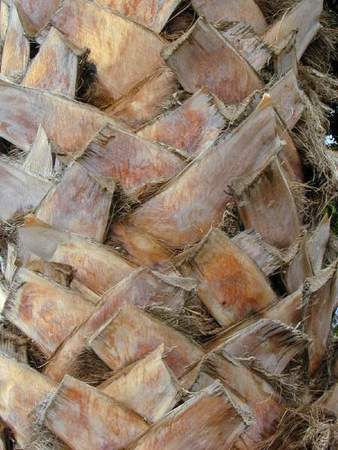
It is an erect single-stemmed palm 25-35 m tall and 2-3 m wide; indoors it reaches 2-2.5 m. In nature it grows rapidly, with annual growth reaching 1 m. The trunk diameter at the base reaches 90 cm and tapers towards the top. The trunk is brown, covered with the bases of dead leaves.
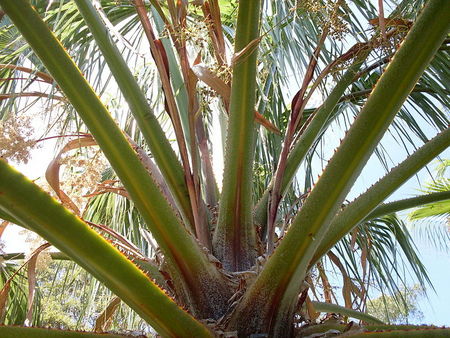
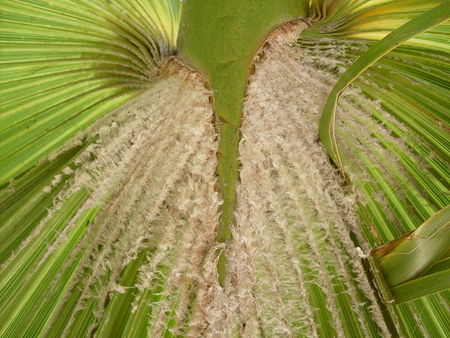
A compact and dense crown of leaves is located at the top of the trunk. Petioles reach 1 m in length, red-brown in color, covered on the sides with sparse stiff light-yellow or orange teeth. Leaf blades are rounded, palmately divided to two-thirds of their length, drooping at the ends, glossy, dark green. The underside of the leaves near the petiole is pubescent.
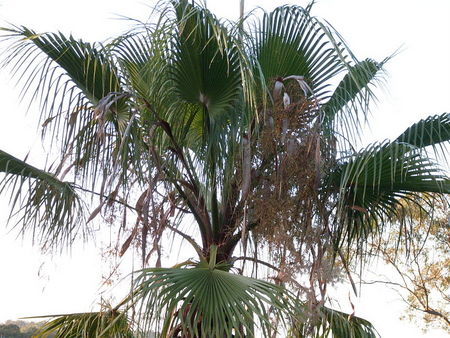
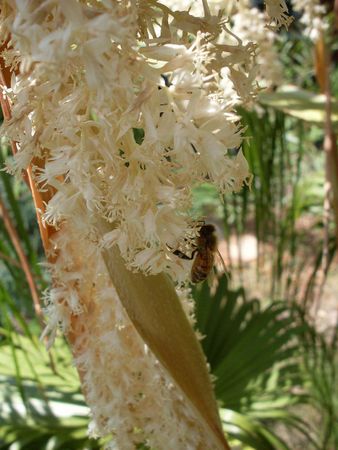
Flowers are bisexual, cream-white in color, gathered in long branched inflorescences (spadices) up to 3 m, which are elongated dense swellings on the axes and enclosed in bracts resembling petals. Over time the inflorescences become pendulous. Indoors it flowers rarely, beginning at 12-15 years of age.
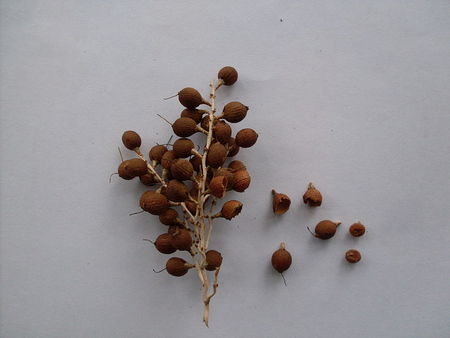
Fruits are globose black fleshy shiny drupes, growing on the woody inflorescence. Seeds are woody.
Hybrids: W. robusta and W. filifera = Washingtonia × filibusta
Cultivars: Santa Barbara
Hardiness zone: 9a (-7°C).
Temperature: In most of Ukraine the species is grown as a houseplant. In the conditions of Crimea and Odessa it can be grown outdoors. The ideal place for cultivation is a greenhouse or winter garden. Recommended temperature in summer should not exceed +23°C, in winter – no higher than 6-8°C. In a warm room in winter the plant dries out. As a houseplant the palm is fairly tolerant of temperature fluctuations, but it is recommended to keep the plant in a constant temperature regime. In spring and summer the recommended temperature is between +20 and +25°C; if the temperature rises to +28-+30°C it is necessary to provide the plant with access to fresh air, as prolonged stay in such conditions can cause overheating.
Light: foliage needs protection from direct sunlight. Optimal positions are east- or west-facing windows (southwest or southeast). In case of insufficient light, additional lighting for 14-16 hours is recommended. For this, fluorescent lamps are used, placed 30-60 cm above the plant. It is recommended to rotate the plant periodically for even crown development. In summer it does not tolerate stagnant air well, but drafts should be avoided. If kept outdoors in summer, the plant must be protected from precipitation and provided with diffused light.
Watering: in summer it needs abundant watering, in winter – moderate (depending on temperature – once every 1.5-3 weeks). In summer water should stand in the saucer for 3-4 hours; in winter its presence there is unacceptable. Mature plants can tolerate short-term soil dryness, but it is recommended to keep the soil always moist. In autumn and winter (October-February) water 2-3 days after the top layer of soil has dried.
Humidity: requires moderately moist air (up to 40%). Daily misting is recommended.
Care: From the period of active vegetative growth (May) the plant should be fed monthly with a solution of organic fertilizer (diluted manure at 1:10 or poultry manure at 1:20) or a mineral complete fertilizer (for young plants - 20 g/10 l). If the palm overheats, move it to a cool place for 2-3 hours, mist the leaves and water with room-temperature water. No feeding is carried out in winter and autumn. If roots become exposed, cover them with soil.
Transplanting: copes poorly with transplanting. Young plants are transplanted once every 2 years, mature ones every 5-6 years. An adult palm is recommended to be kept in an oak tub or in a ceramic pot with a drainage hole. Place drainage at the bottom of the pot from small pieces of broken pots, gravel or bricks.
Potting mix: Soil should be well-drained. Composition of the soil mix: turf and leaf soil and sand in equal parts (soil should be slightly acidic).
Pests: spider mite, mealybug, scale insects, leaf-chewing beetles, aphids, thrips, false scales, whiteflies.
Diseases: parasitic fungi can cause death of the apical bud. With insufficient nutrition growth slows and the leaves yellow. With insufficient humidity the leaf tips may dry. With overwatering brown spots appear on the leaves. Overwatering of the soil can lead to root rot. It does not tolerate high temperatures, at which leaves may yellow in winter. Also encountered: leaf spot diseases, pink rot, Phytophthora (root and stem rots), Fusarium, Rhizoctonia, Pythium, chlorosis of young leaves.
Propagation: does not form lateral shoots. Propagation is mainly by seeds in March-April. It is preferable to sow freshly collected seeds. The surface of the seeds is lightly abraded with sandpaper, soaked in warm water for 2 days and sown in soil to a depth of 2-3 cm, covering the container with glass. The sowing substrate consists of sand, moss and steamed sawdust in equal parts, adding a little crushed charcoal. Recommended temperature for germination +26-+28°C; moderate soil moisture must be maintained. First seedlings appear after 3-4 weeks or up to 2 months (if seeds are commercial) after sowing. Pricking out is carried out one week after the first leaf appears. It is possible to transplant germinated seeds with emerging shoots (1-1.5 cm high) and plant them individually into pots. Soil mix for seedlings – leaf soil, humus, humus, peat soil and sand in the ratio 4:2:2:1:2. Seedlings grow quickly – in 1 year they have 4-5 leaves. Leaf dissection begins from the 7th-8th leaf. In summer seedlings can be kept outdoors; in autumn they are brought indoors. In southern regions the plant can be planted out at the age of 2-3 years.
Uses: widely used as an ornamental plant indoors, and in temperate-continental and subtropical climates outdoors. Planted outdoors at resorts and along the coast. Used in solitary and group plantings, and to create avenues in parks. The plant is attractive for its large fan leaves, yellow-green panicle flowers and blue-black fruits, which persist on the plant for up to a year. In its native area young inflorescences are eaten. Fibers from the trunk are used for stuffing mattresses and mats.