
Deciduous shrubs
Viburnum
Viburnum
Viburnum (Viburnum) – a genus of woody flowering plants in the family Adoxaceae (Adoxaceae). It includes about 150 species, which are distributed mainly in the temperate zone of the Northern Hemisphere, as well as in the Andes, the Antilles and Madagascar.
Members of the genus are evergreen or deciduous shrubs or small trees. Leaves are mostly opposite, less often whorled. Winter buds are naked, sometimes covered with scales.
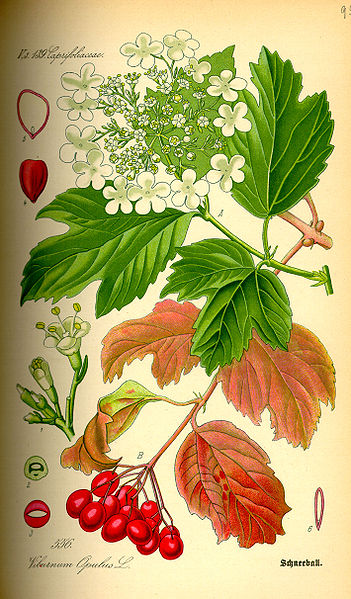
Red viburnum, O.V. Tome «Flora von Deutschland, Österreich und der Schweiz», 1885
Leaves are deciduous, biennial and perennial, entire or lobed, simple, serrate or with entire margins, petiolate, with stipules that are sometimes transformed into glands, or without them.
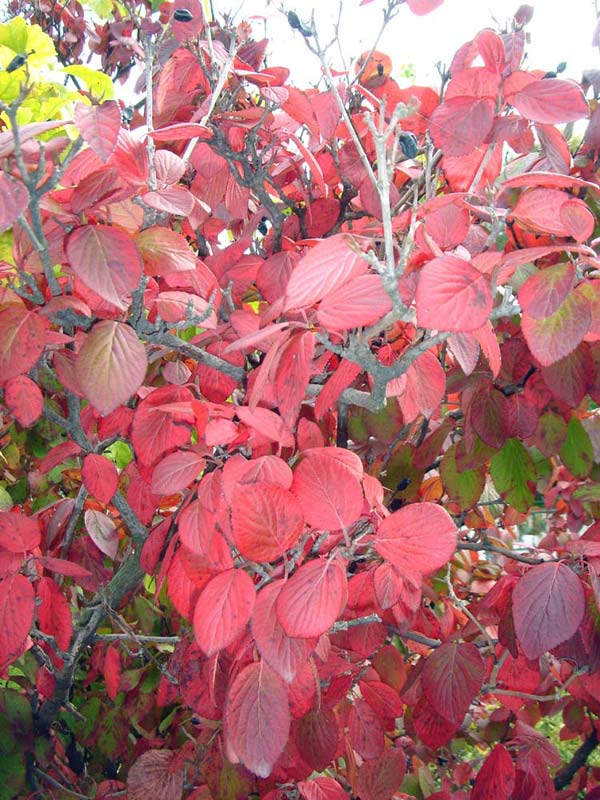
Black viburnum
Inflorescences terminal, umbel-like or umbello-corymbose, simple or compound. Flowers small, white, sometimes pinkish, actinomorphic (regular), marginal flowers sometimes zygomorphic, bisexual, marginal flowers sometimes sterile. Calyx with 5 small teeth, adnate to the ovary. Corolla wheel-shaped, bell-shaped or with an elongated narrow tube. Stamens five, pistil single, ovary three-celled with two undeveloped locules, with a single pendulous ovule. Style short, conical, with a three-lobed or three-part stigma.
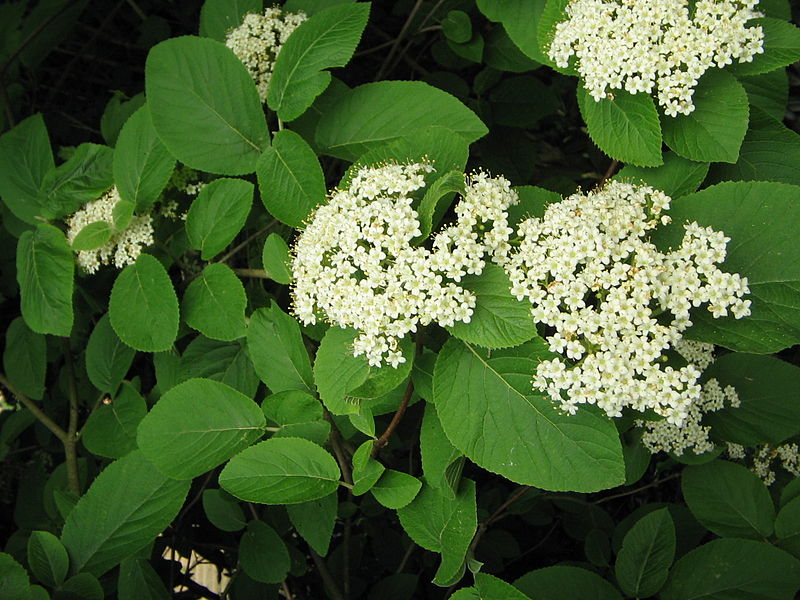
Wayfaring viburnum (Vibúrnum lantána)
Fruits – drupes red, black, sometimes yellow, with a single stone, rounded in shape, laterally compressed, with a fleshy, sometimes folded endosperm.
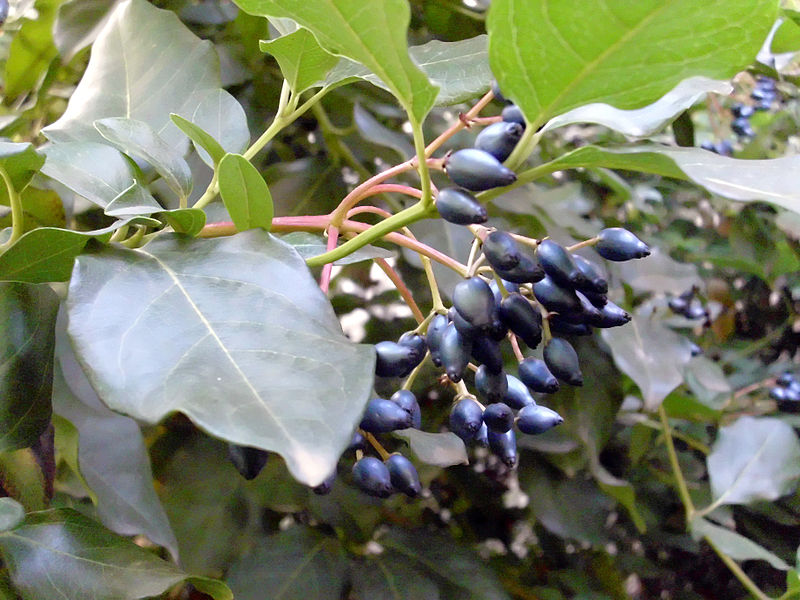
Laurel-leaved viburnum
The root system consists of a taproot and numerous lateral roots.
Cold hardiness: most representatives of the genus are fairly hardy and can tolerate temperatures down to -25…-35°C. Zones 4-5.
Some species: red viburnum, fragrant viburnum, forked viburnum, useful viburnum, Wight's viburnum, wrinkled-leaved viburnum.
Location: prefers sun or partial shade. Thanks to a dense and well-developed root system, it can grow on slopes and embankments. Undemanding to soil, but requires abundant moisture. Optimal soil acidity is 5.5-6.5.
Planting: planting is best carried out in spring or autumn. Hole size 50 x 50 cm. Add peat, phosphorus 40-50 g, potassium and nitrogen 25-30 g each to the hole. When planting, the seedling should be set 3-5 cm deeper. The distance between plants should be no less than 1.5-2.0 m.
Pruning: when forming, leave one strong shoot, all others should be removed. During the following three years allow one shoot to grow that will later become the trunk of the tree. Trunk height 1 - 1.2 m. Rejuvenation pruning for shrubs is carried out by cutting old branches at a height of 15-20 cm from the soil surface.
Care: fertilize twice: before the start of vegetation and before leaf fall. In spring it is recommended to apply phosphorus - 40 g, nitrogen - 50 g and potassium - 30 g per 1 sq.m. In autumn, apply phosphorus and potassium at half the spring dose.
Diseases and pests: affected by leaf-eating pests (viburnum bark beetle); to control it spray the plant with 0.2% chlorophos; scale insects – 0.1% carbophos solution. For prevention of powdery mildew and leaf spot, it is recommended to treat throughout the season with tobacco, onion or garlic infusions.
Propagation: propagated by seeds, cuttings, and layering. For seed propagation, long stratification of 6-7 months is necessary. Seeds germinate in August – first the radicle and hypocotyl emerge while the epicotyl remains dormant. The emergence of the cotyledons to the surface and the shedding of coverings occurs in the following spring. Therefore, beds with viburnum sowings should be covered for the winter with peat or leaves. To accelerate germination, a two-step stratification with variable temperatures can be used. For root emergence the optimal temperature is +18-20°C, and for the dormancy state -3...-5°C. After 2-3 months of warm stratification, seeds should be placed for 3-4 months in cold stratification conditions and after that planted in the ground. Seeding rate 8-15 g, germination 54-88%. With autumn sowing of freshly collected seeds, seedlings appear the next year. Growth vigor in the first years is low, increasing from the third year. Plants from seed begin fruiting in 4-5 years. Their yield at 10-15 years is 10-25 kg.
Ornamental forms are propagated by cuttings. Cuttings from 2-3 year old wood root best. Cuttings should be taken during the period of active shoot growth. Rooting of cuttings is high. Under artificial mist at 22-25°C, 100% rooting is achieved. With insufficient heat, rooting is noticeably reduced. The period for harvesting cuttings falls from early June to the end of July. Cuttings taken in August root at 50%. A cutting is formed as follows: cut the shoot into pieces 7-10 cm long with two to three internodes. The upper cut above the leaves should be straight, and the lower one below the leaves – oblique. Leaves are recommended to be shortened by half, and the two lower leaves removed. After treating cuttings with heteroauxin, they are planted in a nursery under film. Substrate composition: peat and sand in equal proportions. Such seedlings begin to bear fruit at the age of 2-3 years.
Viburnum also often produces layers from low-lying branches.
Uses: several species have edible fruits that are eaten fresh, used for making preserves, and in folk medicine and cosmetology. Viburnum is striking in groups as well as in solitary plantings. It looks great on a slope or near a body of water, by a window or porch. As a backdrop for viburnum, spruce, linden, maple, birch, or rowan can be used.