
Flowers for the garden
Veronica spicata (Spike Speedwell)
Veronica spicata L.
Synonyms: Pseudolysimachion spicatum (L.) Opiz, Veronica barrelieri Schult., Veronica hololeuca Juz., Вероника гибридная (hybrid Veronica), Вероника Пачоского (Paczoski's Veronica), Вероничник колосистый, Псевдолизимахион Пачоского (Paczoski's Pseudolysimachion), Вероника колосковая, Полевые барашки, Синецвет (blue-bloom), Синие батожки.
Veronica spicata (Veronica spicata L.) – a species of plants in the genus Veronica of the plantain family (Plantaginaceae). The species was first described by Carl Linnaeus in 1753 in "Species Plantarum 1: 10". In cultivation since 1570.
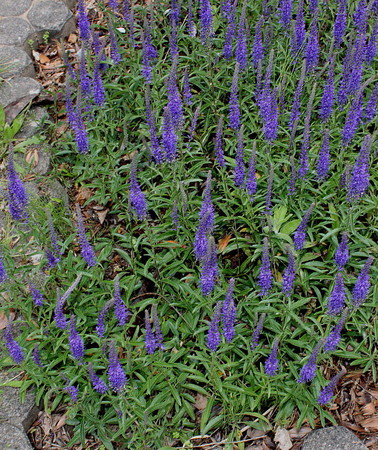
Occurs in Western Europe (in Spain, France, Italy, Germany, Belgium, the Netherlands, Czechoslovakia, Switzerland, Austria, Hungary, Romania, Bulgaria, the former Yugoslavia, Albania, Poland, Denmark, Sweden, Finland, the United Kingdom, Romania, Moldova, Ukraine (throughout the southern part, including the Crimea)), in Asia (Turkey, China, Mongolia, Russia, in the Caucasus, Mongolia, Georgia). It grows in forests (mainly in pine forests) and steppes, less often found in mountains up to the subalpine belt. Occurs on scree slopes and forest glades.
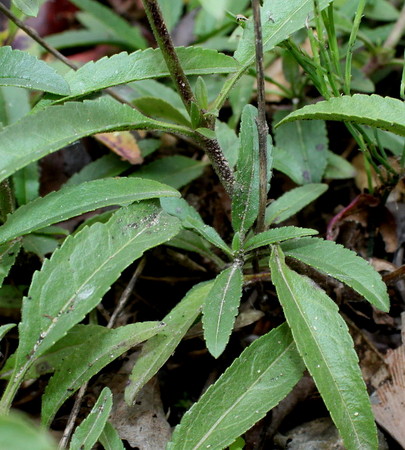
It is a perennial herbaceous plant with solitary stems, erect or ascending, robust, simple, grayish from pubescence or green. It reaches 15-50 (75) cm in height. The rhizome is thin, positioned horizontally.
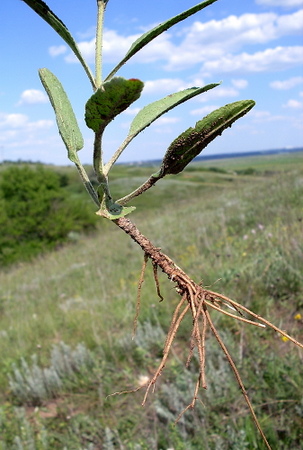
Leaves opposite, upper sometimes alternate, 1.5-8.5 cm long and 0.3-3 cm wide, lanceolate to linear. Lower leaves from oblong to broadly ovate, petiolate, base cuneate, rarely rounded, apex blunt, margins shortly serrate-toothed or crenate, at the apex entire or acute. Upper leaves sessile, margin bluntly toothed or entire, often mucronate at the apex. Bracts linear-subulate, almost as long as the calyx, glandular-hairy.
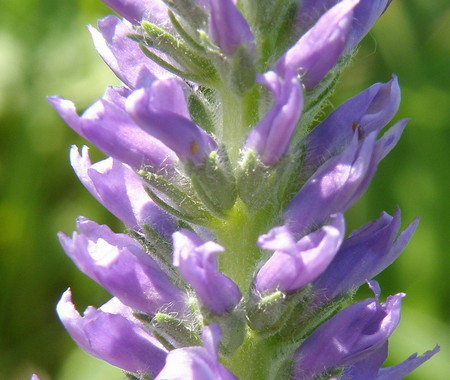
Inflorescences terminal, solitary, dense racemes 5-30 cm long, less often lateral racemes form in the axils of the upper leaves. Inflorescences narrowed toward the top. Flowers borne on pubescent or glandular-pubescent pedicels, shorter than the calyx, rarely almost sessile; calyx ciliate, composed of 4 unequal-in-length oblong-lanceolate lobes; corolla bright-blue or blue, less often pink, purple or white, 6-7 mm long, divided into 4 slightly spreading lateral, unequal-width, lanceolate lobes. Stamens same length as or shorter than the corolla, straight; anthers ovate; style 2.5 times longer than the capsule. Flowers from mid-June, for about 35 days.
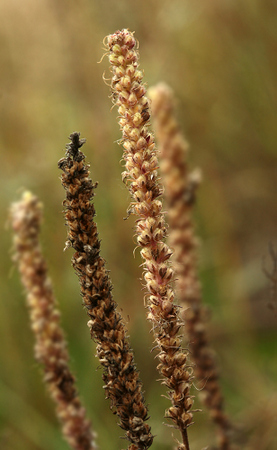
Capsules obovoid or rounded, 2-lobed, slightly emarginate at the apex, sparsely pubescent with simple and glandular hairs, with blunt lobes at the apex 2-4 mm long and wide. Seeds flat-convex and broadly ovoid, 0.75 mm long and 0.5 mm wide, blunt, with a smooth surface.
Chromosome number: 2n = 34
Subtaxa:
- ssp.barrelieri (Schult.) Jelen.
- ssp.barrelieri (Schott) Murb.
- ssp.bashkiriensis Klokov ex Tzvelev
- ssp.incana (L.) Walters
- ssp.klokovii Tzvelev
- ssp.maeotica (Klokov) Tzvelev
- ssp.orchidea (Crantz) Hayek
- ssp.paczoskiana (Klokov) Kosachev
- ssp.petschorica Tzvelev
- ssp.porphyriana (Pavlov) Jelen.
- ssp.transcaucasica Bordz.
- var.pseudoorchidea Pacz.
Hybrids:
- Veronica × media Schrad.
- Veronica spicata L. х Veronica pinnata L.= Veronica × altaica Kosachev
Cultivars: 'Blue Carpet', 'Romiley Purple', 'Blue Peter', 'Barcarolle', 'Red Fox' ('Rothuchs'), 'Heidekind', 'Rotflshs', 'Icicle' ('White Icicle'), 'Rotfuchs', 'Royal Candles Glory', 'Ulster Blue Dwarf'.
Hardiness zone: 3a (-34C).
Exposure: sun-loving.
Soil: undemanding. Drought-tolerant, but tolerates waterlogging.
Care: practically does not require care. When flowering is finished, stems are pruned. Does not require winter shelter.
Pests: gall midge Dasyneura veronicae, mites Anceria anceps.
Diseases: raspberry ring spot, mycorrhiza.
Propagation: self-seeds. Propagated by division, stem cuttings, and also by seeds, which should be sown in autumn outdoors.
Companion plants: saxifrages, sedums, carnations (Dianthus), Geranium dalmaticum.
Uses: widely used in single and group plantings, in mixed borders.