
Flowers for the garden
Thyme-leaved speedwell
Veronica serpyllifolia
Synonyms: Вероника тоненькая, Veronica serpyllifolia ssp. nummularioides (Lecoq & Lamotte) Dostal, Veronica serpyllifolia var. nummularioides Lecoq & Lamotte, Veronica tenella All.
Thyme-leaved speedwell (Veronica serpyllifolia L.) – a species of plant in the genus Veronica of the plantain family (Plantaginaceae). The species was first described by Carl Linnaeus in 1753 in «Species Plantarum 1: 12».
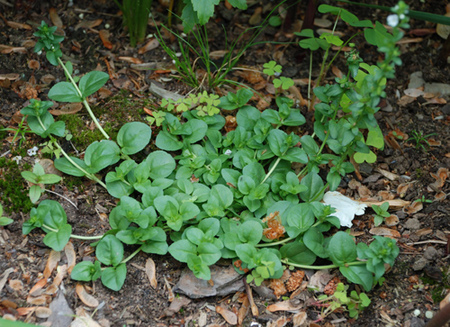
Occurs in Europe (except the island of Crete, the Balearic Islands, and in the mountains of Europe), in Asia (found in Turkey, Iran, Nepal, India (Himalayas), China (mountain regions), the Korean Peninsula, Burma, Japan); North America (Alaska, Aleutian Islands, Canada, USA); South America (Ecuador, Colombia, Peru); Central America (Jamaica); Central Asia (Dzhungar Alatau, Tien Shan); Siberia, Caucasus. Grows in forests and meadows, on pastures, by roads, on shingle, in moist and swampy meadows, in open forests, in mountain forest and forest-steppe areas, on grassy slopes, more rarely in steppes. It rises into the mountains to an altitude of 1500-4500 m above sea level.
Валерий Куделя
It is a perennial herb 10—25 (40) cm high. Stems ascending, prostrate or creeping, rooting, glabrous or shortly pubescent, thin, branched at the base.
Leaves entire, glabrous or shortly pubescent, glossy, opposite; lower leaves on sterile shoots with short petioles or sessile, more rarely clustered into a basal rosette, rounded or ovate in shape, obtuse at the apex, margins entire, indistinctly blunt-toothed or crenate, 5-22 m in length and 3-10 cm in width. Middle leaves spaced, sessile, oblong-ovate, oblong-lanceolate or lanceolate in shape. Upper leaves – gradually turning into elongated bracts.
Валерий Куделя
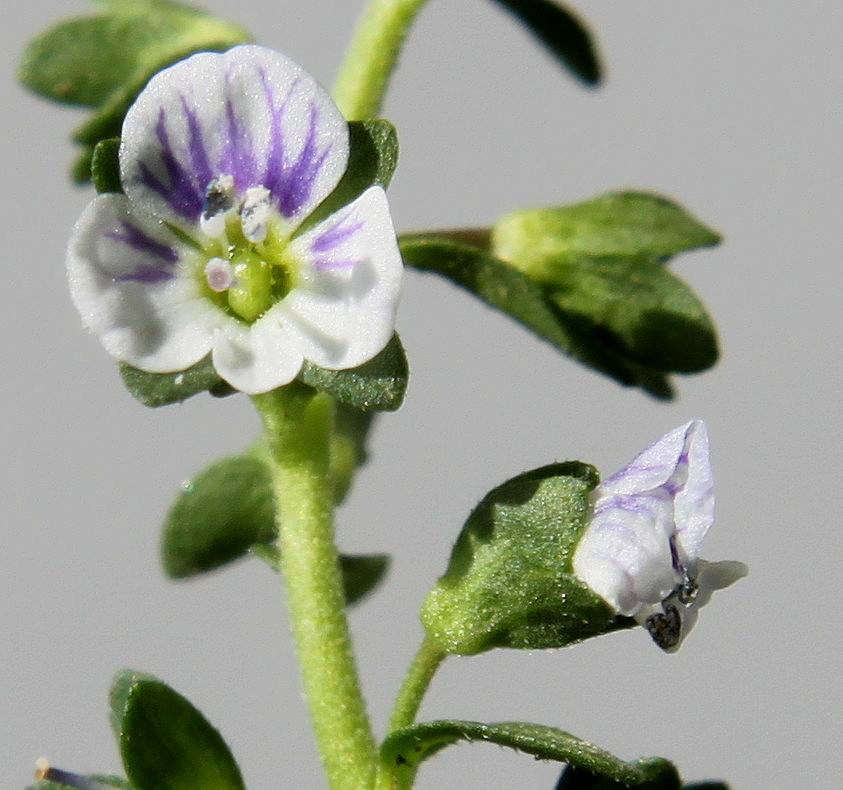
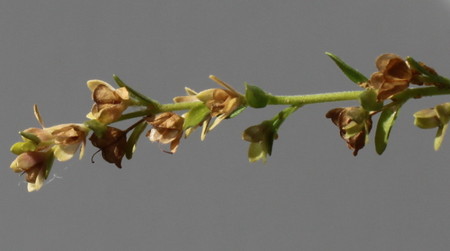
Inflorescences – lateral and terminal racemes, located in the axils, lax, many-flowered, 2-20 cm long, elongated in fruit; flowers in the axils of small bracts are spaced; pedicels covered with indumentum, in fruit straight or directed upward at an acute angle, equal to the bracts or twice as long. The calyx is divided into oblong-ovate, oblong and equal blunt lobes, shorter than, equal to, or longer than the pedicels. Corollas 3-4 mm long, white, blue or whitish in color, with pink veins, almost wheel-shaped, slightly longer than the calyx; tube short, with four veins. Stamens curved, almost equal to the corolla. Style from 1/2 to 2/3 of the capsule length. Flowers from June to August.
Валерий Куделя
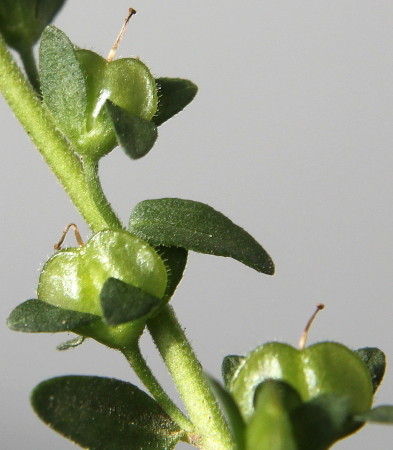
The capsule is broadly obovate, 3.5-4 mm long and 45 mm wide, flattened, rounded at the base, with a shallow and blunt notch at the apex, glandular-ciliate. Seeds flat, shield-shaped, oval, up to 1 mm long, numerous. Capsules open in wet weather, and the seeds are washed out by rain.
Subspecies:
- Veronica serpyllifolia subsp. serpyllifolia
- Veronica serpyllifolia subsp. humifusa (Dickson) Syme
Hardiness zone: 3a (-40°C).
Position: Sun-loving, but shade-tolerant.
Soil: prefers dry, rocky, light, calcareous soil. Drought-tolerant.
Care: practically needs no care. Cut back shoots after flowering. Does not require winter protection.
Pests: gall midge Dasyneura veronicae, mites Anceria anceps.
Diseases: raspberry ring spot, mycorrhiza.
Propagation: propagates vegetatively (by cuttings), by division or by seed. Seeds are sown in autumn or spring. Plants grown from seed flower in the 2nd year. Take cuttings in May or June.
Uses: grazed by cattle and sheep. Withstands grazing pressure and is resistant to mowing. Practically not used in landscape design.