
Flowers for the garden
Common speedwell
Veronica officinalis L.
Synonyms: Veronica tripartita Boriss., Cardia officinalis (L.) Dulac, Veronica officinarum Crantz
Common speedwell (Veronica officinalis L.) – a species of plants in the genus Veronica of the plantain family (Plantaginaceae). The species was first described in 1753 by Carl Linnaeus in "Species Plantarum 1: 11".
Павел Евсеенков
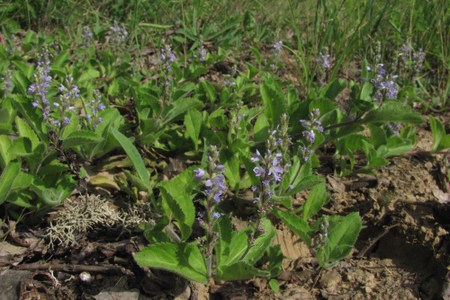
Occurs on the Madeira archipelago, the Azores, across virtually all of Europe, in Turkey, the Transcaucasus, Iran, and Russia (European part). Grows in open forests, forest clearings, forest edges, meadows, among shrubs, in mountains of the subalpine belt.
Евгений Пахомов
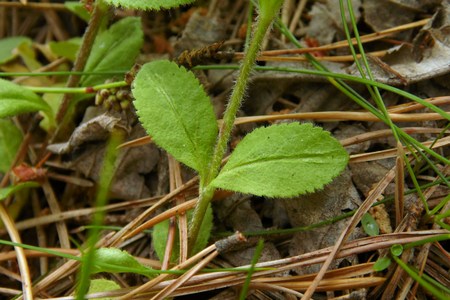
A perennial herbaceous plant 15-30 (50) cm tall. Forms tufts with ascending stems. Roots thin, creeping, winding, with small roots. Stems prostrate, rounded, evenly pubescent, branched, rooting at the nodes, shoots ascending.
Walter Siegmund
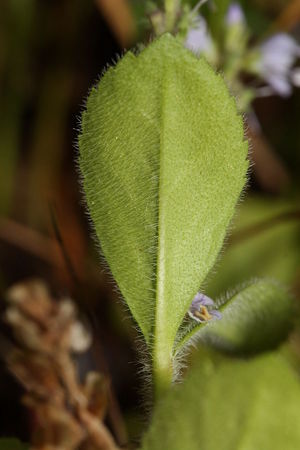
Leaves opposite, rough, narrowly obovate or elliptic in shape, 1.5-4 cm long and 1-2 cm wide, narrowed into a short broad petiole, margins toothed or serrate-dentate, entire at the base, apices shortly acute, more rarely obtuse, pubescent with simple hairs on both sides.
Виталий Гуменюк
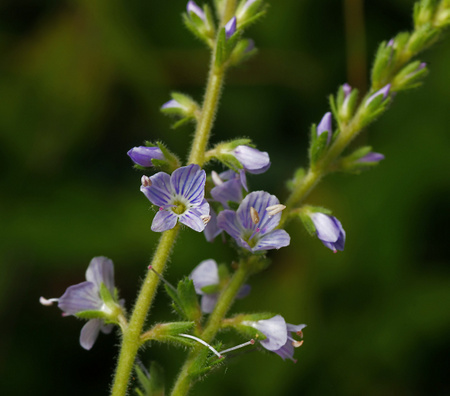
Flowers are borne on lateral shoots in the axils of the upper leaves, more often solitary, not opposite racemes, peduncles thick. Pedicels hairy, shorter than the bracts and calyx or equal to them, erect when fruiting. Bracts lanceolate-elongated in shape, bluntish, covered with simple hairs. Calyx 4-parted, glandular-pubescent, lobes lanceolate, bluntly pointed. Corolla 6-7 mm in diameter, pale-lilac or bluish in color, with dark veins, more rarely whitish with lilac veins, slightly or up to twice as long as the calyx, lobes fused about one-third forming a tube, the corolla limb with 3 broad-ovate bluntish lobes and 1 oblong lobe about twice narrower than the others. Stamens 2, mostly exceeding the corolla, anthers large, broad-ovate; pistil 1; ovary superior; stigma entire. Flowers from June to August.
Jouko Lehmuskallio
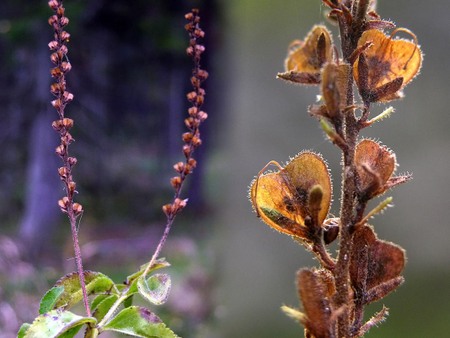
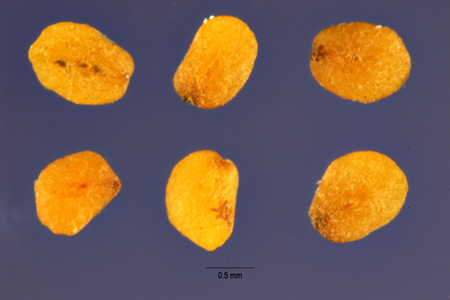
Fruits – many-seeded, 2-loculed capsules, flattened, obtriangular in shape, 4-5 mm long, almost twice as long as the calyx, reaching 4-5 mm wide at the top, narrowed toward the base, truncate at the apex, obtuse or slightly obtusely emarginate, glandular-pubescent. Seeds up to 1 mm wide, flat-convex. Fruits from July to October.
Subspecies:
- Veronica officinalis var. Officinalis
- Veronica officinalis var. tournefortii (Vill.) Reichenb.
Hardiness zone: 5a
Exposure: sun-loving.
Soil: not demanding. Drought-tolerant, but tolerates waterlogging.
Care: virtually no maintenance required. Cut back shoots after flowering. Does not require winter shelter.
Pests: gall midge Dasyneura veronicae, mites Anceria anceps.
Diseases: raspberry ring spot, mycorrhiza.
Propagation: Propagated by division of the clump, stem cuttings, and also by seeds, which should be sown in the ground in autumn.
Uses: a good spring-summer nectar plant (honey yield 18 kg per 1 ha). In ornamental horticulture used for landscape plantings in parks and on glades. Widely used in cooking, traditional medicine and veterinary medicine.