
Flowers for the garden
Long-leaved speedwell
Veronica longifoli
Synonyms: Veronichnik longifolium (Russian name), Snake herb, Snake, Pseudolysimachion longifolium (L.) Opiz, Pseudolysimachion longifolium ssp. maritimum (L.) Hartl, Pseudolysimachion longifolium ssp. septentrionale (Boriss.) Holub, Pseudolysimachion maritimum (L.) A. Love & D. Love, Pseudolysimachion septentrionale (Boriss.) A. Love & D. Love, Veronica longifolia ssp. borealis (Trautv.) Kuvaev, Veronica longifolia var. borealis Trautv., Veronica maritima L., Veronica septentrionalis Boriss., northern veronica.
Veronica longifolia (Veronica longifolia L.) – a species of the genus Veronica in the Plantain family (Plantaginaceae). The species was first described by Carl Linnaeus in the year 153 in «Species Plantarum 1: 10». In cultivation since 1731.
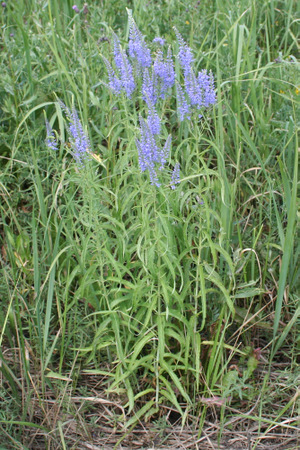
Occurs throughout Europe: Eastern Europe (Belarus, Estonia, Latvia, Lithuania, Moldova, Ukraine), Central Europe (Austria, Belgium, Czech Republic, Germany, Hungary, Netherlands, Poland, Slovakia), Southeastern Europe (Bulgaria, Croatia, Italy, Romania, Serbia, Slovenia), Southwestern Europe (France), Northern Europe (Denmark, Finland, Norway, Sweden), Russian Federation (Ciscaucasia, Far East, Eastern and Western Siberia), China (Heilongjiang, Jilin, Xinjiang), Central Asia (Kazakhstan, Kyrgyzstan), Western Asia (Turkey). Grows in forest and floodplain meadows, on steppified sites, in shrub thickets, in shrub-covered bogs. Prefers moist places and taiga zones.
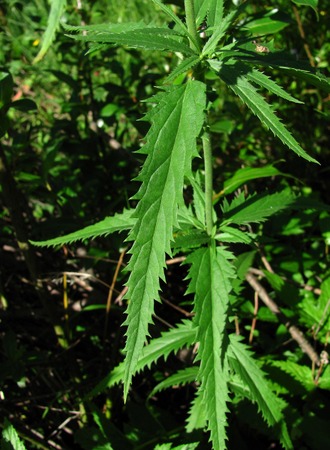
It is a perennial herbaceous plant 40-120 cm high. Roots long, creeping. Stems sturdy, erect, with a smooth or grooved surface, simple or branched near the top, glabrous or shortly pubescent.
Leaves opposite or in whorls of 3-4, oblong or oblong-lanceolate to linear-lanceolate, 3-15 cm long and 1-4 cm wide, petiolate, irregularly serrate toward the margin and to the apex, nearly cordate, truncate or cuneate at the base and acute at the tip, surface glabrous, more rarely weakly pubescent. Petioles short. Bracts longer than the pedicels or the same length, awl-shaped or linear.
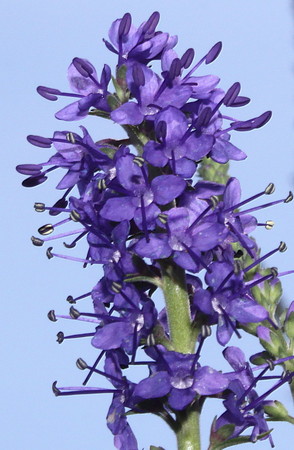
Flowers are borne in terminal dense racemes up to 25 cm long, solitary, more rarely with several short lateral racemes. Up to 450 flowers develop on a single plant. Pedicels almost equal to or shorter than the calyx. Calyx 2-3 mm long, divided into 4 lanceolate or triangular-elongated almost equal acute lobes, two of which are somewhat longer than the others. Corolla blue or blue-violet, 6 mm long; tube white, hairy inside; lobes of the limb blunt or somewhat blunt, broad, almost equal in length; one lobe rounded, the others elongated. Stamens 2, they are longer than the corolla. Nectaries located at the base of the ovary. Blooms from mid or late July for up to 50 days.
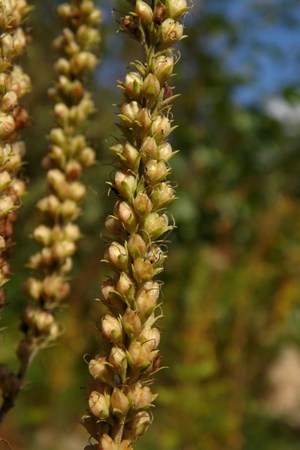
Fruits – capsules 3-4 mm long and wide, obcordate or broadly ovoid in shape, inflated, surface glabrous, firm, with a narrow slight notch at the apex. Seeds oval, smooth, flat-convex, slightly curved, 0.5 mm wide and 0.75 mm long.
Cultivars: 'Blauriesin' ('Blauriesin') (syn 'Forester\'s Blue'), 'Lila Karina' ('Lila Karma'), 'Blue Giant' ('Blue Giant'), 'Schneeriesin' ('Schneeriesin'), 'Snow Queen' ('Snow Queen').
Hybrids: Veronica longifolia L. Х Veronica porphyriana Pavlov = Veronica × schmakovii Kosachev
Hardiness zone: 3a (-34°C).
Position: Hygromesophyte. Light-loving but shade-tolerant.
Soil: prefers turfy soils rich in leaf humus.
Care: practically requires no care. Cut back shoots after flowering. Does not require winter covering.
Pests: butterfly caterpillars, galls, mites, weevils, aphids (Aphis beccabungae).
Diseases: raspberry ring spot, mycorrhiza.
Propagation: by seeds and vegetatively. Seeds are sown in autumn into the ground. Seedlings appear in the 2nd year. For cuttings use the tips of growing shoots. Easily propagated by dividing the clump in early spring or in August. When transplanting, cut back the above-ground part.
Uses: used in rockeries, terraces, rock gardens. Forms a beautiful grey-green carpet.