
Flowers for the garden
Wood speedwell (Veronica chamaedrys)
Veronica chamaedrys L
Synonyms: Veronica pulchella Salisb., Cardia ciliata Dulac, Veronica bibarbata Stokes, Veronicella chamaedrys (L.) Fourr., Veronica chamedris Neck., Veronica chamaedrys Hohen., Pseudolysimachion longifolium.
Wood speedwell (Veronica chamaedrys L.) – a species of plant of the genus Veronica in the Plantaginaceae family (Plantaginaceae). The species was first described by Carl Linnaeus in the year 153 in «Species Plantarum 1: 10». Described from Europe (“in Europae pratis”) (LINN).
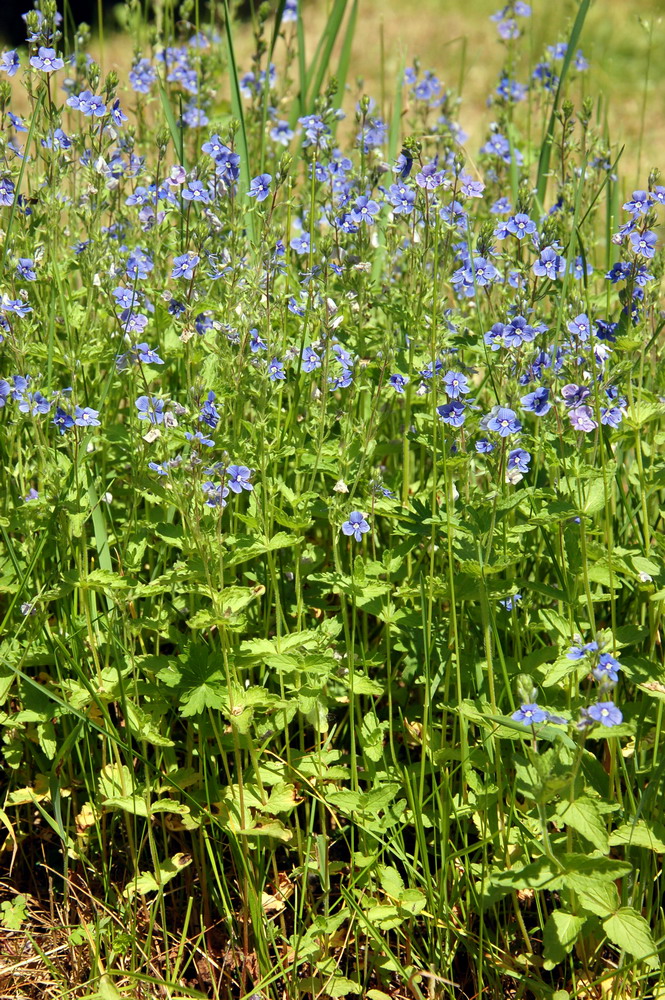
Occurs in Western Europe (except islands in the Mediterranean and on the Iberian Peninsula), in Ukraine (except the southern steppe part), the Russian Federation (European part), steppe Caucasus, Asia Minor, steppe Caucasus, Siberia, North America (USA, Canada). Grows in light forests, on forest edges, among shrubs, in forest glades, in gardens and on fields, as well as on subalpine meadows. Ascends to the mountains up to 2500 m above sea level (Caucasus).
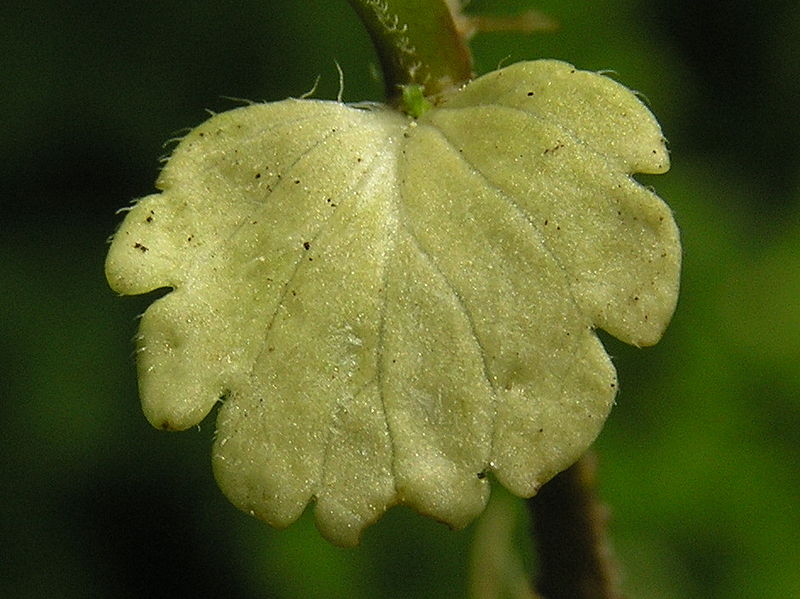
Represents a perennial herbaceous plant with a long creeping rhizome. Stems can reach 10-15 (50) cm in height; they are covered with two rows of scattered soft jointed hairs, which alternate at different internodes, the remaining parts of the stems are glabrous, ascending at the base or prostrate and rooting. Roots thin, branched, creeping.
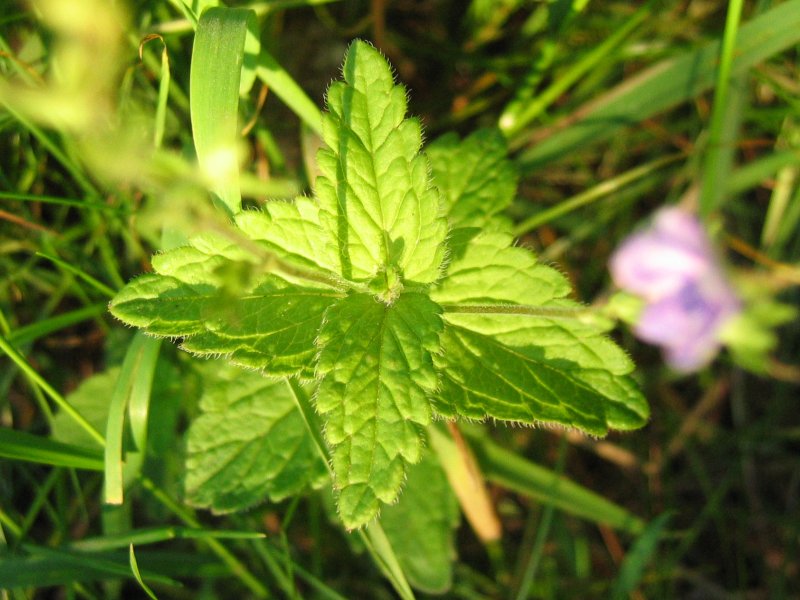
Leaves rounded-ovate to oblong-ovate, 1.5-3 cm long and 1-2 cm wide, obtuse, coarsely blunt-toothed or crenate, less often almost pinnately divided into blunt lobes, downturned, wrinkled, base rounded or nearly cordate. Lower leaves on short petioles, upper ones sessile.
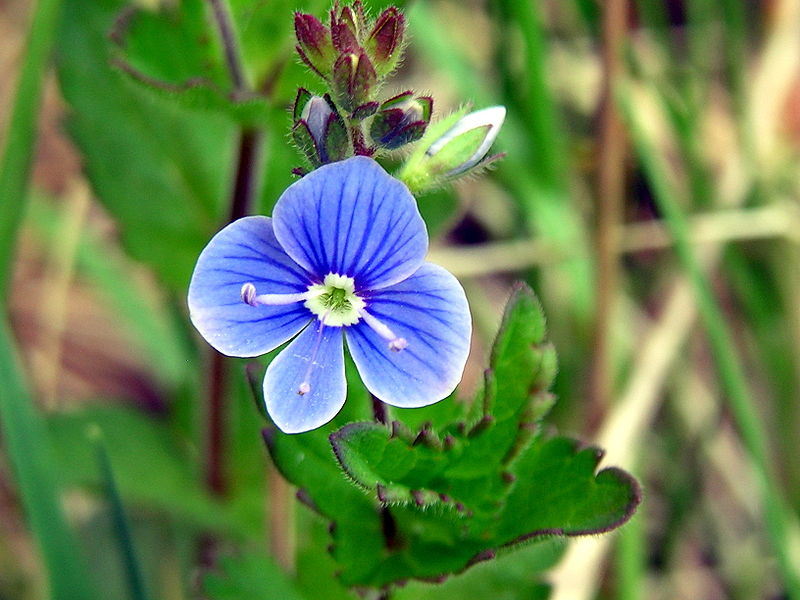
Racemes are opposite, loose, few-flowered, 2-20 cm long, growing in the axils of 2-4 upper leaves. Bracts lanceolate or oblong, shorter than or equal in length to the calyx and pedicels. Pedicels of the lower flowers longer than the calyx and bracts, straight in fruit. Calyx 4-parted, slightly pubescent, lobes lanceolate, half the length of the corolla. Corolla 10-15 mm in diameter, with 3 broad reniform or rounded lobes and 1 ovate-oblong lobe, bright blue in color, less often with a white margin, with dark veins, rarely with a white lower lobe and throat or pink in color. Flowers in the 4th year, in June-July. Reflowering is possible in a warm autumn.
Fruits – capsules 2.5-3 mm long and 3.5-4 mm wide, three-angled, inversely heart-shaped, cuneate at the base, with a shallow notch at the apex, slightly pubescent covered with hairs, ciliate at the margin, 1.5-2 times shorter than the calyx, flattened, with triangular lobes. Seeds numerous, up to 1 mm long and wide, flat, ovate, smooth.
Chromosome number: 2n = 16, 32.
Subspecies:
- Veronica chamaedrys subsp. chamaedrys
- Veronica chamaedrys subsp. vindobonensis M.A.Fisch.
Hardiness zone: 3a (-34C).
Position: semi-shade tolerant
Soil: not demanding regarding soil, prefers nitrogen-rich soils, does not tolerate stagnant waterlogging.
Care: practically does not require maintenance. After flowering, shoots are cut back. Does not require winter covering.
Pests: gall midge Dasyneura veronicae, mites Anceria anceps.
Diseases: raspberry ring spot, mycorrhiza.
Propagation: by seeds and vegetatively. Seeds are sown in autumn into the ground. Seedlings appear in the 2nd year. Seeds can be stored for up to 3 years. Tips of growing shoots are used for cuttings. Easily propagated by division of the clump in early spring or in August. When transplanting, the above-ground part is cut back.
Use: widely used in group plantings. A good spring-summer nectar plant (honey productivity 100 kg/ha). A good hay fodder plant.