
Flowers for the garden
Armenian veronica
Veronica armena
Armenian veronica (Veronica armena Boiss. & A.Huet.) – a species of the genus Veronica in the plantain family (Plantaginaceae). The description was first published by the Swiss botanist Pierre Edmond Boissier in 1856 in his «Diagn. pl. orient.» ser. 2. Described from Turkey (Erzurum).
In nature it occurs in the Caucasus – Georgia (Trialeti Range), Armenia (Sevan basin, Mount Alagöz, Leninakan plateau); Asia: Turkey (eastern part up to the Inner Taurus). It grows on rocky slopes in the alpine belt. It ascends mountains to an altitude of 2000-3000 m above sea level.
It is a perennial herbaceous plant forming a dense turf. Stems reach 7-10 cm in height, prostrate or ascending, less often erect, numerous, thin, woody at the base. Bark darkish. Rhizome woody.
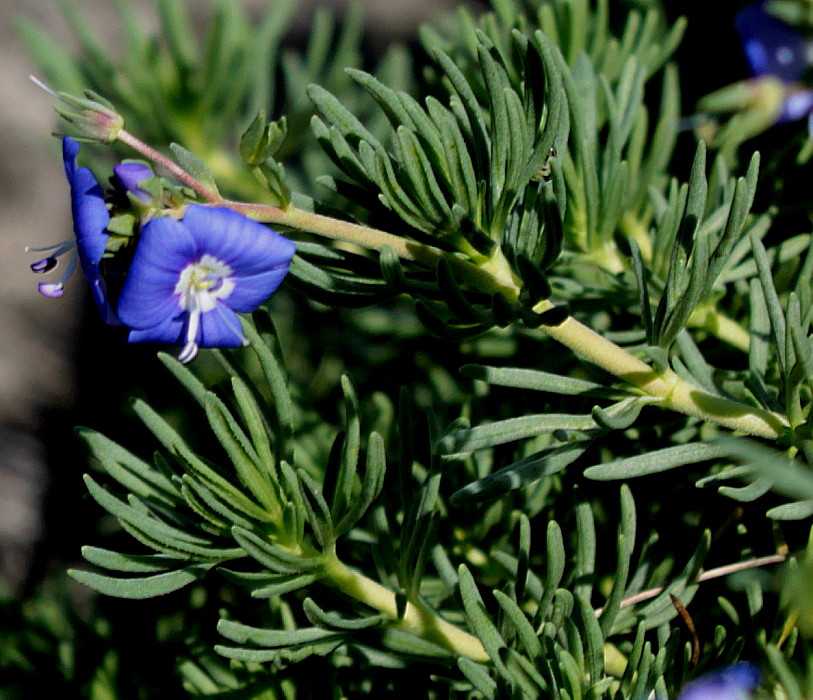
Leaves 8-12 mm long, sessile, short at the base, pinnately divided into thin, linear, twisting segments.
Flowers are gathered in racemose inflorescences, located in the leaf axils on short peduncles; the inflorescences are loose and short, fragrant. Pedicels thin, deflexed in fruit, 2-3 times longer than the bracts. Bracts linear-lanceolate. Calyx 5-parted, almost hairless or roughened by sparse small hairs. Calyx lobes blunt, oblong, five times shorter than the pedicels, 1 lobe larger than the others, the smallest lobe often deciduous. Corolla intensely blue, 2-3 times larger than the calyx. Throat white. Flowers in May-June.
Fruits are capsules, borne on straight or arcuately curved pedicels, glabrous, obcordate, 3-4 mm long and up to 4 mm wide, notched at the top. Seeds ovate, boat-shaped concave, up to 1.5 mm long and 1 mm wide, surface slightly wrinkled.
Hardiness zone: 3a (-29C).
Exposure: sun-loving, very drought-tolerant and undemanding.
Soil: alkaline, rocky substrate with a small amount of clay or river silt.
Care: practically requires no care. Cut back shoots after flowering. Does not need winter shelter.
Pests: butterfly caterpillars, galls, mites, weevils.
Diseases: raspberry ring spot, mycorrhiza.
Propagation: by seed and vegetatively. Seeds are sown outdoors in autumn. Seedlings appear in the 2nd year. For cuttings use the tips of growing shoots. Easily propagated by dividing the clump in early spring or in August. When transplanting, trim the above-ground part.
Companion plants: primulas, geums, bellflowers, saxifrages, sedums, carnations, Dalmatian geranium.
Uses: used in rock gardens for planting large areas, in flowering stone walls, on terraces or dry spots. Attractive near wildlife corners or naturalistic landscapes.