
Deciduous shrubs
Lingonberry 'Coral'
Vaccinium vitis-idaea Koralle
Lingonberry 'Coral' – a high-yielding and highly ornamental lingonberry cultivar. The cultivar was developed in Germany in 1969. In 1976 it was awarded the Royal Horticultural Society's AGM (Award of Garden Merit).
It is a medium-sized shrub up to 0.3 m in height and 0.3 m in diameter. The crown is rounded, shoots are long and erect. Leaves are obovate or elliptic in shape, with recurved margins, alternate, glossy, evergreen; the lower surface is covered with small punctate pits.
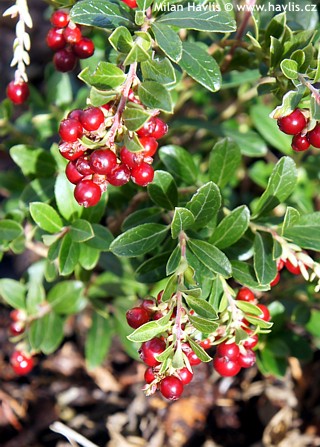
Flowers in May-June. Flowers are white with a pink tint, small, borne in terminal clusters.
Fruits in the second year after planting. Yield is high, reaching more than 0.2-0.4 kg per shrub. Berries are medium-sized, 0.8-0.9 cm in diameter, light red in color. Flavor is sweet-and-sour with a slight bitterness. They ripen twice in the season – at the end of July - beginning of August and at the end of September – beginning of September.
Hardiness zone: 2a-6b
Site: prefers acidic and low-fertility soil (pH 3-5), air- and water-permeable. Grows well on peat soil or a mix of peat and sand. If water stagnates, drainage is necessary. The site should be well-lit and protected from strong winds.
Planting: best carried out in late autumn or in late April – early May. Soil mix – river sand, top peat, sawdust from coniferous species (to 5 parts peat add 2 parts sand). Do not add compost or well-rotted manure. Planting scheme: 30 x 30 cm. After planting, water the plant and mulch with conifer bark or leaf litter.
Pruning: in early spring perform sanitary and rejuvenation pruning – shorten the shrubs by one-third or half of their height.
Care: requires sulfur feeding – apply 50 g of sulfur per 1 sq. m. After the onset of fruiting mineral fertilizers may be applied. Needs watering during dry periods. Removal of weeds, loosening and mulching of the soil are recommended.
Pests and diseases: affected by the fungi Melampsora Goeppertiana and Exobasidium vaccinii.
Propagation: by seeds, green cuttings (begins fruiting in the 2nd year), hardwood cuttings, division of the bush.
Uses: Berries are consumed fresh, used for making jam, marinades, candies, extract, mors (berry drink), and for sugaring. Good nectar source.