
Deciduous shrubs
Bog bilberry
Vaccinium uliginosum L
Synonyms: bog blueberry, swamp blueberry, low-growing blueberry, vodopyanka, golubets, golubitsa, gonobob, gonobóbel, gonoboy, gonobol, durakha, durnika, durnikha, durnitsa, drunken berry, pyanika, pyanichka, pyanitsa, blue grape, sinika, buyakhi, lohina
Bog bilberry (Vaccinium uliginosum L.) – the typical species of deciduous plants of the genus Vaccinium of the family Ericaceae.
Grows in all regions of the Northern Hemisphere with temperate and cold climates, in the tundra, forest zone and upper mountain belt, in bogs and peatlands. Grows in small stands along rivers and streams, in coniferous and mixed forests; can form vast bilberry stands (several tens of kilometers).
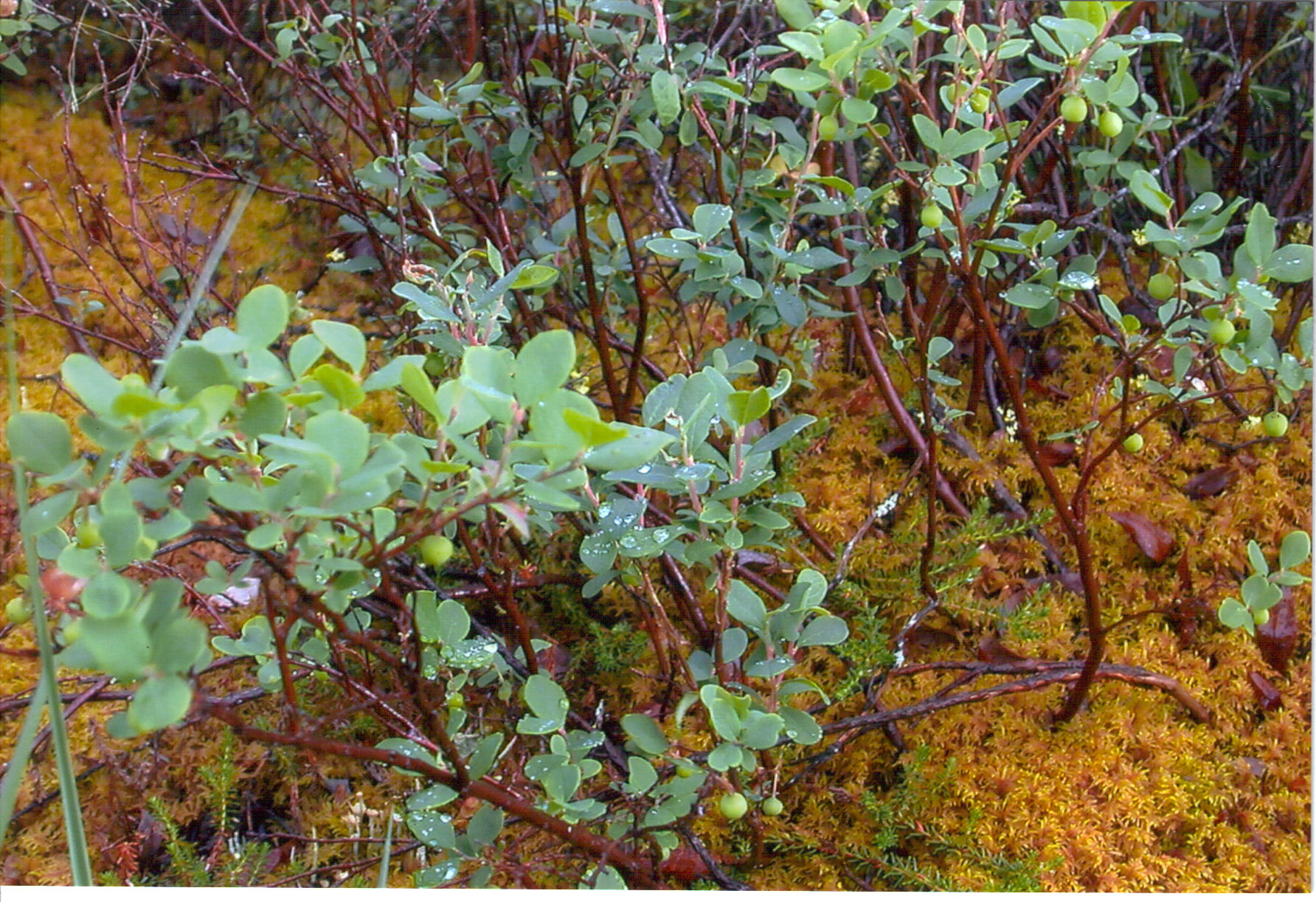
It is a branched shrub or subshrub up to 1 m tall (30-50 cm), more rarely with a creeping stem. The stem becomes woody almost to the top. Bark brownish or dark gray, young shoots green. Root system fibrous, without root hairs (nutrients are absorbed with the help of mycorrhiza).
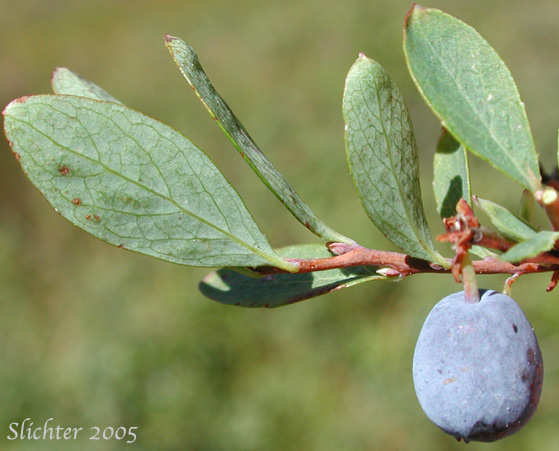
Leaves 0.7-5 cm long and 0.4-3 cm wide, obovate or oblong in shape, firm, thin, with entire margins. Upper surface bluish-dark-green, underside lighter with prominent veins. Petioles short. In autumn leaves take on reddish tones and fall.
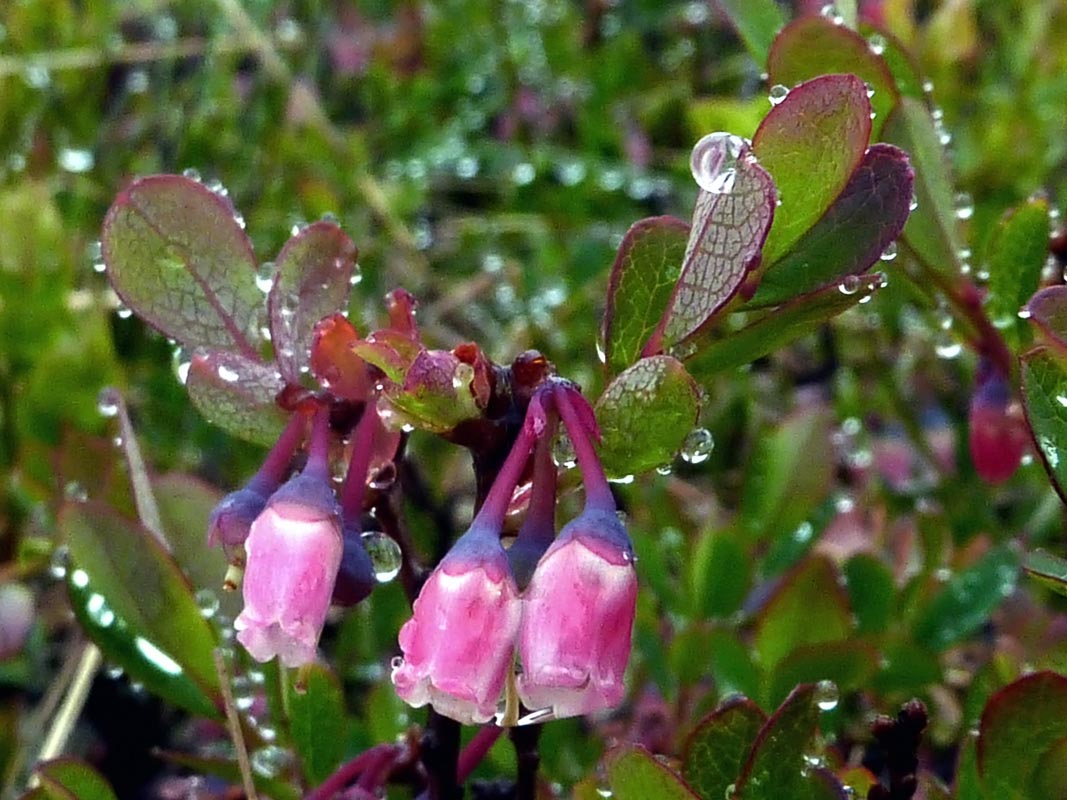
Flowers five-toothed, small, pendulous, grow 2-3 per last year’s shoots. Corolla urn-shaped, white or pinkish, 45 mm in length, ovoid-urn-shaped, with 4-5 teeth bent outward. Calyx 4-5-toothed, green. Stamens 8-10, ovary inferior. Flowers in May.
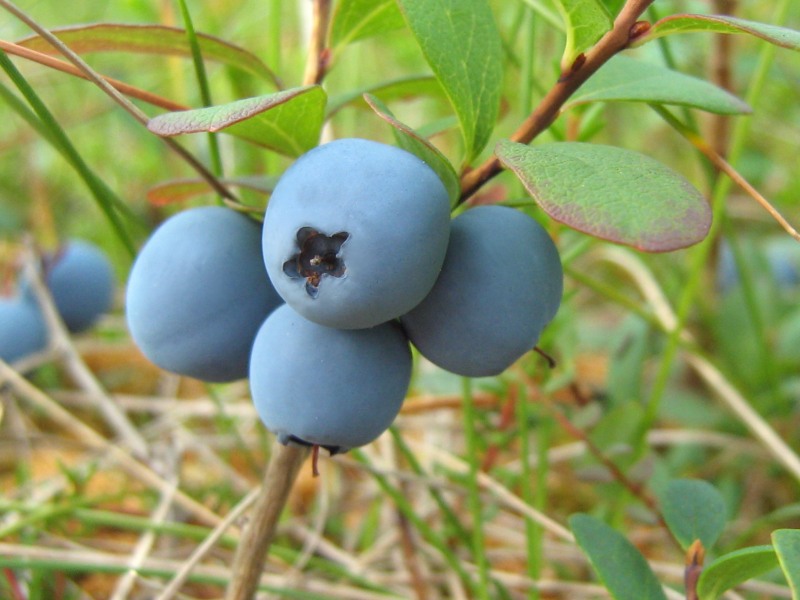
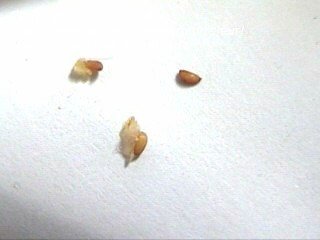
Fruits – pear-shaped or oval blue edible berries with a glaucous bloom, 9-12 mm in diameter. Flesh greenish, sweet-sour in taste. Seeds numerous, light brown, pointed, crescent-shaped, with a netted seed coat. Fruits ripen in August. Yield 120 - 550 kg/ha.
Cultivars: Reka (Reka), Earliblue (Earliblue), Zuckertraube (Zuckertraube), Patriot (Patriot), Bluegold (Bluegold), Northland (Northland), Bluecrop (Bluecrop), Bluejay (Bluejay), Toro (Toro), Northcountry (Northcounry), Northblue (Northblue), Elizabeth (Elizabeth), Nelson (Nelson), Puru (Puru), Legacy (Legacy), Duke (Duke), Spartan (Spartan), Brigitta (Brigitta Blue), Jersey (Jersey), Goldtraube (Goldtraube).
Hardiness zone: 3a (-40°С)
Site: undemanding, hardy, frost-resistant. To avoid damage to flowers from spring frosts, plant in locations without stagnant cold air and not on southern exposures.
Soil: soil should be well-drained, with groundwater not closer than 50 cm from the soil surface. Prefers light loam or sandy loam, grows poorly on heavy soils. Optimal pH 3.5-5.2. To lower pH, sulfur can be used, applied one year before planting. Grows and fruits well on soils with high organic matter (for this, green manure crops are sown a year before).
Planting: distance between rows – 2.6-3.5 m, distance between plants 0.8-1.6 m. Planting is carried out in autumn and spring. Add 5-10 L of well-moistened peat into the planting hole.
Pruning: pruning is done in early spring. Prune frost-damaged shoots, as well as thickening and lateral branches. Usually when pruning, every 6th branch is removed (if the bush consists of 12 branches, cut the 2 oldest). Remove branches damaged by disease, as well as those that touch the ground. To improve berry quality, it is recommended to thin fruiting twigs.
Care: requires a small amount of nutrients and does not like concentrated fertilizers. Nitrogen is applied in ammonium form, preferably ammonium sulfate. Nitrogen rate 10-24 kg/ha (applied in 2 doses); on commercial plantations apply 50-70 kg/ha. On soils with high organic matter reduce the rate, on poor and light soils increase it. Phosphorus on plantations is applied 60-820 kg/ha, potassium is applied after full entry into fruiting – 50-100 kg/ha for the whole season. Do not apply potassium chloride and other chloride-containing potassium fertilizers. Microelements are applied as foliar feeds. Mulching bushes with peat or sawdust is recommended.
Harvesting: harvest in the morning after the dew has evaporated from early July until September. Harvest every 7-10 days, cool and store at 0+2°С and 90-95% relative humidity. Produce can be stored up to 14 days. Berries are picked 5 days after reaching color.
Diseases and pests: practically unaffected.
Propagation: to preserve cultivar characteristics, propagated vegetatively – with hardwood and semi-hardwood cuttings, layering, partial bushes, shoots with part of the rhizome and pieces of rhizome. Hardwood cuttings are prepared in December-March. From one-year shoots cut cuttings 7-10 (10-15) cm long. The lower cut is slanted below the bud, the upper cut horizontal above the bud (1.5-2 cm). Dip the lower cut in Korpvin (rooting hormone). The rooting medium consists of peat or peat-sand with bark or well-rotted sawdust. Cuttings are planted in beds with spacing 5×5, 5×7, 5×10 or 10×10 cm. Semi-hardwood cuttings are taken during summer dormancy – from late June to late July, rarely to early August. For these, use shoots formed by the current year's growth or branching shoots, which are cut so that a little of last year’s wood remains – the "heel". For propagation by layering, individual branches are covered with sawdust and waited on until roots appear (in 2-3 years).
Uses: grown for its berries, which are eaten fresh and are suitable for processing, making jams, wine, fruit drinks or juices. Mixed with cranberry, lingonberry, bilberry.