
Encyclopedia - Plants for ponds
Common bladderwort
Utricularia vulgaris
Common bladderwort (Utricularia vulgaris) – a perennial aquatic plant of the genus Utricularia, family (Utriculariaceae).
Range: bodies of water in Europe and North America; occurs in the tropics, subtropics and temperate regions.

 <
<
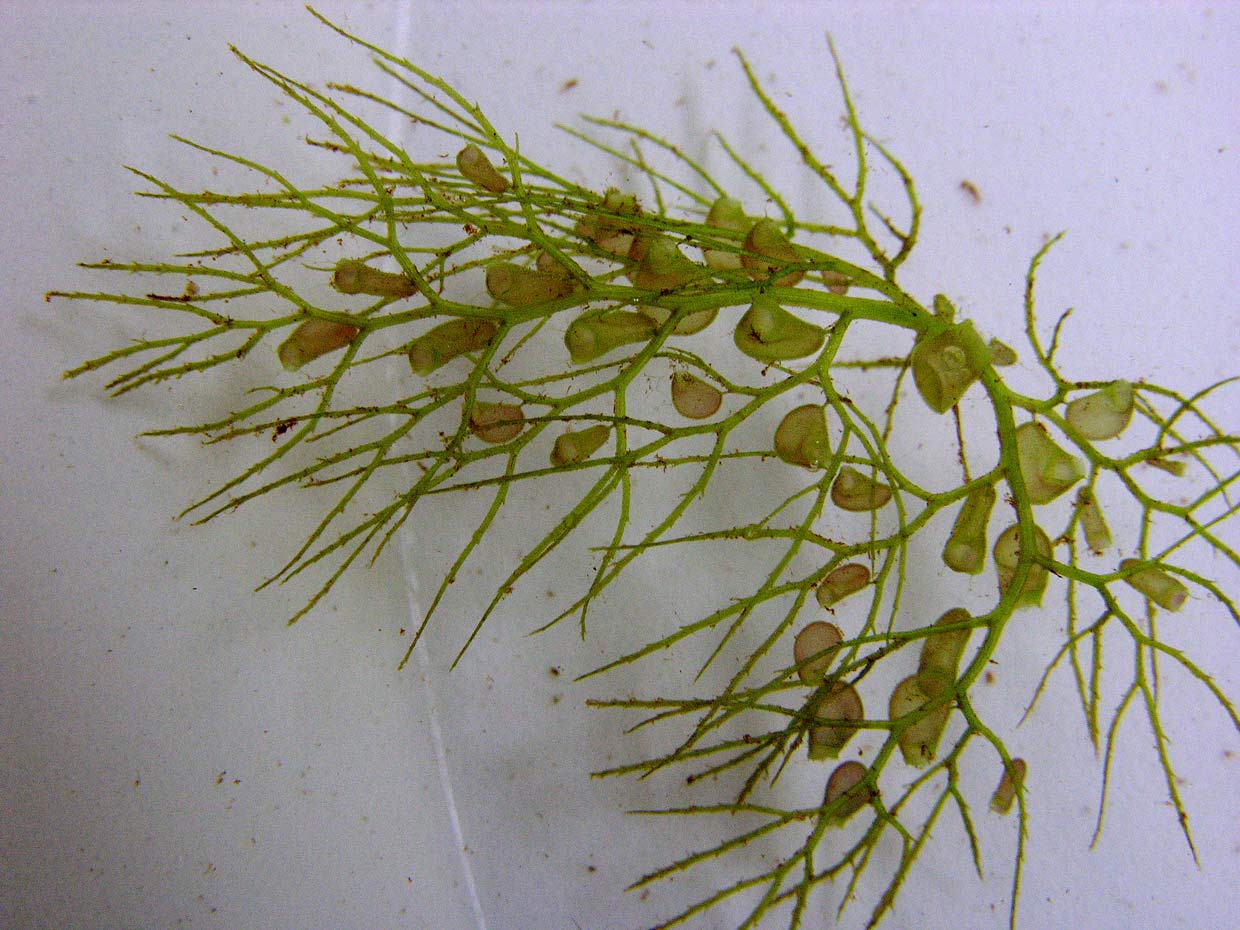
A floating, rootless plant with an elongated, highly branching stem. Leaves are divided and repeatedly divided. On several segments of the leaf blade there is a rounded bladder, partially filled with air, with an opening closed by a lid and surrounded by mucus-covered hairs. It serves to trap tiny aquatic organisms, which are then sucked into the plant and serve as its food.
During flowering the bladderwort stands out on bodies of water by flowering shoots rising above the water by 15-20, sometimes 30 cm, on which bright yellow large flowers are borne, gathered in a raceme with few flowers. Blooms from June to September.
In autumn the bladderwort forms overwintering buds. They detach from the main stem, gather into a clump, are covered with a thin layer of mucus and sink to the bottom. New plants develop from them in spring.

Habitat: this plant floats freely in lakes, ponds and stagnant waters of bogs. Not demanding regarding water quality; it can live in large bodies of water and even in slowly flowing water. It can pose a danger to fish fry.
Care: does not require special care. It is necessary to control the number of plants in an artificial pond.
Reproduction: they reproduce on their own, mainly vegetatively. If necessary, shoots can be divided in summer.