
Encyclopedia - Plants for ponds
Cattail
Typha
Cattail - a genus of monocotyledonous plants of the family Typhaceae. Monoecious perennial aquatic or marsh herbs 2 to 4 m, with long thick creeping rhizomes.
Leaves mostly broad- or narrow-linear, sheathing, arising from the base of the stem and sometimes exceeding it in length.
Flowers unisexual, small; staminate — naked, pistillate — with a perianth of many thin long hairs; gathered at the top of the stem in two dense, mostly cylindrical, inflorescences. The upper inflorescence is loose and narrow, consisting of staminate flowers; the lower is dense and broad, from light to dark brown, consisting of pistillate flowers of three types.
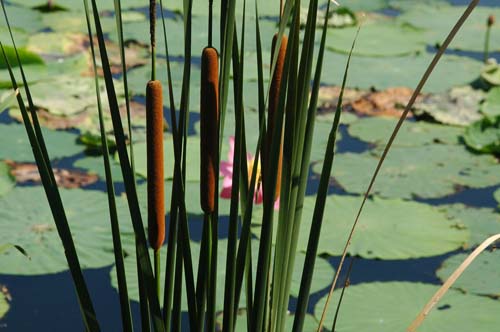
Fruit — an achene with a coma of long hairs; about 20 species occur almost worldwide. In the countries of the former USSR about 15 species, including the broadleaf cattail (T. latifolia), the narrowleaf cattail (T. angustifolia), Laxmann's cattail (T. laxmannii), grow in the European part, the Caucasus, Siberia and Central Asia and sometimes form extensive stands. In Central Asia the southern cattail (T. australis, formerly T. angustata) is widespread. Cattails are used as fodder (for ensiling), as a building material, and for paper production. Leaves are used for weaving baskets, mats, ropes, etc. Starch-rich rhizomes are good food for muskrat, nutria, desman and others. The hairs of the bracts are used to obtain cellulose, for motion-picture film, mixed with animal wool to produce felt; they are used to stuff life belts. Some cattails are weeds in rice fields.
Lesser Cattail (Typha minima).
Native range — almost all of Europe, Central Asia, China, Mongolia, Japan.
A very slender plant, 30–60 (sometimes up to 100 cm) tall, with thin stems. Easily distinguished from other cattails by its small size. Leaves of sterile shoots very narrow, 0.1–0.2 cm wide, semi-cylindrical. Flowering stem thin; the pistillate part of the inflorescence cylindrical, 0.8–1.2 cm wide, sometimes broadened at the top, brown.
Flowers in July–August. Used for decorating small ponds at depths of 5–10 cm. Propagates like the previous species.
Narrowleaf Cattail (Typha angustifolia).
Grows throughout Europe, North America and on the Canary Islands.
Plant height 100–180 cm. Rhizome thick, creeping. Stem simple without nodes. Leaves distichous, gathered at the base of the stem, oblong-linear, 0.4–1 cm wide, semi-cylindrical. Flowers very small, arranged in male and female inflorescences on the same scape. Female flowers form a dense fluffy spike in the lower part of the inflorescence. The spike is cylindrical; the staminate and pistillate parts are separated by 3–8 cm.
Flowers in June–August. Prefers clayey fertile soils.
Propagated by dividing the rhizomes (only their terminal segments) in early spring, and also by seeds. Seedlings require a water depth of up to 15 cm.
Broadleaf Cattail (Typha latifolia).
Occurs in all non-tropical zones of the Northern Hemisphere.
Reaches 2 meters in height. Stems thick, cylindrical. Rhizome large, creeping, shallowly submerged in water. Leaves stiff, strap-shaped, up to 2 cm wide. Inflorescence — a spike, up to 2.5 cm in diameter, turning brown by autumn, softly velvety. The spikes remain decorative until spring, when they disperse into small seeds.
Requires acidic, waterlogged soils or pond banks and a well-lit location. Spreads rapidly. In small ponds excess rhizomes should be removed to prevent waterlogging.
Location: should be planted on a moist bank with a barrier or submerged in water depending on growth: large plants — up to 60 cm, small ones — up to 30 cm. May suffer winterkill in severe snowless winters. In small or ornamental ponds plant in containers. Soil should be fertile and the site sunny. Grows well on silty, peaty and clay soils.
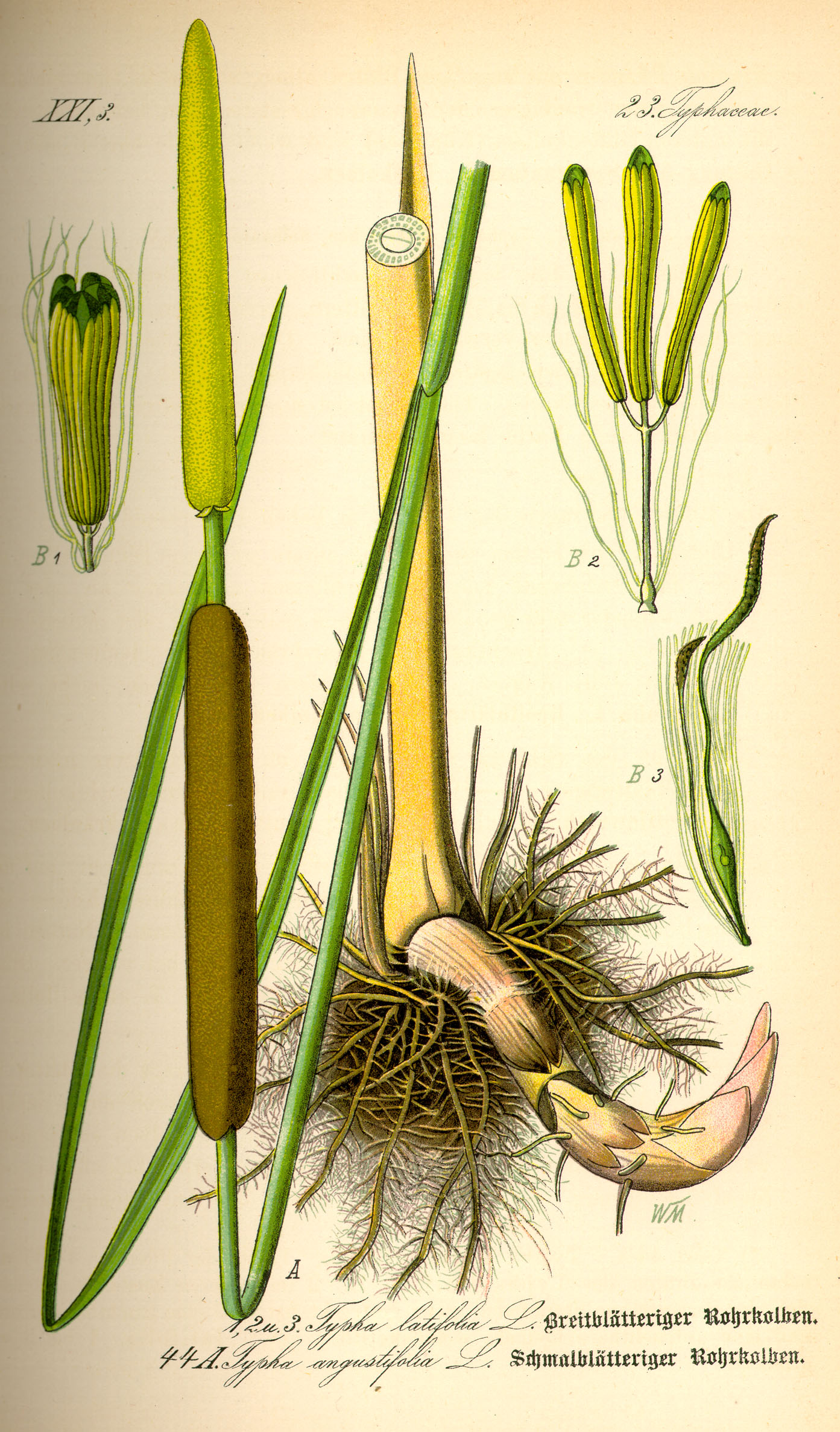
Care: it is necessary to control its spread. When cultivating, note that cattail is a biennial and rapidly spreading plant. Shoots that appear at the end of summer should be removed, otherwise there will be no flowering specimens the following year.
Propagation: in spring by dividing rhizomes and by sowing seeds.