
Flowers for the garden
Tulip
Tulipa
Tulip (lat. Túlipa) — a genus of perennial bulbous plants of the family Liliaceae. The name comes from the Persian word toliban («turban»), and was given to the flower because its buds resemble the Eastern headwear similar to a turban.
Phylogenetic studies of the late 20th and early 21st centuries have shown that there are up to 110 species of tulips in nature. The native habitat of most of them is Central Asia, its arid and mountainous regions: steppes, sandy and rocky deserts. Wild tulips are found in nature in Eastern Europe and southern regions of Kazakhstan. A significant number of species grow in Iran, Turkey, and northern India.
The genus is divided into two subgenera, Tulipa and Eriostemones (according to L. W. D. van Raamsdonk). A fairly large number of varieties, forms and hybrids are known. Most tulips cultivated belong to the species Tulipa gesneriana L., which grows wild in eastern Russia, the Altai, and Armenia; cultivated forms of this species occur with single and double flowers in all sorts of colors, solid and variegated. Other species are also found in cultivation: Tulipa suaveolens Roth with numerous varieties, Tulipa greigii Regel, Tulipa pubescens Willd., Tulipa eichleri Regel, and others.
The tulip is a herbaceous bulbous perennial. Plant height varies depending on species and cultivar from 10–20 to 65–100 cm.
The root system consists of annually dying adventitious roots located on the horseshoe-shaped lower part of the basal plate. In young bulbs (before the first flowering) stolons are formed — hollow structures at the bottom of which a daughter bulb is located. Usually stolons grow vertically downward, less often sideways.
The stem is represented by three forms: the basal plate, the stolon and the generative shoot bearing flowers and leaves. The stem is erect, cylindrical, from 5–20 to 85–100 cm high.
Leaves are elongate-lanceolate, green or glaucous, with smooth or wavy margins and a slight waxy bloom. Venation is arcuate. They are alternate and clasp the stem. The lower leaf is the largest, the upper, the so-called flag leaf, is the smallest. In Kaufmann tulips (T. kaufmanniana), Greig tulips (T. greigii), Micheliana (T. micheliana) and their garden forms, the upper surface of the leaves is decorated with purplish-brown, purple spots or streaks, and stripes, giving the plants special decorative value. An adult flowering plant most often has 2–4(5) leaves, which are located in the lower part of the stem. In young plants (before the first flowering) a single leaf develops by the end of the season. Leaf primordia are laid down in the replacement bulb of an adult plant during the vegetation period, and growth continues in the next season.
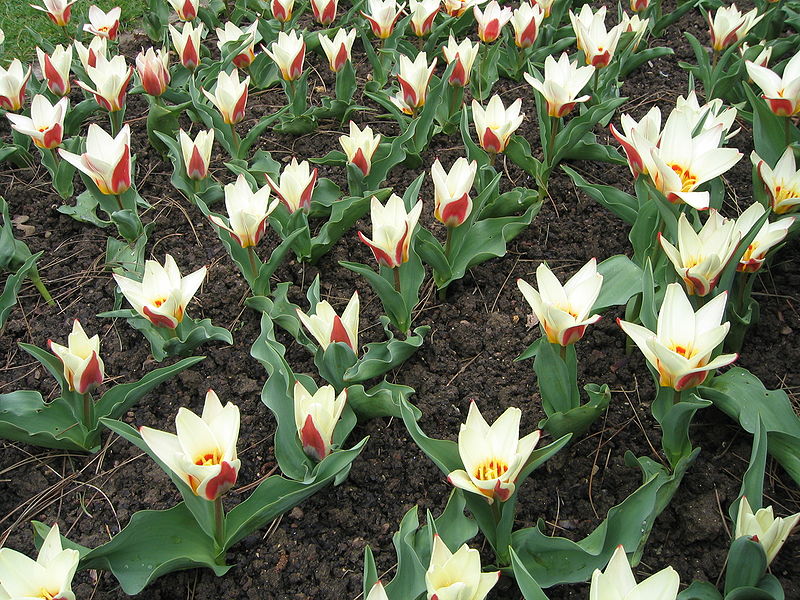
The flower is usually single, but there are multi-flowered species (T. praenstas, T. turkestanica) and cultivars derived from them, on the scape of which 3–5 flowers or more are borne. The flower is regular, bisexual, the perianth consists of six free segments, stamens six with elongated anthers; pistil with a superior three-loculed ovary, a short style and a three-lobed stigma. Flowers of wild tulips are more often red, yellow, less often white. The coloration of garden tulips is extremely diverse: from pure white, yellow, red, purple, violet and almost black to combinations of two, three or several colors. Often the base of the petals is colored in a different color from the main one, forming the so-called "base" of the flower. The shape of the flower is also varied: goblet-shaped, cup-shaped, oval, lily-shaped, double (peony-like), fringed, star-shaped, parrot. Flowers are large, up to 12 cm long, 3–10 cm in diameter, and when fully open in wild tulips up to 20 cm. Tulip flowers open widely in the sun and close at night and in cloudy weather.
The fruit is a many-seeded capsule of triangular shape. Seeds are flat, triangular, brownish-yellow, positioned horizontally in two rows in each locule of the capsule.
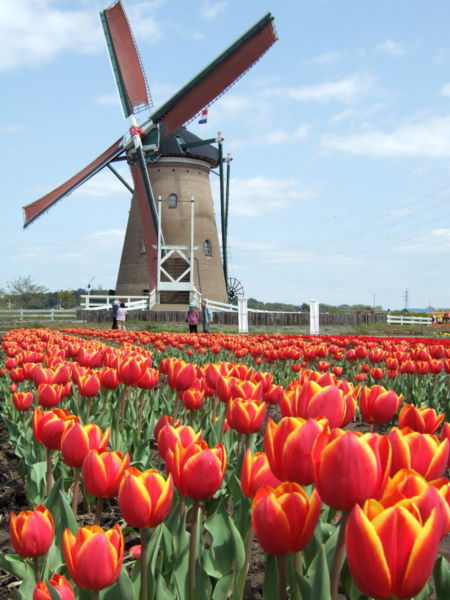
By the rhythm of seasonal development, tulips belong to spring ephemerals. Their growth and development continue for 80–120 days: from early April until the end of June, when the above-ground parts wither.
Tulip vegetation begins with leaf emergence in April, immediately after the snow melts. Flowering occurs on average 20–30 days after the start of vegetation. Tulips, being typical ephemerals, are very sensitive to temperature, less so to moisture, and almost undemanding to other factors affecting plant growth and development.
The duration of flowering depends on air temperature. For most plants it is 12–14 days. During flowering, prolonged exposure to temperatures above 25 °C leads to a sharp reduction in vegetation in tulips, the flowering shoot dies back and the outer scales of the replacement bulbs become corky. Under normal temperature conditions, 4–5 weeks pass from the end of flowering to the end of vegetation.
Stem, flower, leaves and roots are annual, i.e., they live for one growing season. The bulb, unlike them, lives about 2.5 years; during this time its replacement — the replacement/daughter bulb — and several smaller bulbs — offsets — are formed. In addition to seeds, tulips propagate by small bulbs (offsets) that develop at the base of the stems in the ground.
Garden classification
In accordance with the International Register of Tulip Names adopted in the Netherlands in 1981, the modern Unified Classification System of tulips is divided into 4 groups (depending on flowering time), including 15 classes:
- Group I — early flowering
- Class 1. Single early tulips
- Class 2. Double early tulips
- Group II — mid-season
- Class 3. Triumph tulips
- Class 4. Darwin hybrids
- Group III — late flowering
- Class 5. Single late tulips
- Class 6. Lily-flowered tulips
- Class 7. Fringed tulips
- Class 8. Green‑flowered tulips
- Class 9. Rembrandt tulips
- Class 10. Parrot tulips
- Class 11. Double late tulips
- Group IV — species tulips and their hybrids
- Class 12. Kaufmann tulip, its varieties and hybrids
- Class 13. Foster tulip, its varieties and hybrids
- Class 14. Greig tulip, its varieties and hybrids
- Class 15. Wild species of tulips, their varieties and hybrids
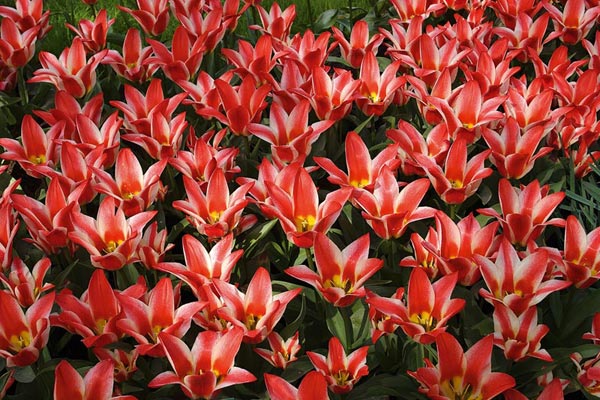
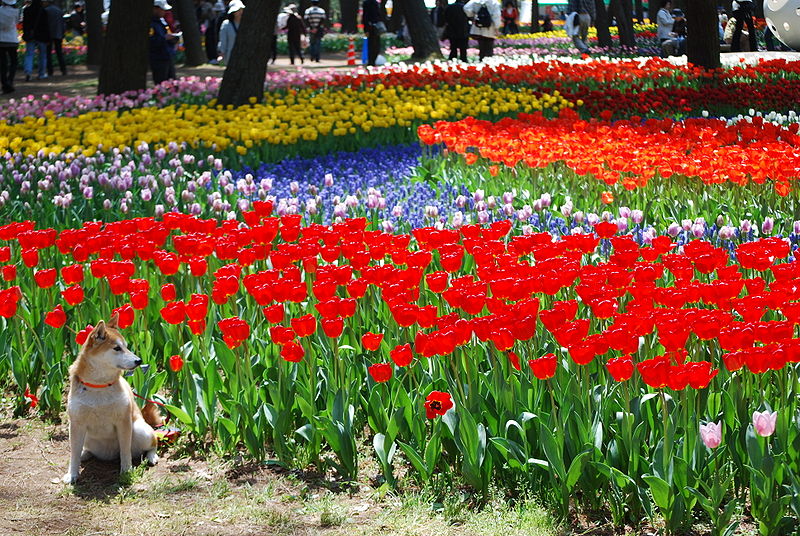
Brightness of color, elegance of form and ease of cultivation have made the tulip one of the most beloved garden flowers. In garden and park landscaping tulips are a versatile plant with a wide range of uses: tulips are planted in flower beds and borders, under trees and on rockeries, used to decorate balconies and planted in street containers. The great variety of modern cultivars can satisfy the most demanding tastes of gardeners. Among species and cultivars there are those ideally suited for planting in flower borders and rock gardens, and others that will look great against a backdrop of tall perennials or ornamental shrubs. The variety of tulip cultivars by flowering time allows you to choose varieties for the garden that will please you from mid‑April until early June.