
Flowers for the garden
Large nasturtium
Tropaeolum Majus
Garden nasturtium, or Large nasturtium (Tropaeolum majus) — an annual herbaceous plant of the family Tropaeolaceae (Tropaeolaceae). Native range — South America from Peru to New Granada. It is now widespread everywhere.
As an ornamental plant it is cultivated in Europe, in the south of the European part of Russia, in the Caucasus and in Central Asia.
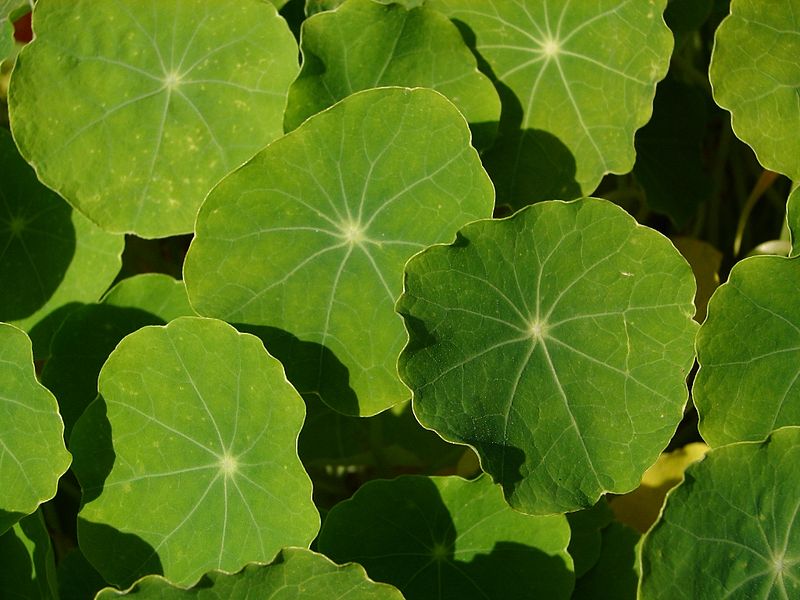
Perennial herbaceous (sometimes semi-shrub) plant, which is grown as an annual. Stems are fleshy, succulent, highly branched, about one meter long or more. There are upright and trailing forms. Leaves on long petioles, peltate, entire, roundly asymmetrical, 3—15 cm in diameter. There is a series of cultivars with variegated leaves (Tropaeolum majus; alaska series)
Flowers are fairly large (up to 5-7 cm in diameter), simple, semi-double or double, solitary, borne from the leaf axils on long peduncles, with a delicate, rather pleasant fragrance. The calyx is brightly colored, with a spur at the base. The corolla has free petals, consisting of 5 velvety petals. Colors — cream, yellow, red, orange, cherry or salmon. Many cultivars have spots or streaks on the petals. The fruit is dry, splitting into three parts.
The nasturtium is very ornamental. Tall trailing forms are used to decorate balconies and fences; low-growing forms are used for group plantings, for borders and for rock gardens.
Nasturtium has long been used in cooking. Fresh leaves, firm flower buds and unripe green seeds have a peppery taste; they are used as a condiment for salads, meat, vegetable and egg dishes. Flower buds and green fruits are pickled with dill and vinegar as a substitute for capers. Opened flowers are used as a garnish.
Site: prefers moderately fertile and moist, loamy and sandy-loam, water- and air-permeable soils. The plant is very sun- and heat-loving.
Watering: fairly drought-tolerant, but requires watering in the early stages of vegetation, in the evening hours or after a prolonged period of drought.
Fertilization: does not tolerate fresh manure. With an excess of nitrogen and moisture it grows very vigorously but flowers poorly, "runs to foliage". Outdoors, nasturtiums are fed every 4-6 weeks with a complete mineral fertilizer with a low nitrogen content.
Propagation: by seed. Seedlings usually appear on the b-7th day at a temperature of 18°. Seedlings are planted in the ground at the end of May-beginning of June, always with a root ball, 20-25 cm apart. Nasturtiums can also be sown directly into the ground when the threat of late frosts has passed (end of May-beginning of June). Flowering of bush varieties begins 40-45 days after emergence, of climbing varieties — on the 55-60th day.