Flowers for the garden
Trillium
Trillium
Trillium (lat. Trillium) — a genus of herbaceous plants of the family Trilliaceae (Trilliaceae), comprising about 30 species occurring in the temperate regions of North America and East Asia.
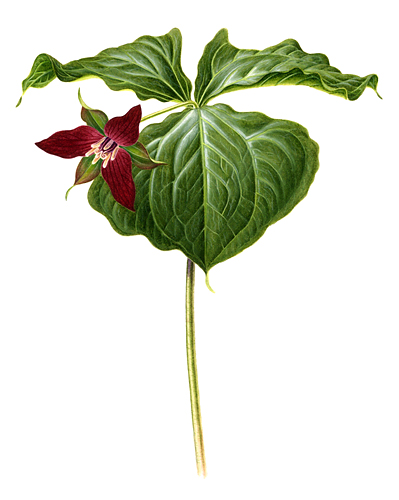
The name comes from the Latin word 'trilix' — threefold. Almost all parts of the plant occur in threes — three leaves, three petals, three sepals, a three-chambered ovary.
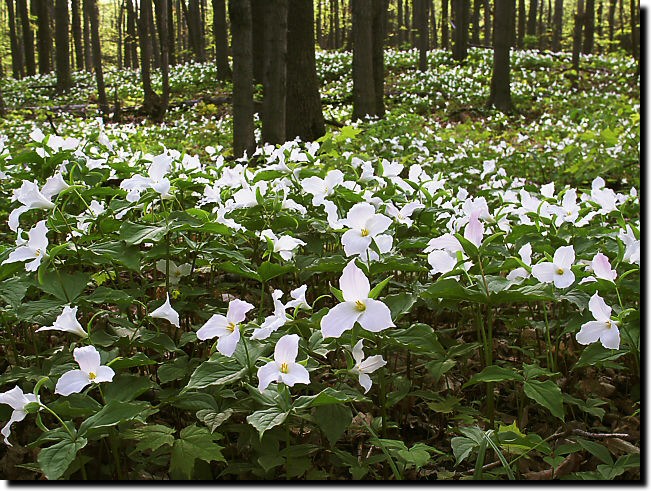
Perennial herbaceous plants with short, thick rhizomes. Stems erect with numerous scale-like basal leaves; stem leaves are arranged in whorls of three. The perianth consists of six parts: three outer greenish ones and three inner petal-like ones, white, reddish, or dull yellow, longer than the outer segments. The fruit is a three-chambered green capsule. An important characteristic that helps distinguish different Trillium species is the position of the flower. In some species the peduncle is absent and the flowers appear to sit on the leaves; in others the flower is borne on an erect stalk and faces upward, while in some the stalks are drooping and the flowers face the ground.
Trillium erectum
Trilliums have been cultivated since the 16th century, but despite their attractiveness they are still rarely found in our gardens. The reason is the difficulty of propagation. Although many viable seeds are usually produced, the embryo within them is underdeveloped. It takes several seasons for the embryo to fully develop and for the seeds to germinate in all Trillium species, and only in the third year do seedlings appear. This feature is typical of many ancient forest plants, which include Trillium.
Trillium kamtschaticum, or rhombifolium — Trillium kamtschaticum = T. rhombifolium
Trillium kamtschaticum occurs mainly in forests. In valleys it grows in birch stands, in willow-alder woods with tall herbaceous vegetation, and in stands of tall herbs; in the mountains it is found in fir, spruce-fir, deciduous, broad-leaved (oak) and mixed forests, and it ascends to considerable heights. It also grows on species-rich meadows along the seacoast.
Plants 15—40 cm tall. Rhizome thick, short (3—4 cm). Stem ribbed, erect. Leaves sessile, broadly ovate-rhombic, acute, 8—10 cm long and 7—9 cm wide, matte green beneath. Flowers fairly large, bright white. The yellow stamens and the pistil with a dark-red stigma look very beautiful against the bright white petals. The fruit is intermediate between a capsule and a berry, green, three-angled. The fruits are edible raw but tasteless. This species blooms for a long time — up to 15 days (from early to mid-May). Fruits ripen at the end of August.
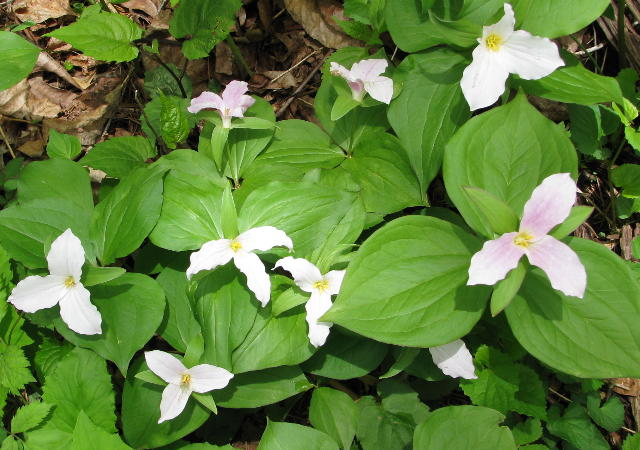
Location: prefer shade and partial shade. They require moist, fertile soils under the canopy of broad-leaved trees, for example linden, maple, chestnut, ash, oak, etc. (except those that produce root suckers: cherry, plum), where the soil is rich in leaf humus.
Care: require leaf cover for the winter. In summer keep the soil loose and moderately moist. On humus-rich soils fertilizers may not be necessary, except for spring feedings with a complete mineral fertilizer in doses indicated for ornamental flowering plants. Trilliums are frost-hardy.
Propagation: most often by dividing the clump in late August — early September. When propagated by seed, sow seeds immediately after collection. Germination is subterranean; leaves appear in the second to third year, and seedlings flower in the third to fourth year.