
Indoor plants
Trachycarpus fortunei (Fortune's fan palm)
Trachycarpus fortunei (Hook.) H.Wendl.
Synonyms: fan palm, Fortune's kidney-fruit palm, Chamaerops excelsa hort., Chamaerops fortunei Hook., T. wagnerianus hort. ex Becc., трахикарпус форгуна, lofty chamaerops, Chamaerops excelsa misapplied, трахикарпус фортуна, Trachycarpus lofty, Chinese fan palm, Japanese fan palm, Trachycarpus caespitosus Becc., Trachycarpus wagnerianus Becc.
Trachycarpus Fortune (Trachycarpus fortunei (Hook.) H.Wendl.) – a species of plants of the genus Trachycarpus (Trachycarpus) in the palm family (Arecaceae, Palmae). The species was first brought to Europe from Japan (Dejima Island) in 1830 by the German researcher Philipp Franz von Siebold. The name refers to Zhoushan Island, where Robert Fortune first saw the first cultivated specimens of the species. In 1849 R. Fortune smuggled several specimens to Leiden and gave some of them to the Royal Botanic Gardens, Kew and the Royal Garden of Prince Albert in England. The species was first described by Carl Friedrich Philipp von Martius in 1850 in his book "Historia Naturalis Palmarum", but under the name "Chamaerops excelsa". The plant entered commerce in 1860 from the Glendinning nursery, which received seeds of the plant from R. Fortune taken from the Nimbo area near Zhejiang.
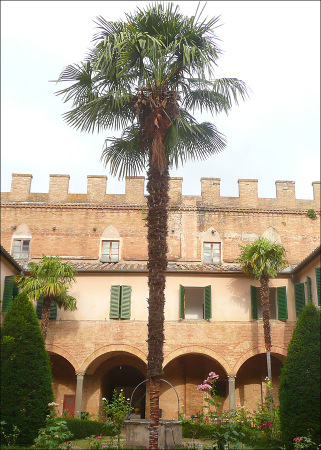
Occurs in central China (Hubei province), south to the northern part of Myanmar (Burma) and northern India. In mountains it rises to an altitude of 100-2400 m above sea level.
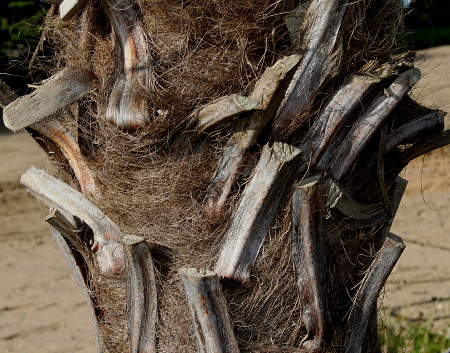
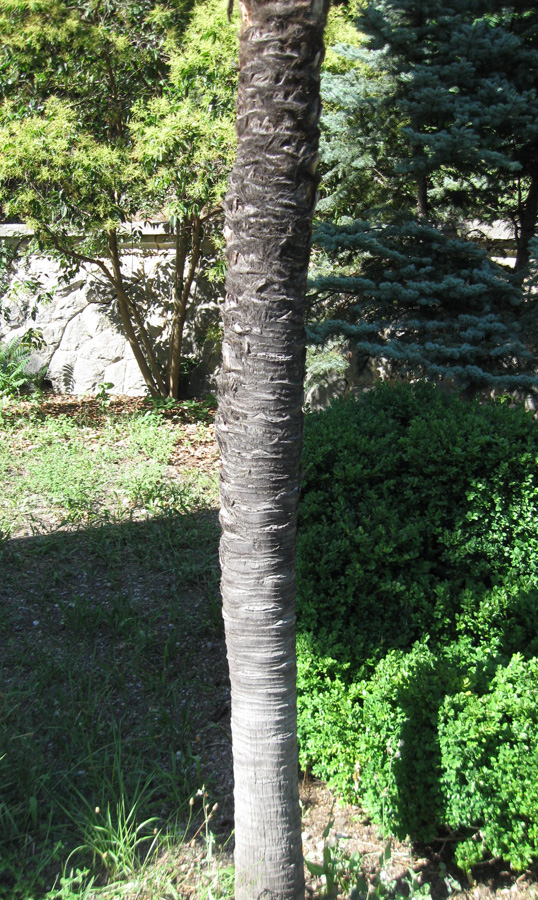
It is a woody plant 12-20 m in height, consisting of a single trunk with a diameter of 15-30 cm. It grows slowly. Trunk erect, covered with coarse brownish fibres and bases of dead leaves, becoming bare at the base.
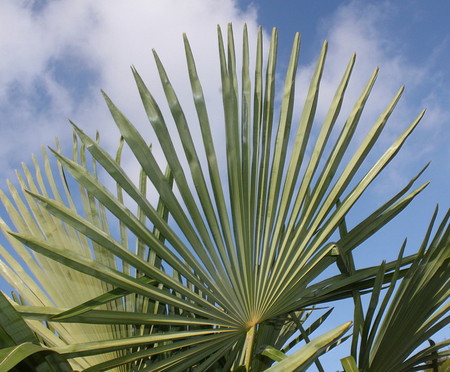
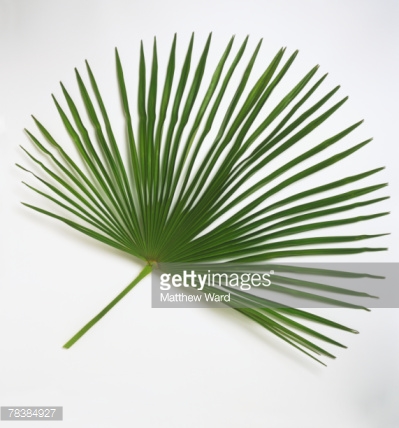
Leaves large, 140-190 cm long, fan-shaped, deeply radially divided into 40-50 bifid, rigid segments up to 3 cm wide, dark green. Petioles long, 60-100 cm long, finely toothed along the edges.
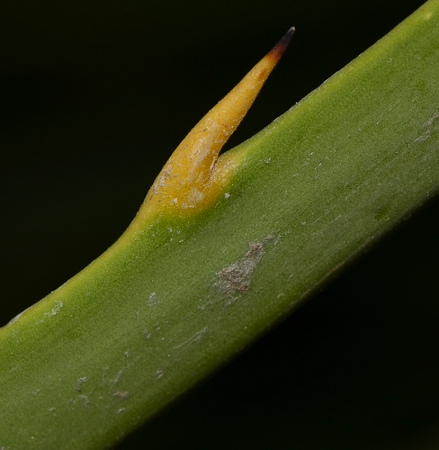
Leaf petiole
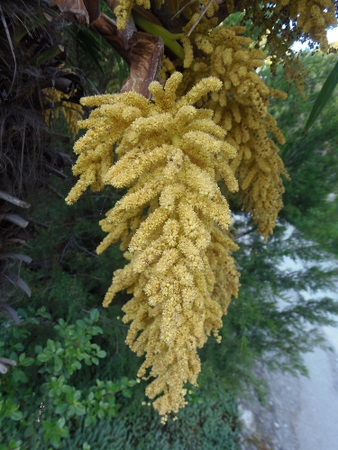
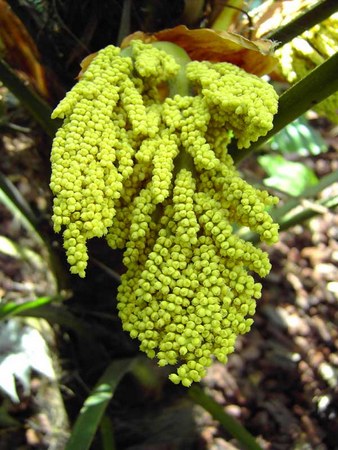
Inflorescences axillary. Male inflorescences yellow, female – greenish, 2-4 mm in diameter, borne in large branched panicles up to 1 m long. They appear in April and flower in May.
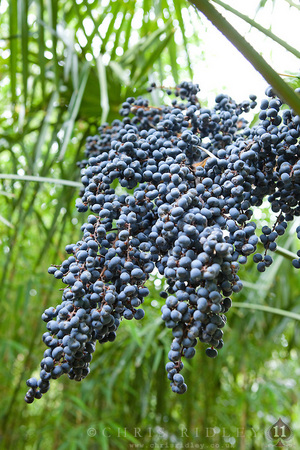
Fruits yellow, becoming blue-black when ripe, kidney-shaped drupes 9 mm wide and 14 mm long, covered with a waxy bloom. They ripen in November-January.
Cultivars: Trachycarpus fortunei 'Wagnerianus', Trachycarpus fortunei 'Nanus'.
Hardiness zone: 6a (-19°C).
Temperature: in most of Ukraine representatives of the genus are grown as houseplants. In the conditions of Crimea and Odessa it can be grown outdoors. An ideal place for cultivation is a greenhouse or winter garden. Recommended summer temperature should not exceed +23°C, winter – not above 6-8°C. In winter in a warm room the plant dries out.
Light: requires bright light with some direct sun. At midday it is necessary to shade it from the sun. Indoors this plant is usually given the brightest spot.
Watering: in summer it needs abundant watering, in winter – moderate (depending on temperature – once every 1.5-3 weeks).
Air humidity: requires moderately humid air (up to 40%). In winter humidity requirements increase when kept in heated rooms. Daily misting is recommended.
Care: from May to September it is recommended to fertilize every 3 weeks with a palm fertilizer or any other houseplant fertilizer taken at half the usual dose.
Repotting: young plants (up to 1-15 m in height) should be repotted annually, larger ones – once every 2-3 years, but the top layer of soil to a depth of 5-7 cm should be changed every year. Mature plants do not like repotting, so it is carried out only when roots protrude beyond the container. Repotting is done in spring – in March. Requires drainage.
Potting mix: light clay-turf soil, humus-leaf soil, peat, well-rotted manure, sand and a little charcoal in ratio 2:2:1:1:1.
Pests: spider mite, mealybug, scale insects, leaf-eating beetles, aphids, thrips, false scales.Diseases: parasitic fungi can cause death of the apical bud. With insufficient nutrition the plant's growth slows and the leaves yellow. With insufficient humidity the leaf tips may dry out. With overwatering brown spots may appear on leaves. Overwatering of the soil can lead to root rot. Does not like high temperatures, at which leaves can yellow in winter. Also encountered: leaf spots, pink rot, Phytophthora (root and stem rots), Fusarium, Rhizoctonia, Pythium, chlorosis of young leaves.
Propagation: propagated by seeds and offshoots. Seeds lose viability after 10 months. Seeds are sown at the end of February - March into small pots 5-7 cm in diameter. Before sowing the seed coat is shallowly nicked. Lighting should be bright. Optimal temperature +25 to +30°. Germination time 1-4 months. It is advisable to treat with a growth stimulator. Offshoots should be at least 7 cm in diameter. Offshoots are cut from the mother plant with a disinfected knife. Practically all offshoots have a curved shape.
Uses: widely used as an ornamental plant in indoor conditions, and in temperate-continental and subtropical climates outdoors. Planted outdoors at resorts, along the coast. Used in solitary and group plantings, for creating alleys in parks. The plant is attractive for its large fan leaves, yellow-green panicle flowers and blue-black fruits, which remain on the plant for up to a year. In its native range young inflorescences are eaten. Fibres from the trunk are used for stuffing mattresses and mats.