
Indoor plants
Trachycarpus
Trachycarpus
Synonyms: fan palm, kidney-fruited plant.
Trachycarpus (Trachycarpus H.Wendl.) – a genus of plants in the Palm family (Arecaceae, Palmae). The genus was first described in the journal «Bulletin de la Société Botanique de France. Paris» by the German botanist Hermann Wendland in 1861. The name comes from the Latin words «trachy» (rough) and «carpus» (fruit).
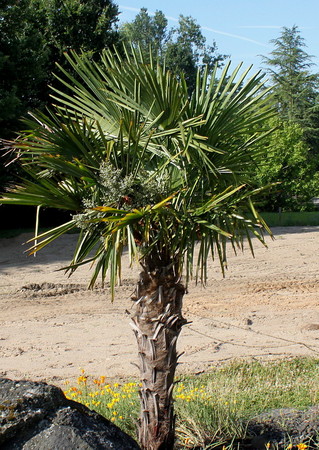
Trachycarpus fortunei
Native to the temperate regions of the northeastern Indian subcontinent (Bhutan, Myanmar, Nepal), Burma, Thailand, Vietnam and China. 3 species (2 endemics) from China. Occurs in mountains up to 2400 m above sea level.
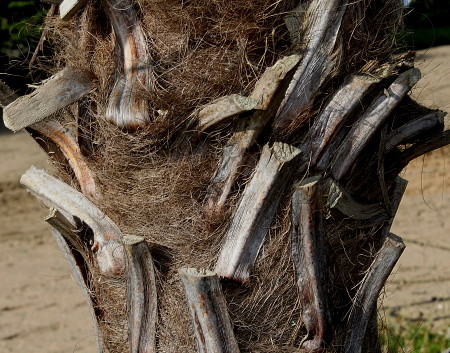
Trachycarpus fortunei
Members of the genus are dioecious or polygamous plants with a solitary tall, less often short stem 12-20 (in indoor conditions up to 2.5) m in height. In natural conditions they live more than 150 years, in indoor conditions up to 20. Trunk 15—25 cm in diameter, erect, less often creeping, bare or covered with brown fibers and bases of dead leaves.
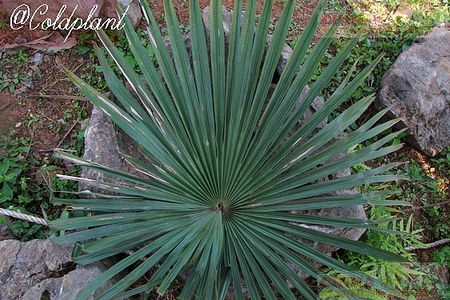
Leaves large, up to 1 m wide, divided into 6-8 deeply radially cleft lobes up to 3 cm wide; they are stiff, two-notched, dark green. Leaves form a dense crown. The underside of the leaves has a glaucous bloom. Leaves grow on long, narrow, flat petioles, often with small blunt teeth along the edges.
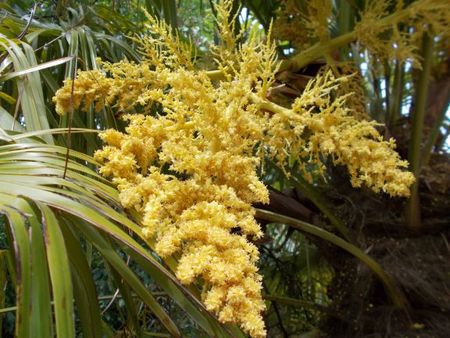
Inflorescences single, axillary, racemose panicles, on long peduncles 30-40 (100) cm tall, white or bright yellow, scented or odorless, abundantly branching. Calyx of 3 sepals, fused into a triangular base. Petals usually considerably exceed the sepals. Carpels 3, ovoid, with a triangular or rounded apex, glabrous. Stamens 6. Anthers short, oblong, sometimes pointed. Pedicels oval in cross-section, often pubescent. Flowers in May. Do not flower under indoor conditions.
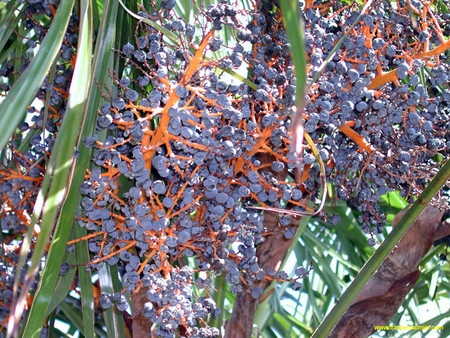
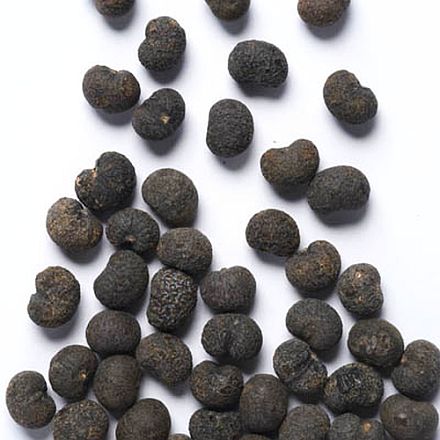
Fruits – kidney-shaped, purple-black, elongated and slightly ribbed, immature – slightly covered with hairs, when ripe glabrous, with 1 seed inside. Seeds kidney-shaped, slightly elongated. They ripen in November-January and remain on the branches for a long time.
Chromosome number: 2n = 36.
Species: includes 9 species:
- Trachycarpus fortunei
- Trachycarpus geminisectus Spanner et al.
- Trachycarpus latisectus Spanner
- Trachycarpus martianus (Wall. ex Mart.) H.Wendl.
- Trachycarpus nanus Becc.
- Trachycarpus oreophilus Gibbons & Spanner
- Trachycarpus princeps Gibbons, Spanner & San Y.Chen
- Trachycarpus takil Becc.
- Trachycarpus ukhrulensis M.Lorek & K.C.Pradhan
Hardiness zone: 7a (-16°C).
Temperature: in most parts of Ukraine members of the genus are grown as houseplants. In Crimea they can be grown outdoors. The ideal place for cultivation is a greenhouse or winter garden. Recommended summer temperature should not exceed +23°C, winter – not above 6-8°C. In winter in a warm room the plant dries out.
Light: requires bright light with some direct rays. At midday it is necessary to shade from the sun. Indoors this plant is usually given the brightest place.
Watering: in summer requires abundant watering, in winter – moderate (depending on temperature – once every 1.5-3 weeks).
Air humidity: requires moderately humid air (up to 40%). In winter humidity requirements increase when kept in a heated room. Daily spraying is recommended.
Care: from May to September every 3 weeks it is recommended to feed with a fertilizer for palms or any other houseplant fertilizer taken at half the usual dose.
Repotting: young plants (up to 1-15 m in height) should be repotted annually, larger ones – every 2-3 years, but the top layer of soil 5-7 cm deep should be changed every year. Mature plants do not like repotting, so it is carried out only when roots grow out of the container. Repot in spring – in March. Requires drainage.
Potting mix: light clay-turf soil, humus-leaf soil, peat, well-rotted manure, sand and a little charcoal in the ratio 2:2:1:1:1.
Pests: spider mite, mealybug, scale insects, leaf-eating beetles, aphids, thrips, false scales.
Diseases: parasitic fungi can cause death of the apical bud. With insufficient nutrition plant growth slows and leaves turn yellow. With insufficient humidity tips of the leaves may dry out. With overwatering brown spots appear on the leaves. With overwatering of the soil root rot may develop. Does not like high temperature, at which in winter the leaves may yellow. Also occur: leaf spots, pink rot, Phytophthora (root and stem rots), Fusarium, Rhizoctonia, Pythium, chlorosis of young leaves.
Propagation: propagated by seeds and offsets. Seeds lose viability after 10 months. Seeds are sown at the end of February - March in small pots 5-7 cm in diameter. Before planting the seed coat is shallowly incised. Lighting should be bright. Optimal temperature +25 +30°. Germination time 1-4 months. It is desirable to treat with a growth stimulator. Offsets should be taken no less than 7 cm in diameter. Offsets are cut from the mother plant with a disinfected knife. Almost all offsets have a curved shape.