
Conifers
Torreya taxifolia (yew-leaved torreya)
Torreya taxifolia
Synonyms: Tumion taxifolium (Arn.) Greene, Caryotaxus taxifolia (Arn.) Henkel & W. Hochst., торрея флоридская, Florida torreya
Torreya taxifolia (Torreya taxifolia Arnott.) – a species of evergreen coniferous shrubs in the yew family (Taxaceae). It was first described by the Scottish botanist George Arnott Arnott in «Annals of Natural History» 1(1): 130 in 1838. Introduced to Europe in 1838. It was first discovered in Florida by the botanist Hardy Bryan Croom in 1835. An endangered species.
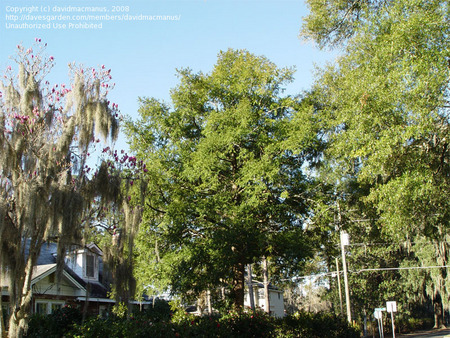
In the wild it grows in the southeastern United States (Florida and Georgia) and in southwestern Georgia. It is found along limestone bluffs on the Apalachicola River in a region with a warm and humid climate, sometimes influenced by winter cold waves from the north that lower temperatures below freezing. It grows in shade – wooded gorges and on steep rocky slopes and limestone cliffs of mountains. Associates include Fagus grandifolia, Liriodendron tulipifera, Acer barbatum, Liquidambar styraciflua, Quercus alba, Pinus taeda, Pinus glabra, Smilax, Bignonia capreolata.
It is an evergreen coniferous tree with an open, conical crown 12–15 m tall and a trunk diameter up to 60 cm. Bark is brown-orange, irregularly fissured, scaly, up to 1.3 cm thick. Branches are whorled, spreading, slightly drooping. Two-year-old shoots are yellowish-green, yellowish-brown or yellowish-gray.
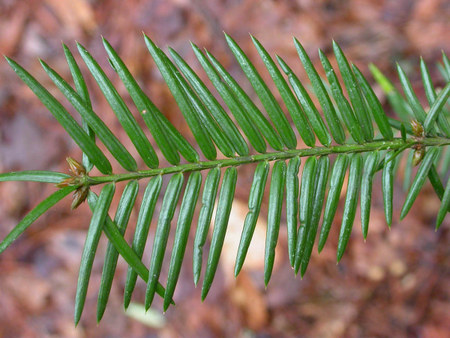
Foliage 1.5–3.8 cm long and 3 mm wide, with 2 stomatal bands on the underside, resembling yew foliage, with sharp tips. Needles remain on the branches for 3–4 years. When crushed they emit a pungent smell.
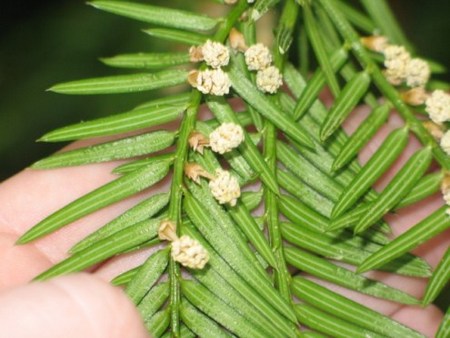
Begins to flower at about 20 years of age, in March–April. Male cones are pale yellow, conical, 5–7 mm long, occurring along the lower part of the shoot. Female cones are solitary or grouped 2–5 on a short stalk.
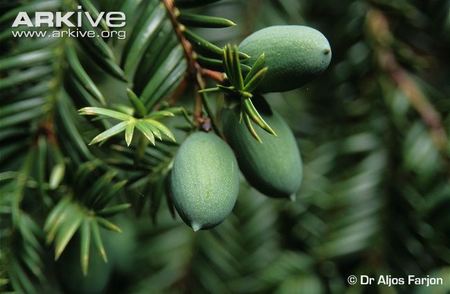
Seeds are surrounded by a fleshy dark green aril, maturing in 18 months (September–October), turning purple as they ripen. Seeds (including the aril) reach 2.5–3.5 cm in length.
Hardiness zone: 6b (-20 to -15°C)
Placement: grows best in sunny locations but can tolerate shade. Does not like dry air. Climate subtropical, with a humid summer and dry winter. Average annual precipitation is 1420 mm, and the average length of the growing season is 270 days.
Soil: well-drained soils, with a pH range from 4.0 to 8.0.
Planting: soil mix – topsoil, peat and sand in proportions 3:2:2. Dig a planting hole 70 cm deep, with the root collar at ground level.
Care: in hot, dry summers, to maintain ornamental appearance it is recommended to water the plant 1–2 times a month at 11–12 L per plant and to mist once every 2 weeks. In the first years after planting it is recommended to loosen the soil to a depth of 10–15 cm. Young trees are recommended to be insulated for the winter with a 5–7 cm layer of peat and protected from sunscald with boughs.
Pruning: only sanitary pruning is required.
Diseases and pests: damaged by fungal rot.
Propagation: produces root and stem suckers. Propagated by seed and cuttings.
Uses: practically not used. Seeds are edible and are used to make oil. Can be used as specimen plantings in arboreta and parks.