
Conifers
Torreya
Torreya
Synonyms: Tumion Raf. ex Greene
Torreya (Torreya Arn.) – a genus of evergreen coniferous shrubs of the yew family (Taxaceae). It was first described by the Scottish botanist George Arnott Arnott in his "Annals of Natural History 1: 130–132" in 1838. The genus was named in honor of John Torrey – the first professional botanist of the New World.
The range extends to East Asia and North America. They grow in China, Japan, California, western Florida. They occur in mountains, rising to 500–1800 m above sea level.
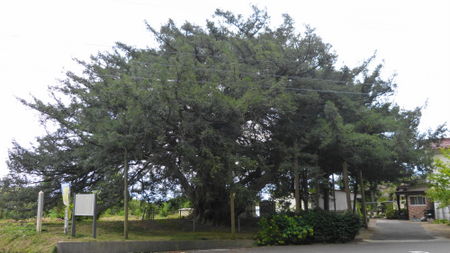
Members of the genus are evergreen coniferous dioecious, less often monoecious trees or shrubs 5–20 m tall. They grow slowly. Bark orange-brown or grayish-brown, fissured. Branches grow horizontally, shoots drooping at the ends.
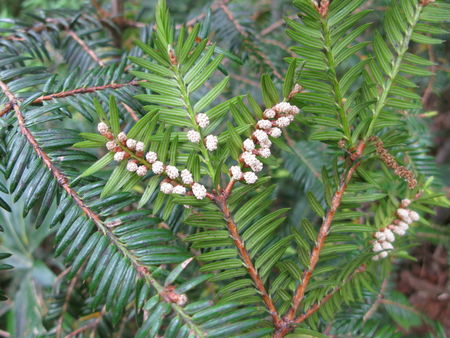
Needles stiff, glossy, dark green, linear, 2–8 cm long and 3–4 mm wide, with 2 stomatal bands on the underside, with sharp tips.
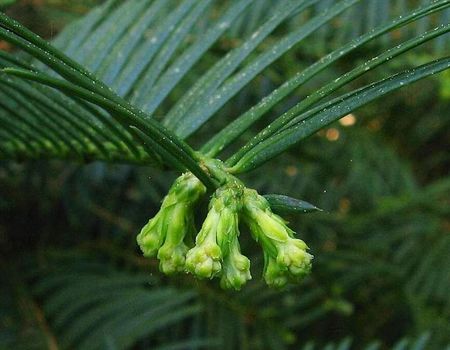
Microstrobili solitary. Pollen without air sacs. Megastrobili solitary or 2 together on a short axillary shoot. Male cones 5–8 mm long, occurring in groups of several in a row along the lower part of the shoot.
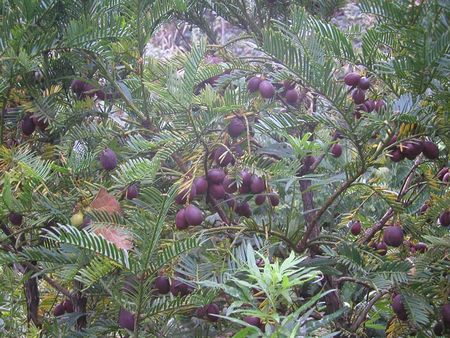
Seeds are surrounded by a fleshy aril of reddish, green to purple color, 2–4 cm in thickness, each containing one seed. The fruits resemble a berry in appearance. They ripen in the second year. Seeds are edible.
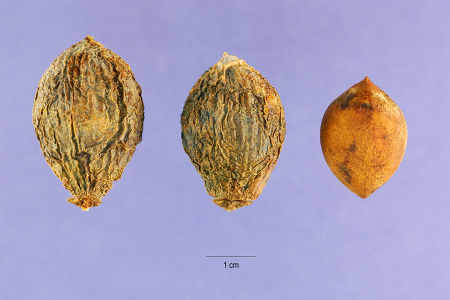
Species: the genus comprises 7 species.
- Torreya bogotensis Linden ex K. Koch
- Torreya californica Torr. — California torreya
- Torreya grandis Fortune ex Lindl. — large torreya
- Torreya grandis var. fargesii (Franch.) Silba (syn. Torreya fargesii Franch.)
- Torreya grandis var. grandis Fortune ex Lindl.
- Torreya grandis var. jiulongshanensis Z.Y.Li, Z.C.Tang & N.Kang
- Torreya grandis var. yunnanensis (W.C.Cheng & L.K.Fu) Silba
- Torreya jackii Chun
- Torreya nucifera (L.) Siebold & Zucc. — nut-bearing torreya
- Torreya parvifolia T.P.Yi, Lin Yang & T.L.Long
- Torreya taxifolia Arn. typus — yew-leaved torreya (type species)
Hardiness zone: 6b (-20 to -15°C)
Location: shade-tolerant, requires sites protected from sun and wind. Does not like dry air.
Soil: Grows in any garden soil, not demanding in fertility, but more ornamental on calcareous and loamy soils.
Planting: soil mix – topsoil, peat and sand in proportions 3:2:2. Tolerates transplanting well, even at an older age. Optimal spacing between plants 0.6–2.5 m, for large specimens – 3–4 m. Dig the planting hole to a depth of 70 cm, root collar at ground level. For a hedge, dig trenches 50 cm deep and wide.
Care: In hot and dry summers, to maintain ornamental quality it is recommended to water the plant 1–2 times per month at a rate of 11–12 L per plant and to mist once every 2 weeks. In the first years after planting it is recommended to loosen the soil to a depth of 10–15 cm. Young trees are recommended to be covered for the winter with a 5–7 cm layer of peat and protected from sunscald with conifer boughs.
Pruning: tolerates clipping and pruning well.
Diseases and pests: practically unaffected.
Propagation: produces root and stump suckers. Propagated by seeds and cuttings.
Uses: used for creating hedges or as solitary specimens planted on lawns.