
Flowers for the garden
Tigridia
Tigridia
Tigridia (lat. Tigridia) — a genus of perennial herbaceous bulbous plants of the Iris family (Iridaceae). The genus includes more than 20 species native to South and Central America.
The name derives from the Latin word 'tigris' (genitive tigridis), «tiger», and refers to the characteristic coloration of the flowers.
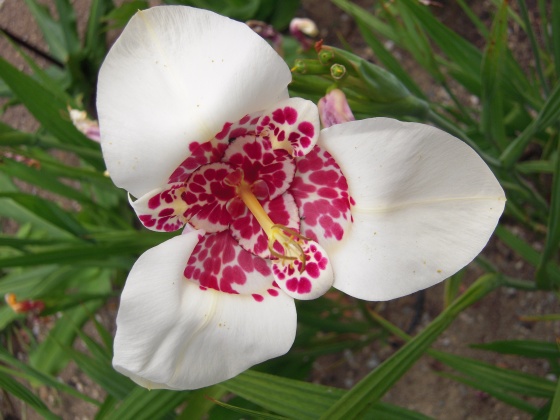
Perennial herbaceous, bulbous plants with simple or branching stems up to 70 cm tall. Leaves are sword-shaped, light green, evenly pleated. Flowers are very unusual, distinctive, solitary or 2-3 at the top of the scape. The perianth consists of six segments. The fruit is a capsule. Seeds are angular, compressed.
In cultivation:
Tigridia pavonia — Tigridia pavonia
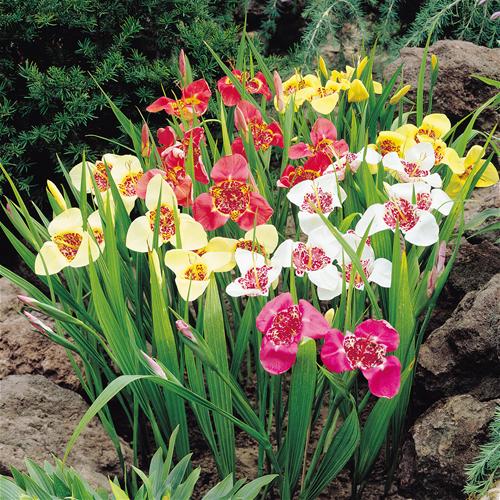
Perennial herbaceous plant. The corm is irregular in shape, up to 6 cm long and 3-4 cm in diameter, covered with dark brown dry membranous scales. The old corm is completely exhausted by the end of the growing season and is replaced by a cluster of new ones (usually corresponding to the number of scales of the mother corm) and several offsets.
Leaves are broadly sword-shaped, light green, pleated along their length. One mature corm produces 3—5 scapes, each with up to 5 buds. Flowers open sequentially. Flowers have six segments, 10–15 cm in diameter. The outer segments are large, uniformly violet-orange or bright red, the inner ones are smaller, yellowish-orange, spotted like the throat. There are garden forms in various colors. Blooms in July–August. A single flower lasts 8—10 hours; the overall flowering period is 15—25 days.
The fruit is an oblong many-seeded capsule with brown, large, flat seeds.
Used in group plantings and borders. Presents an original appearance near a pond or large stones.
Location: prefers a well-lit, warm site; tolerates light frosts. In a sunny spot protected from strong winds the stems develop sturdy and do not require staking.
Soil: prefers light, loose, fertile, well-drained, non-acid soils.
Care: similar to that for gladioli. Watering is needed on hot days. In winter the corms are dug up before frost.
Propagation: by seeds and corms. With vegetative propagation it produces up to 5 replacement corms per season.