
Deciduous shrubs
Thyme, or Wild Thyme
Thymus
Thyme, or Wild thyme (lat. Thymus) — a genus of subshrubs of the mint family (Lamiaceae), the leaves are used as a seasoning. The plant is highly aromatic, with a warm spicy scent, caused mainly by phenolic volatile aromatic compounds — thymol and carvacrol. The genus comprises about 400 species distributed in the temperate zones of Europe, Asia and North Africa.
'Thymus' is the Ancient Greek name of the plant, mentioned by Dioscorides and Theophrastus. It probably originates from ancient Egypt, where it was used ritually. The Russian name "bogorodskaya travka" ("Our Lady's herb") apparently refers to the plant's fragrance and pleasant smell.
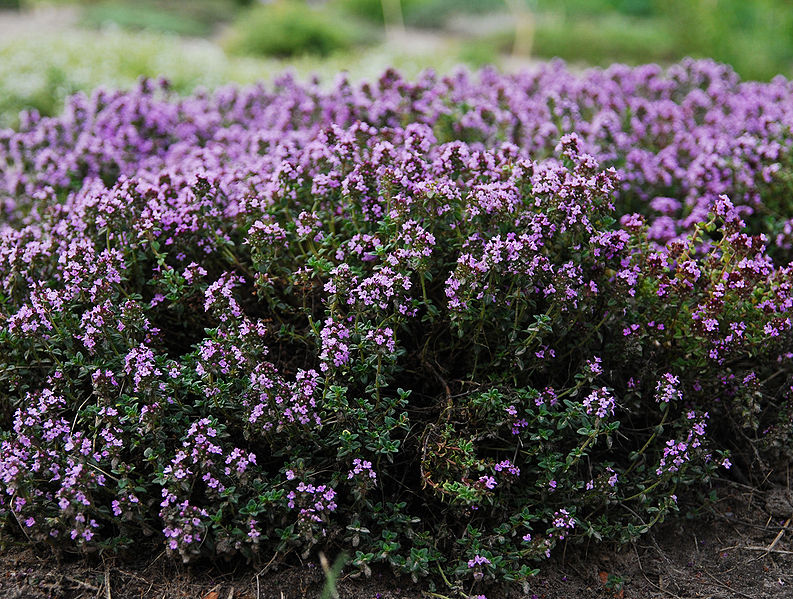
Perennial subshrubs up to 35 cm high with a woody prostrate or ascending stem and erect or rising herbaceous branches. Root a woody taproot. Stems woody at the base, prostrate on the soil, branched, covered with hairs bent downwards or erect. Leaves vary in size, venation and shape (from rounded or ovate to linear-elongated), stiff, almost leathery, shortly petiolate, more rarely sessile, entire or sometimes toothed (a constant trait in some Far Eastern species).
Flowers are small, lilac, pink or white, gathered in head-like or interrupted spike-like inflorescences. Fruits — capsules containing four black-brown ellipsoid or almost globular nutlets. Flowers from June to August. Fruits ripen in August-September.
In cultivation:
Common thyme - Thymus vulgaris
A perennial subshrub up to 30—40 cm high. Root a branched taproot. Stem erect or ascending, woody in the lower part, strongly branched. Branches herbaceous, four-angled, grayish-pubescent, with shortened lateral shoots. Leaves small (5—10 mm long), dark green, shortly petiolate, opposite, oblong-lanceolate, margins entire, turned downwards, dotted-glandular.
Flowers lilac-pink, sometimes white, small, bilabiate, gathered in whorls and half-whorls in the leaf axils. Flowers in June—July. The fruit consists of four nutlets enclosed in the persistent calyx. Nutlets small, almost rounded, grayish- or brownish-brown.
Creeping thyme, or Common wild thyme, or Our Lady's herb - Thymus serpyllum
A perennial subshrub up to 15 cm high, ending in a prostrate shoot; flowering stems erect or rising. Leaves elliptic or oblong-elliptic, 5—10 mm long, on a short petiole, with glands filled with essential oil.
Inflorescences head-like, compact. Calyx narrowly bell-shaped, about 4 mm long. Flowering stem shorter than the calyx. Corolla bright pinkish-lilac, 6—8 mm long. Fruit a small ellipsoid nutlet about 0.6 mm long. Flowers, depending on habitat, from late May to late August. Fruits ripen in July—September.
One of the best melliferous plants, producing exceptionally fragrant honey. Previously it was used as part of incense during religious services. Thyme is also used in perfumery.
Thyme has a pleasant strong aroma and a sharp, strongly spicy, bitter taste. It is a popular spice added to smoked meats, pork and lamb, to pâtés, mushrooms, cottage cheese, game and cheeses. In small amounts common thyme is added to fried fish, liver, offal and veal. The aerial part of the plant is used for beverage production until fruiting. Leaves and young shoots of thyme are used as a salad and for pickling cucumbers. They are used to scent sausages, vinegar, cocktails and tea. Both fresh and dried leaves are used for these purposes.
Lemon-scented thyme — Thymus x citriodorus
A natural hybrid T. pulegioides x T. vulgaris, widespread in southern France.
A perennial subshrub. Leaves small, ovate or rounded. Flowering shoots 15—30 cm high. Flowers pale pink. Flowers in June-July. In cultivation since 1596. Older specimens need occasional trimming to keep the shrubs dense and neat. The plant is sensitive to low temperatures and requires winter protection.
Location: prefer sunny sites. Plants tolerate partial shade and even shading, but in such conditions they become leggy and flower poorly.
Soil: plots with light, fertile, well-drained soil with alkaline or neutral pH.
Care: plants do not need fertilizing; at best a little ripe compost or horn meal can be added to the soil. If thyme bushes are pruned regularly, they will remain dense and compact. This is done in early spring or after flowering. Shorten shoots by about two-thirds — to the woody part. Watering is required only in dry spring and summer, when active growth of young shoots occurs and plants prepare to flower.
Propagation: by seeds, cuttings and division of the bush. The simplest method is division of the bush. For division the bush is dug up, the roots are disentangled and the plant is carefully divided into parts. Shoots that creep along the ground are removed throughout the growing season and planted immediately in their permanent place or separately for further growth.