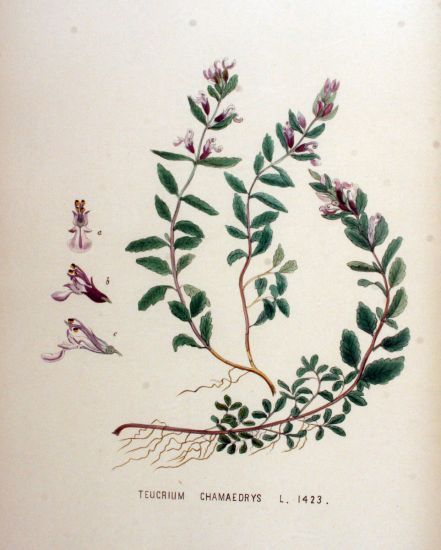
Flowers for the garden
Common germander or Wall germander
Teucrium chamaedrys
Common germander, or Wall germander (Latin: Teucrium chamaedrys) — a species of the genus Teucrium (Teucrium) of the mint family (Lamiaceae). Distributed in Eurasia and Africa.
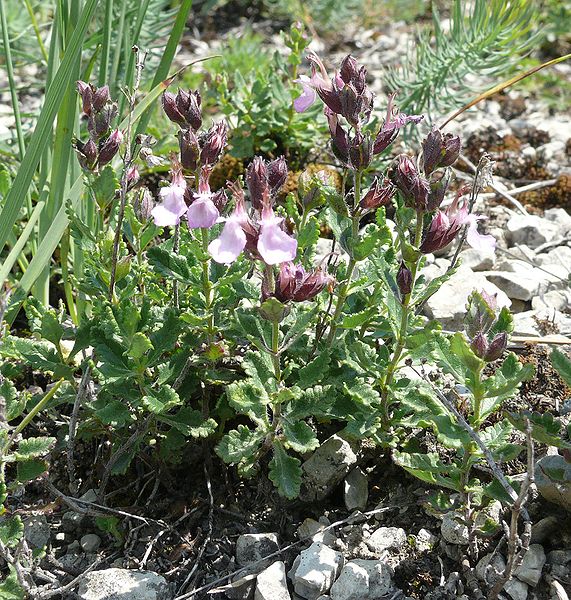
It occurs in Central and Southern Europe, in North Africa (Algeria, Tunisia, Morocco), in Asia Minor; additionally, it is found in the Russian part of the Caucasus, Armenia and Turkmenistan. It grows on rocky steppe slopes, forest edges, in shrub thickets and in light dry forests.
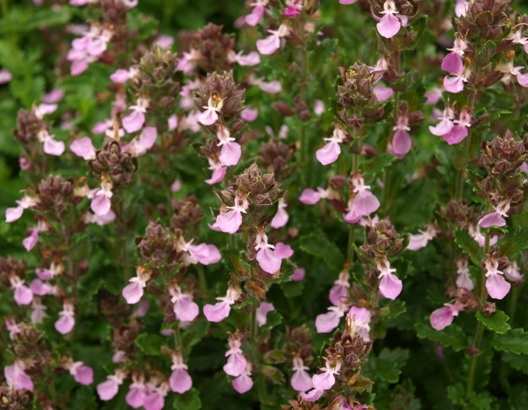
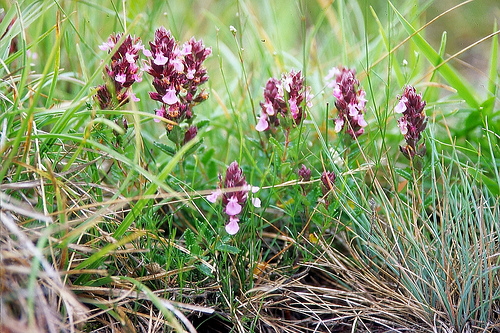
A perennial plant 10—100 cm tall, pubescent. Stem woody at the base, with ascending, often curved or winding reddish or pale green branches. Leaves numerous, ovate, less often elliptic or oblong, gradually narrowing into a petiole, with teeth or lobes numbering 4—9 on each side of the leaf. Bracts green, less often lilac.
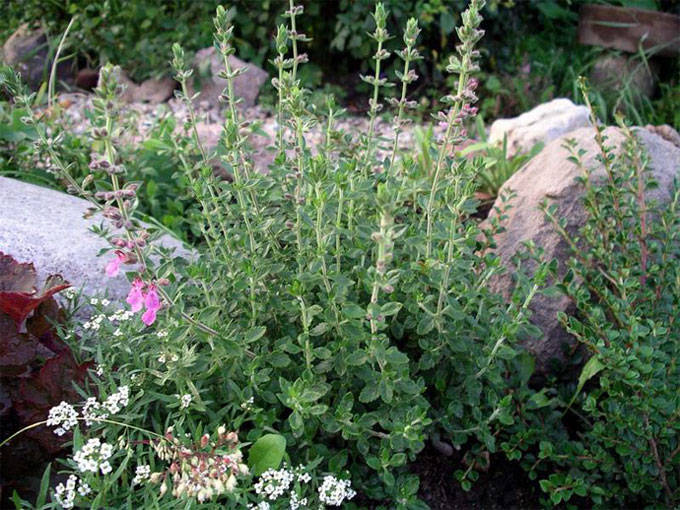
Flowers pink, 1—1.3 cm long, in spaced false whorls, gathered into racemose inflorescences. The calyx teeth are almost equal, set along the margin with dense short hairs mixed with long cilia. Corolla purple, 10—13 mm long. Fruit — a broadly elliptic brown nutlet. Flowers in July—August. Fruits ripen in August—September. Common germander is used as an ornamental plant, for edging borders and rock gardens.
Location: full sun or light partial shade. An open site is preferable; in shade the plant loses its decorative value.
Soil: undemanding. Grows well on both fertile substrates and ordinary garden soil.
Propagation: by dividing the roots in May or by shoots from June to September. Rooted shoots are planted in the rock garden in spring.