
Conifers
Canadian yew
Taxus canadensis Marshall
Synonyms: Canadian yew, Taxus baccata var. minor Michx. (1803), Taxus procumbens Lodd. ex Loudon (1836), Taxus baccata var. procumbens Loudon (1842), Taxus baccata var. adpressa Carrière (1855), Taxus baccata var. canadensis (Marshall) A.Gray (1856), Taxus minor (Michx.) Britton (1893), Taxus baccata subsp. canadensis (Marshall) Pilg. (1903).
Canadian yew (Taxus canadensis Marshall) – a species of evergreen coniferous shrubs in the genus Taxus, family Taxaceae. It was first described by the "father of American dendrology" Humphry Marshall in "Arbustrum Americanum 151" in 1785. In cultivation since 1809.
In nature it occurs in the eastern regions of North America (Connecticut, Illinois, Indiana, Iowa, Kentucky, Maine, Massachusetts, Michigan, Minnesota, New Hampshire, New York, Ohio, Pennsylvania, Rhode Island, Tennessee, Vermont, Virginia, West Virginia, Wisconsin), in Canada (Saint Pierre and Miquelon; New Brunswick, Newfoundland, Nova Scotia, Ontario, Prince Edward Island, Quebec). It grows as an understory plant in deciduous, mixed, and coniferous forests, in bogs, ravines, gullies, on slopes and on rocky banks of rivers or lakes. Grows at altitudes of 0-1500 m above sea level. Associates with Tsuga canadensis, Picea mariana and Thuja occidentalis.
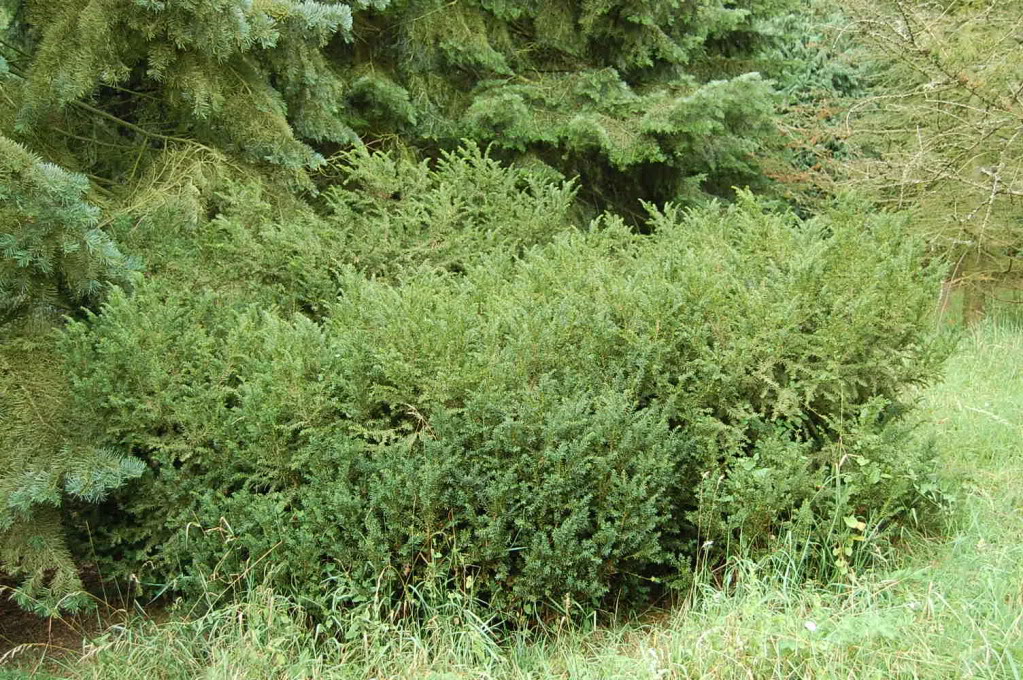
It is a monoecious low spreading shrub or small tree 1-2 m high. Grows slowly, annual increment about 10 cm. At 15 years it reaches 1.3 m in height and 1.5 m in diameter. Crown open, low, spreading. Branches prostrate, long, ascending or sprawling, loose. Shoots ascending, short, densely leaved. Bark brownish, thin, peeling. Buds yellowish-green, with keeled sharp scales.
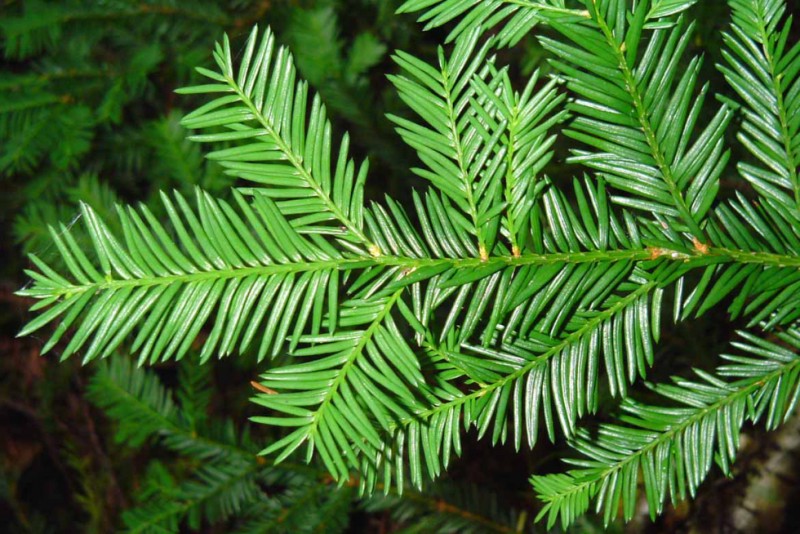
Foliage 1-2.5 cm long and 2 mm wide, yellowish-green above, light green beneath, flat, slightly falcate, abruptly shortly acuminate, with a scarcely prominent midrib, beneath with pale green stomatal bands, on short petioles. At the base the leaves are longer than at the tips. In winter they take on a reddish tint.
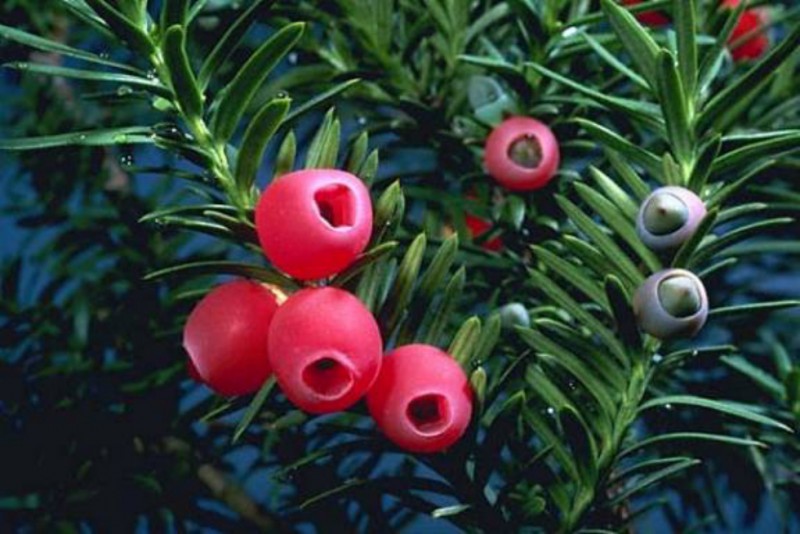
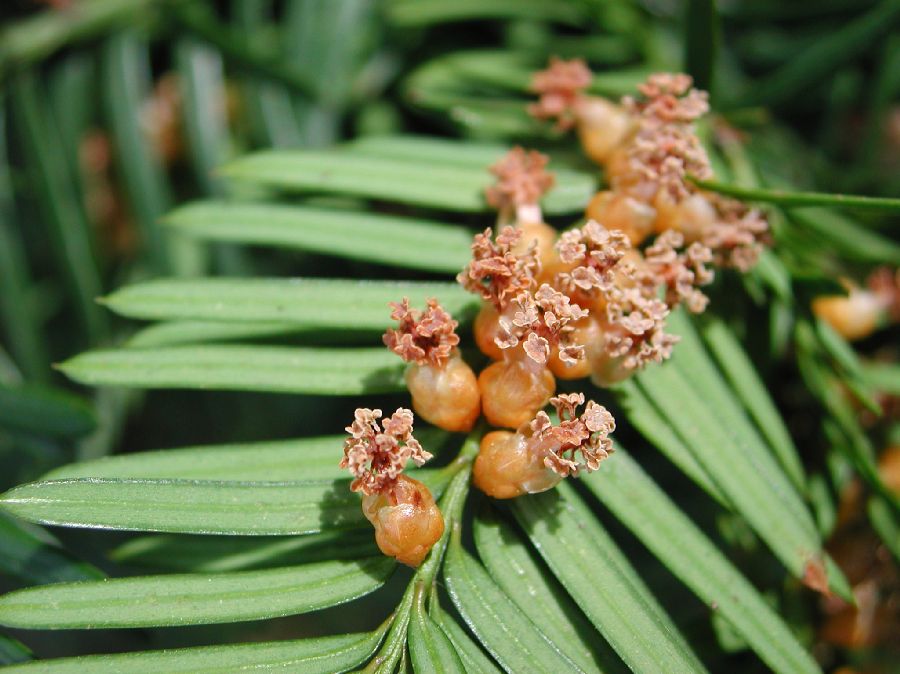
Flowers in March. Fruits edible, fleshy, globose, berry-like, tasting reminiscent of molasses, bright red. Seeds ripen in August-September.
All parts except the aril are poisonous, as they contain the alkaloid taxine, which is very dangerous to humans.
Varieties:
- Taxus canadensis Marshall var. adpressa (Carrière) Spjut
- Taxus canadensis Marshall var. minor (Michx.) Spjut
- Taxus canadensis var. floridana
Cultivars: "Golden" (Aurea), "Pyramidal" (Pyramidalis).
Hardiness zone: 4b (-35°C)
Site: shade-tolerant, requires locations protected from sun and wind. Tolerates partial shade; in shade it is more cold-hardy and better colored. Demanding with respect to air and soil moisture. Drought-resistant, undemanding, but does not tolerate stagnant overwatering. Resistant to air pollution and smoke.
Soil: Grows on any garden soil, on calcareous and on acidic soils; not demanding for fertility, but more decorative on neutral or acidic fertile soil with good drainage.
Planting: soil mixture – turf soil, peat and sand in proportions 3:2:2. Tolerates transplantation well, even in mature age. Optimal spacing between plants 0.6-2.5 m, for large specimens 3-4 m. Dig the planting hole to a depth of 70 cm, root collar at ground level. For hedges dig trenches 50 cm deep and wide.
Care: in hot and dry summers, to maintain decorative appearance it is recommended to water the plant 1-2 times a month at a rate of 11-12 L per plant and to perform overhead irrigation once every 2 weeks. In the first years after planting it is recommended to loosen the soil to a depth of 10-15 cm. Young plants are recommended to be covered for the winter with a layer of peat 5-7 cm thick and protected from sunscald with conifer branches.
Pruning: characterized by a high ability to produce shoots. Tolerates trimming and heavy pruning with removal of ½ of the shoot when forming hedges or the crown.
Diseases: fungus Phomopsis juniperovora, Phytophthora cinnamomi
Pests: yew gall midge, yew false scale, Parthenolecanium pomeranicum, Cecidophyopsis psilaspis, vine weevils (Otiorhynchus singularis).
Propagation: produces abundant suckers. Propagated by seeds; ornamental cultivars and forms by cuttings, grafting or layering. Seeds retain viability for up to 4 years. After harvest they are stored in a dry room at 5-6 °C, but it is recommended to sow them in autumn immediately after collection. First seedlings appear after 1-2 years. For spring sowing stratification for 7 months is recommended. Cuttings root very well. Cuttings from upward-growing shoots produce compact and vertical-growing bushes; cuttings from horizontal twigs form low spreading shrubs.
Uses: widely used in ornamental groupings or as solitary plantings, for decorating formal lawns, creating borders, hedges, rockeries and heather gardens, for decorating the lower layer under tree canopies, as well as for creating green sculptures. Can be grown in bonsai style.