
Conifers
Yew
Taxus
Synonyms: Verataxus J.Nelson
Yew (Taxus L.) – a genus of evergreen coniferous trees of the family Taxaceae. The genus was first described by Carl Linnaeus in his «Species Plantarum» 2: 1040 in 1753. In cultivation since the mid-19th century.
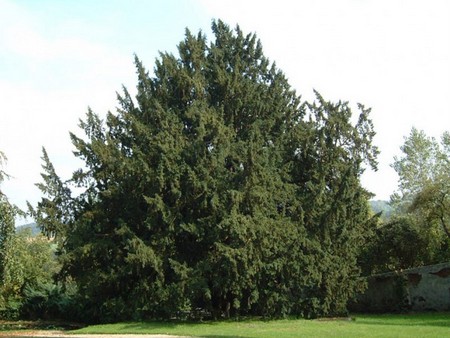
Occurs in North America, Western Europe, North Africa, East and Southeast Asia, and the Far East.
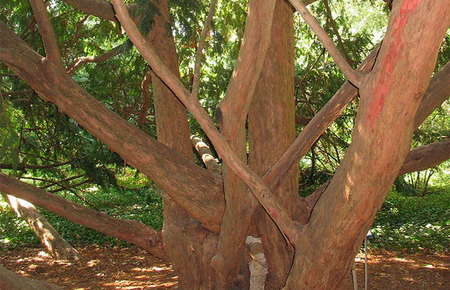
They are evergreen, usually dioecious, less often monoecious trees or large shrubs 1–10 m in height; trunk diameter may reach 4 m. Grows slowly, can live up to 3000 years. Crown is densely branched, variable in shape, broad. Bark on young shoots smooth, later becoming deeply longitudinally furrowed, peeling in thin flakes, reddish or reddish-brown in color.
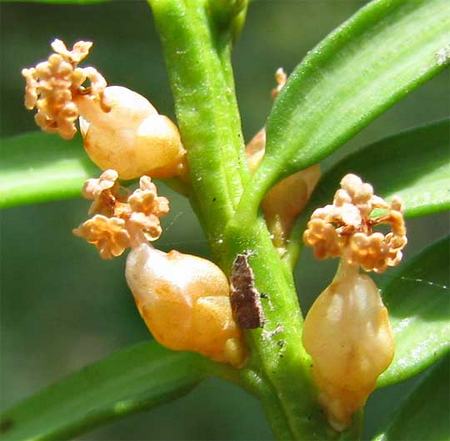 | 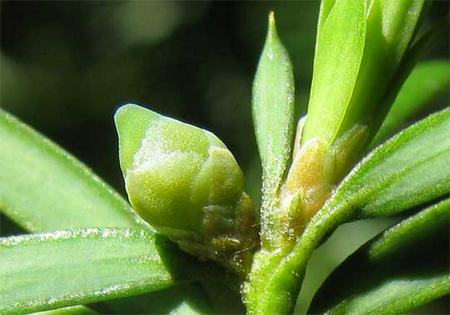 |
| Megastrobili | Microstrobili |
Needles are nearly perfectly spiral, more or less two-ranked, linear, narrow, flat, often almost awl-shaped, on short petioles, glossy, densely green, with a deep longitudinal groove on the upper surface; the midrib is noticeably raised, and two yellow-green or grayish stomatal bands are located on the underside.
Microstrobili are almost spherical, small, located in the leaf axils at the tips of short shoots, on short stalks which are covered with very small scales. Pollination occurs from late April to early May.
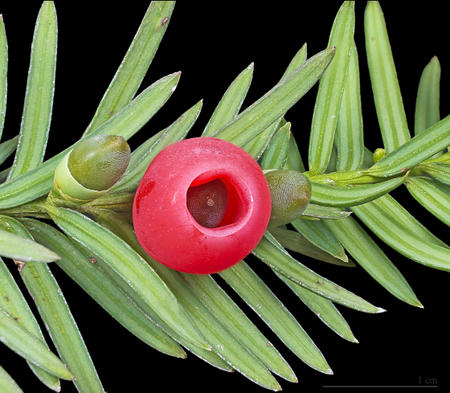
Seeds up to 0.8 cm long, ovoid-elliptic, dense, nut-like. When ripe they are surrounded by a fleshy, brightly red or orange aril of a cup-like shape, enclosing the seed from the apex to about the middle but not fused with it. Seeds mature in August–September of the same year and persist on the shrubs until late autumn.
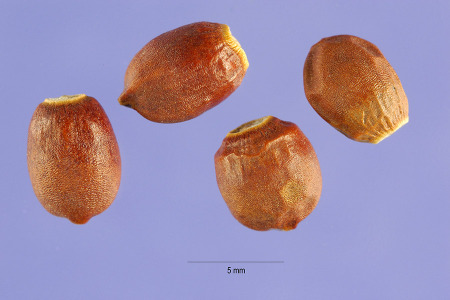
All parts of the plant are poisonous, except for the aril.
Species:
- Taxus baccata L.— European yew (common yew)
- Taxus brevifolia Nutt.— short-leaved yew (Pacific yew)
- Taxus canadensis Marshall — Canadian yew
- Taxus chinensis (Pilg.) Rehder — Chinese yew
- Taxus contorta Griff.— Himalayan yew
- Taxus cuspidata Siebold & Zucc.— pointed yew (Far Eastern yew)
- Taxus floridana Nutt. ex Chapm.— Florida yew
- Taxus florinii Spjut
- Taxus globosa Schltdl. — globose yew (Mexican yew)
- Taxus mairei (Lemée & H.Lév.) S.Y.Hu— Maire's yew
- Taxus wallichiana Zucc.— Wallich's yew
Hardiness zone: 5b (-26°C)
Site: Shade-loving, needs places protected from sun and wind. Tolerates partial shade; in shade it is more frost-hardy and better colored. Demanding of air and soil moisture. Drought-resistant, undemanding and hardy, but does not tolerate stagnant waterlogging.
Soil: Grows on any garden soil, both calcareous and acidic; not demanding to fertility, but more ornamental on neutral, fertile soil with good drainage.
Planting: soil mix – topsoil, peat and sand in proportions 3:2:2. Tolerates transplanting well, even at an adult age.
Care: In hot, dry summers, to maintain ornamental appearance it is recommended to water the plant 1–2 times per month at a rate of 1–2 buckets per plant and to use frequent overhead watering. In the first years after planting it is recommended to cultivate (loosen) the soil to a depth of 10–15 cm. Young trees should be covered for the winter with a 5–7 cm layer of peat and protected from sunscald with conifer boughs.
Pruning: notable for its strong shoot-forming ability. Easily endures trimming and severe pruning, including removal of half of a shoot when forming hedges or crowns.
Diseases: fungus Phomopsis juniperovora, Phytophthora cinnamomi
Pests: yew gall midge, yew false scale, Parthenolecanium pomeranicum, Cecidophyopsis psilaspis, vine weevils (Otiorhynchus singularis).
Propagation: produces abundant suckers. Propagated by seeds; ornamental cultivars and forms by cuttings, grafting or layering. Seeds retain viability for up to 4 years. After harvesting they are stored in a dry place at 5–6 °C, but it is recommended to sow them in autumn immediately after collection. First seedlings appear in 1–2 years. For spring sowing stratification for 7 months is recommended. Cuttings root very well.
Uses: widely used in ornamental groups or as solitary specimens, for decorating parterre lawns, creating borders, hedges, rock gardens and heather gardens, for decorating the lower layer under the tree canopy, and also for creating green sculptures.