Flowers for the garden
Tagetes or Marigolds
Tagetes
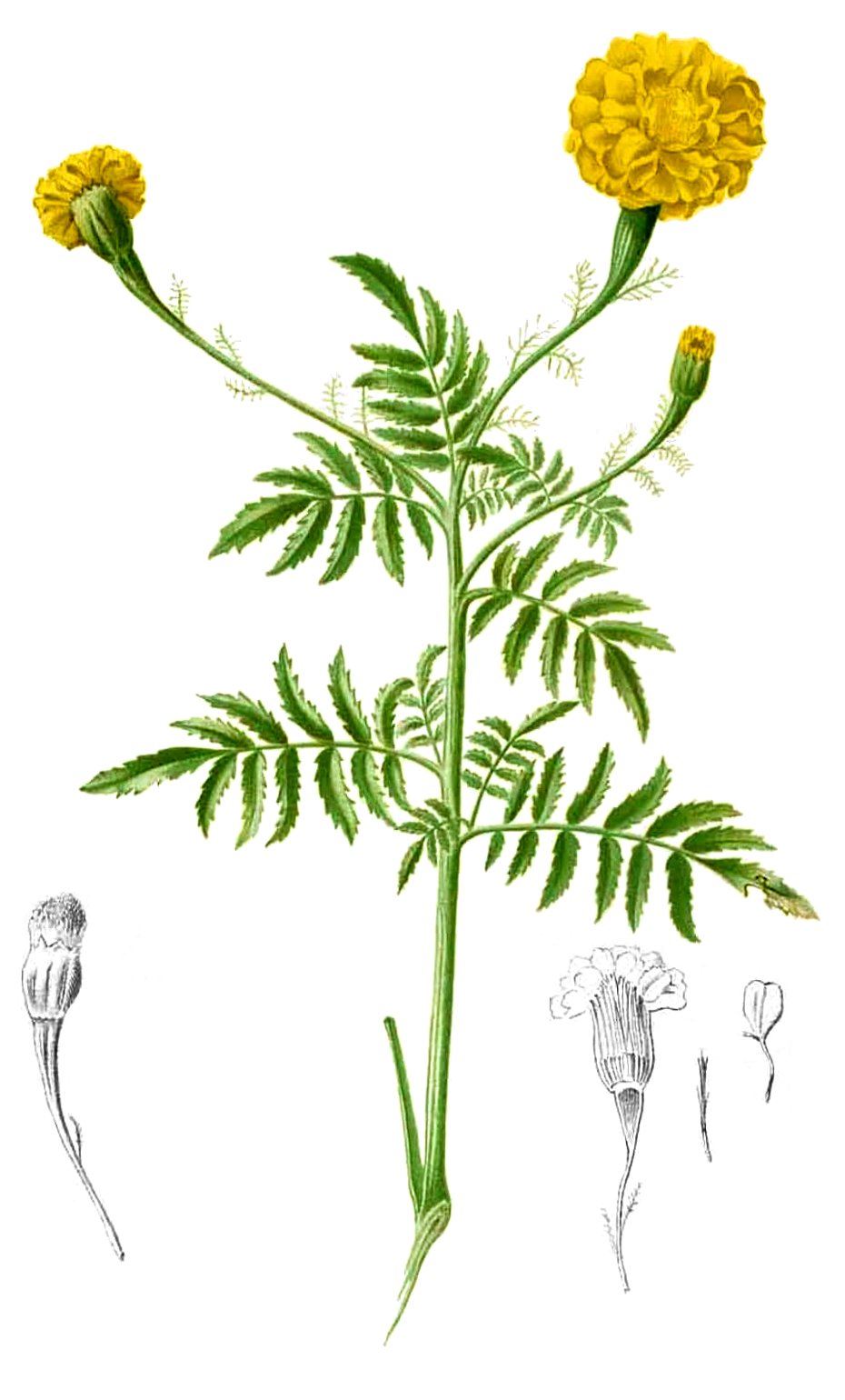
Tagetes or Marigolds (Tagetes) — a genus of annual and perennial plants in the family Asteraceae, or Compositae. The name comes from the name of the grandson of the god Jupiter — Tages (Tages), famed for his beauty and his ability to predict the future. The native range is the Americas, where they grow wild from New Mexico and Arizona to Argentina.
More than 50 species are known, annual and perennial herbaceous plants. Stems erect, sturdy, forming compact or spreading bushes 20 to 120 cm tall, with a strong, distinctive scent.
Leaves pinnately divided or pinnately parted, rarely entire, toothed, from light to dark green, arranged oppositely or alternately. Inflorescences are capitula (flower heads), very bright, yellow, orange, reddish-brown, brown or variegated, solitary or gathered into compound inflorescences. Ray florets are ligulate, with broad, horizontally spreading corollas; disc florets are tubular and bisexual. They bloom abundantly from June until the first frosts. Fruit — an achene. Seeds remain viable for 3-4 years. They self-seed abundantly.
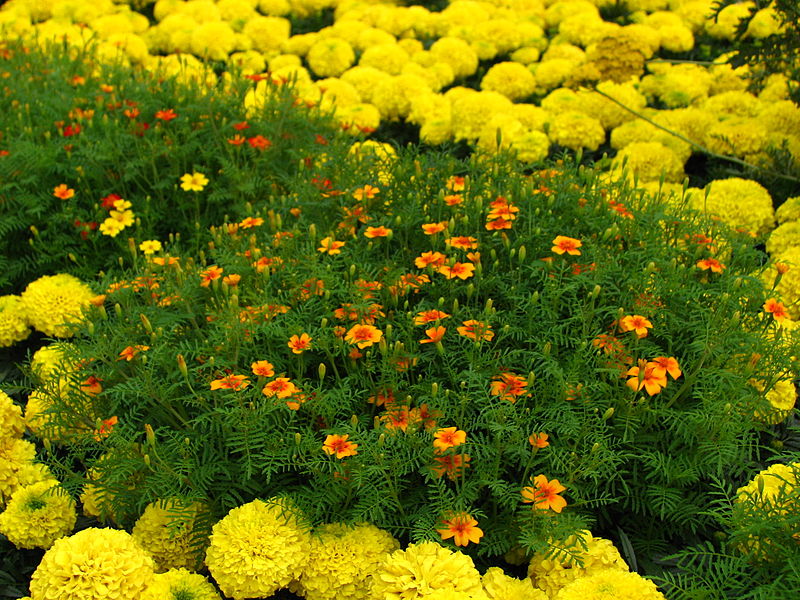
In ornamental horticulture, numerous hybrid cultivars of the species listed below are usually used. One of the main varietal characteristics of marigolds is the structure of the inflorescences. There are carnation-flowered and chrysanthemum-like types; double, semi-double and single forms.
Tagetes patula, or French marigolds (Tagetes patula L.)
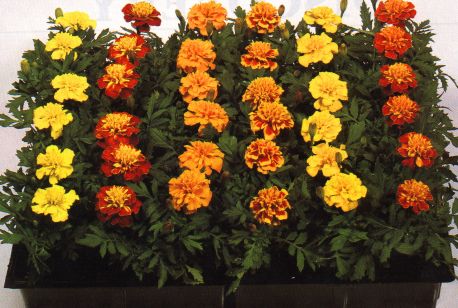
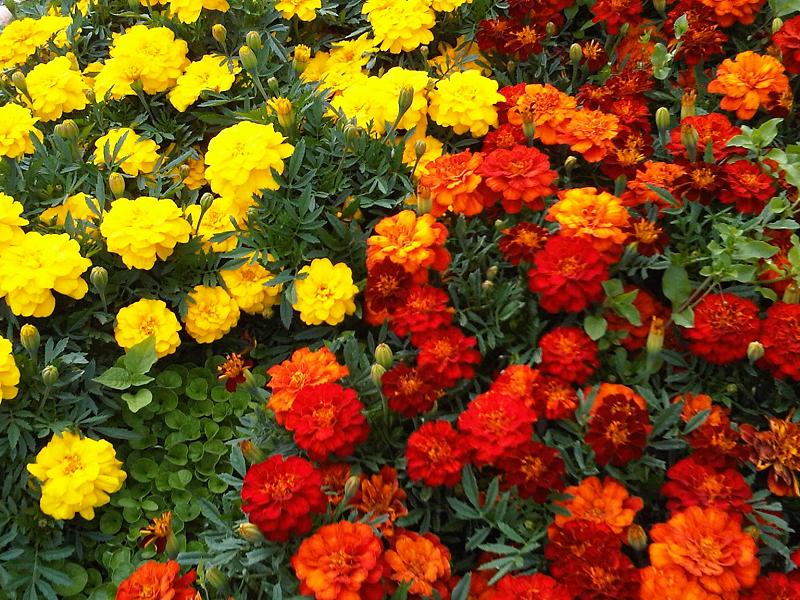
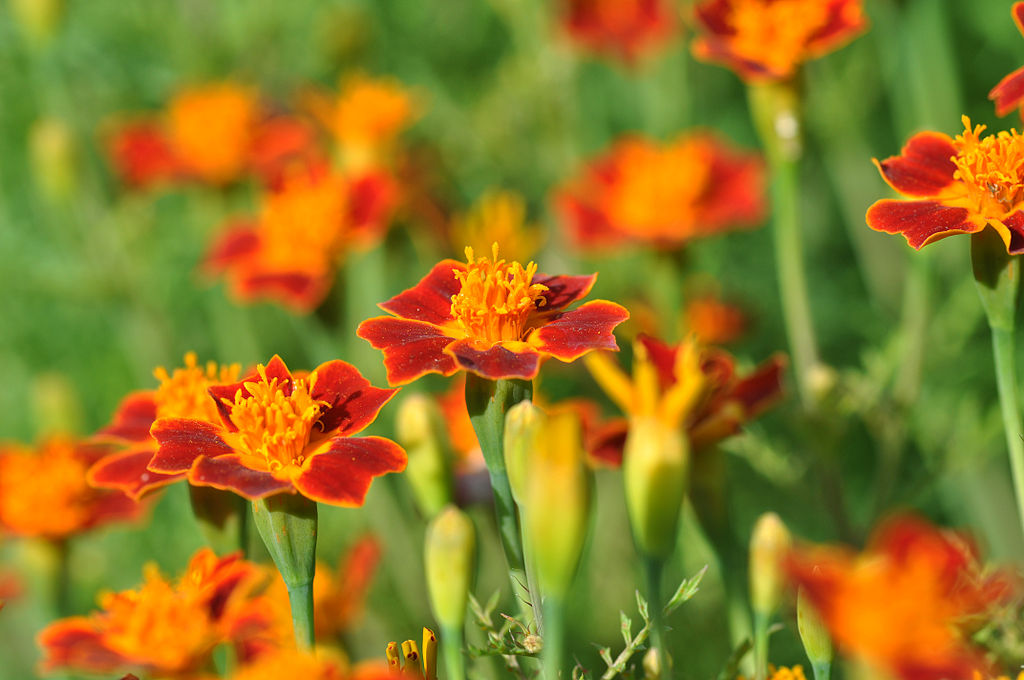
Annual plant. Stems erect, 15-50 cm tall, very branched from the base, lateral shoots spreading. Leaves small, pinnately divided, with linear-lanceolate segments, dark green, arranged alternately or oppositely. Inflorescences — capitula 4-6 cm in diameter, solitary or in corymbiform clusters, cup-shaped, variable in form, on long peduncles. Involucre single-row, of 5-7 fused bracts, pointed at the tip. Ray florets yellow, orange, lemon, brownish-brown or dark red, velvety, often bicolored, with various proportions of the mentioned shades; disc florets yellow or orange. In cultivation since the early 16th century.
For practical purposes, the many cultivars of this species are divided into groups: tall — up to 60 cm and more, with simple flowers; medium — up to 50 cm, with double flowers; low — 25-40 cm with simple or double flowers; very low ('dwarf') — 15-20 cm, with simple or double flowers. The most common cultivars include:
'Carmen' ('Carmen') —
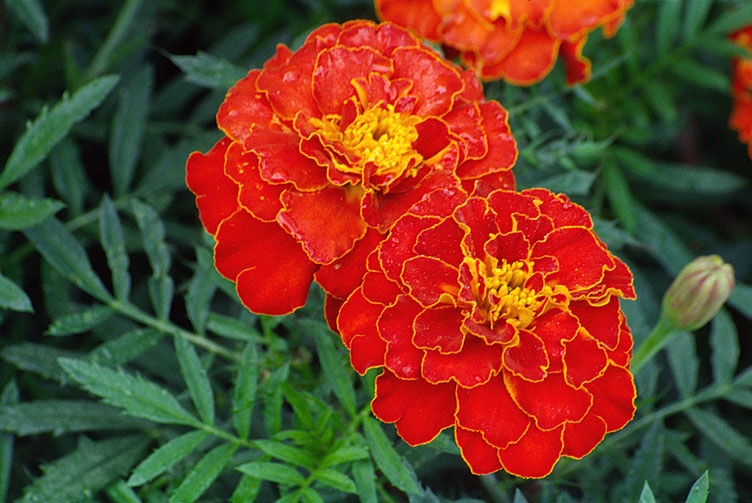
Bushes spreading, 20-30 cm tall, very branching. Shoots sturdy, green with a reddish-brown bloom, ribbed. Leaves medium-sized, green. Inflorescences double, 4-7 cm in diameter. Ray florets arranged in 1-2 rows, reddish-brown, velvety. Disc florets golden-yellow. Early cultivar. Blooms from early June until the first frosts. Good for cutting.
'Bonanza Bolero' ('Bonanza Bolero') —
Bushes spreading, 25-40 cm tall, densely leafy. Shoots sturdy, green with a reddish bloom. Leaves medium-sized, dark green. Inflorescences double, 4-7 cm in diameter, yellow with reddish-brown spots, velvety. Early cultivar. Blooms from early June until the first frosts. Good for cutting. Recommended for beds, borders, pot culture and balcony decoration.
'Queen Sophia' ('Queen Sophia') —
Inflorescences moderately double, bicolored: red with a bronze-orange margin, slightly fade in the sun, acquiring a brownish tint, 7 cm in diameter.
'Legion of Honour' ('Legion of Honour') —
Bushes compact, 20-30 cm tall, almost spherical, very branching, densely leafy. Shoots sturdy, thick, with dark red ribs. Leaves medium-sized, dark green. Inflorescences simple, 3-6 cm in diameter, yellow with brown spots at the base. Early cultivar. Blooms from early June until the first frosts. Recommended for beds, borders, balcony decoration and vases.
'Orangeflamme' ('Orangeflamme') —
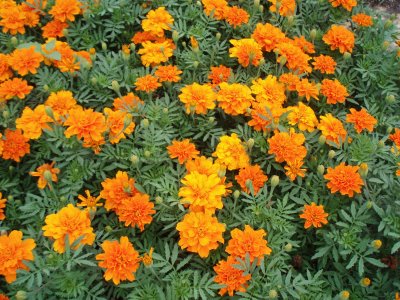
Bushes up to 20-30 cm tall, compact, densely leafy. Shoots sturdy, green with reddish stripes. Leaves dark green with small narrowly lanceolate segments. Inflorescences chrysanthemum-like, double, 3.5-4.5 cm in diameter, consisting of broadly funnel-shaped bright orange tubular florets with red streaks and one row of ligulate, turned-down, reddish-brown, velvety ray florets with a yellow spot at the base and a yellow margin. Early cultivar. Blooms from early June until the first frosts.
and others.
Tagetes erecta, or African marigolds (Tagetes erecta L.)
Annual plant, bush compact or spreading with a clearly expressed main shoot. Stems very branched, 80-120 cm tall, glabrous, erect, finely ribbed, woody at the base, lateral shoots directed upwards, forming bushes of inverted-pyramid shape. Leaves pinnately parted with lanceolate, acute segments, serrate at the margin, from light to dark green, arranged alternately. Inflorescences — large capitula 6-13 cm in diameter, solitary, single, semi-double or double, on long peduncles. Blooms from late June — early July. Flower color is usually uniform: pale yellow, yellow, bright yellow, orange or bicolored.
Cultivars are distinguished by height: giant — over 90 cm; tall — 60-90 cm; medium — 45-60 cm; low — up to 45 cm tall.
'Antigua' ('Antigua') —
Only 20 cm tall, yet forms many flower heads up to 10 cm in diameter of bright yellow or orange color.
'Gold Dollar' ('Gold Dollar') —
Bushes compact, 90-120 cm tall. Shoots sturdy, ribbed, thick, light green. Leaves large, dark green. Inflorescences carnation-flowered, almost spherical, densely double, 7-8 cm in diameter, red-orange, without fragrance. Early cultivar, blooms from early June until the first frosts. Recommended for tall groups and cutting.
'Sweet Cream' ('Sweet Cream') —
Bushes compact, 60-75 cm tall. Shoots sturdy, ribbed, light green with a reddish bloom. Leaves large, dark green. Inflorescences carnation-flowered, hemispherical, double, 8-10 cm in diameter, cream or white. Blooms from late June until the first frosts.
and others.
Tagetes tenuifolia, or Mexican marigolds (Tagetes tenuifolia Cm.)
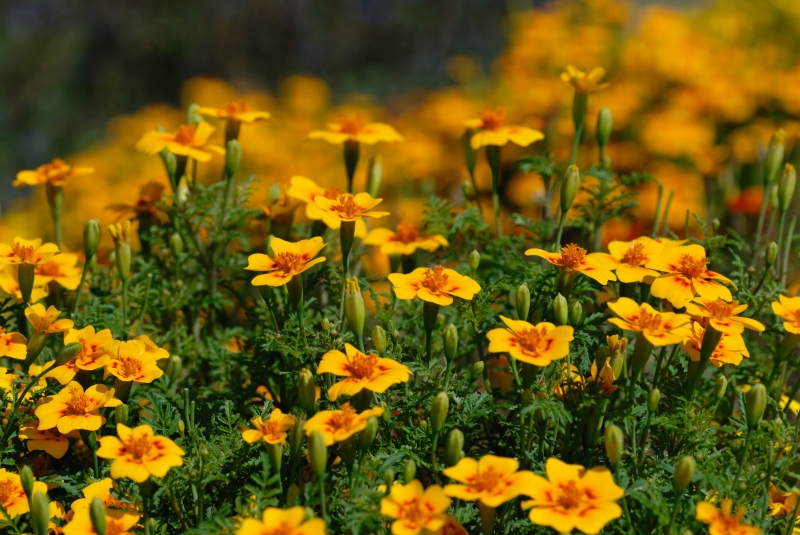
Plants annual, low, compact, 20-40 cm tall, densely branched, with erect, glabrous, sturdy or fragile light green shoots. Leaves small, twice pinnately divided, with narrow, sparsely toothed segments, light green with dotted glands, arranged alternately. Inflorescences — small capitula, 1.5-3 cm in diameter, single, on short peduncles, gathered into corymbiform clusters. Flower color yellow, yellow-orange, red. Involucre single-row, of five fused bracts, acute at the tip. Blooms very abundantly. In cultivation since 1795. Over 70 complex hybrid cultivars are known. Used for borders, beds, edging, masses and pots.
Marigolds are undemanding, fast-growing, light- and heat-loving, drought-resistant plants. The optimal temperature for the growth of young plants is 18-20 °C. At temperatures below 10 °C leaves may develop an anthocyanin tint and growth slows. At -1...-2 °C plants perish.
Location: they do not require intense sunlight, although maximum ornamental effect is achieved in sunny spots. This especially applies to thin-leaved marigolds. They do not tolerate spring and autumn frosts well.
Soil: require fertile, well-moistened soils in the first half of summer.
Care: considered drought-tolerant, but during early growth they need watering, otherwise plants will be spindly and flower heads small. Excess moisture in the soil is unfavorable for marigolds, especially erect types. In rainy weather their large flower heads often rot. If the soil is waterlogged, plants may die from root fungal diseases. Spring fertilization leads to vigorous vegetative growth and delays flowering.
Diseases and pests: flower heads often rot during prolonged rains. In dry hot conditions marigolds can be attacked by spider mites. To get rid of them, first increase air humidity by spraying seedlings several times a day with water. For complete eradication use 2-3 treatments with infusions of onion, hot red pepper or yarrow.
Propagation: by seed. Marigolds can be sown outdoors in late May — early June. Seedlings emerge 5-10 days after sowing. It is desirable to cover the soil with nonwoven material (acrylic, lutrasil). In that case sowing can be done one to one and a half weeks earlier than usual, thus accelerating flowering.
When growing seedlings earlier than others, in mid-March sow erect marigolds. Spreading and thin-leaved marigolds are sown in early April. If these dates are observed, flowering of all three species will begin in June. It is not difficult to grow marigold seedlings indoors on a bright windowsill, and even better in small greenhouse films, where the plants will be the strongest. To obtain healthy seedlings you need loose, fertile soil (1 part humus + 1 part peat + 1 part sod soil + 0.5 part sand), a stable temperature of 18-22 °C and moderate watering. Spreading marigolds are less demanding regarding soil and temperature. Although marigold seedlings are considered undemanding, it is better to use fresh soil for sowing, especially for thin-leaved marigolds, which are more susceptible to damping-off than other species.

Seedlings can be grown in a box, tray or pot. Drainage (crushed stone, expanded clay, coarse sand) 3 cm thick should be placed at the bottom or holes made. Otherwise plants may die from fungal diseases. Initially place 2/3 of the soil on the drainage and compact this layer by hand or tamper. The next layer should be loose so that emerging roots have sufficient air. The soil should not reach the edge of the container by 1-2 cm. The prepared soil is well watered and left for one to two days in a warm place so that it can "breathe."
Marigold seeds are large, so they can be carefully placed in grooves at a distance of 1-1.5 cm. The distance between the grooves is 1.5-2 cm. Dense seedlings suffer more from lack of light and become leggy. They may even contract damping-off.
The easiest way to obtain the optimal density is to sow pre-germinated seeds. For germination, place them on a moist cloth on a saucer and, putting them in a polyethylene bag, place in a warm spot. After 2-3 days seeds will begin to germinate. The sprouted seeds are covered with 0.5-1 cm of soil. Seeds covered too lightly may die from drying out. If seeds are sown too deeply they may not germinate at all, especially thin-leaved marigolds. After sowing, water the surface layer gently and then cover with paper. Place the containers in a warm place (22-25 °C) and monitor soil moisture closely. Seedlings will appear in 3-7 days and containers should be moved to a bright place with a lower temperature (18-20 °C).
If the seedlings are still too dense, they should be pricked out. Seedlings are carefully removed from well-watered soil and planted into holes, buried up to the cotyledons. This will encourage formation of new roots. Good seedlings at the time of planting have 2-3 pairs of leaves and a strong root system. Seedlings are planted outdoors in late May — early June. Plants are planted 1-2 cm deeper than they grew before. Spacing depends on species and cultivar. Tall hybrids and cultivars of erect marigolds are planted at 40 x 40 cm, medium cultivars and F1 hybrids 30 x 30 cm and low cultivars and hybrids of all types 20 x 20 cm. Transplanting is easily tolerated at any age, even when flowering.
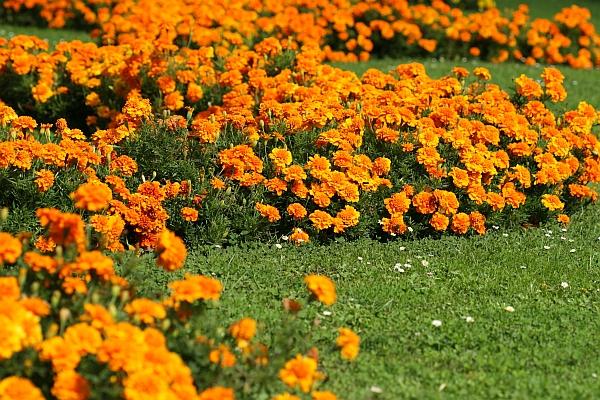
Uses: extracts from marigold roots reduce infection of other plants by fungal diseases, especially fusarium, and protect against some species of nematodes. Erect marigolds can be grown for cutting. In water they last about three weeks. Marigolds are used in all types of flower beds. They are not suitable only for ponds and shady gardens. Marigolds tolerate harsh conditions of small soil volumes. For this reason they also grow well in pots on windowsills and can be used to decorate interiors, just like primroses or cinerarias. Marigolds can be planted into a pot or window box in autumn before frosts. In some cases they survive the winter and form a large flowering bush in spring (this applies only to spreading marigolds).