
Indoor plants
Strobilanthes
Strobilanthes
The genus name comes from the Greek strobil - cone and anthos - flower: referring to the shape of the inflorescence. About 250 species occur in the tropics of Asia and on the island of Madagascar; one species is found in the Americas.
The genus includes about 250 evergreen and deciduous perennials or shrubs from the forest regions of Asia and Madagascar. The plant is undemanding and shade-tolerant, but good light is required for vivid leaf coloration. A very beautiful, striking plant that is easy to grow indoors because of its hardiness. It is cultivated for its brightly colored pinkish-lilac elongated-oval leaves.
Strobilanthes dyerianus Mast.
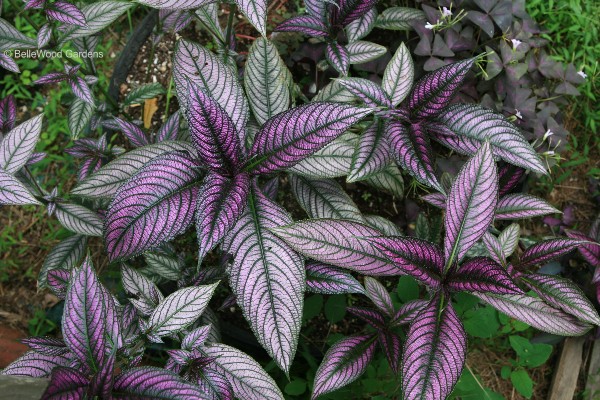
An evergreen, bushy plant up to 1 m tall with erect, partially woody-based, pubescent shoots. Leaves opposite, sessile, large, up to 30 cm long and 9–10 cm wide, oval or oblong, long-acuminate at the tip, finely serrate at the margin, bristly-pubescent; young leaves are silvery-violet with a metallic sheen, with dark green veins and margins, and violet-purple beneath. With age the leaves lose their bright violet coloration. Flowers are arranged in axillary spike-like inflorescences. The calyx is 5-lobed with linear, blunt lobes. The corolla is pale violet, 5-lobed, with an inflated tube and short broad lobes. Native to Burma.
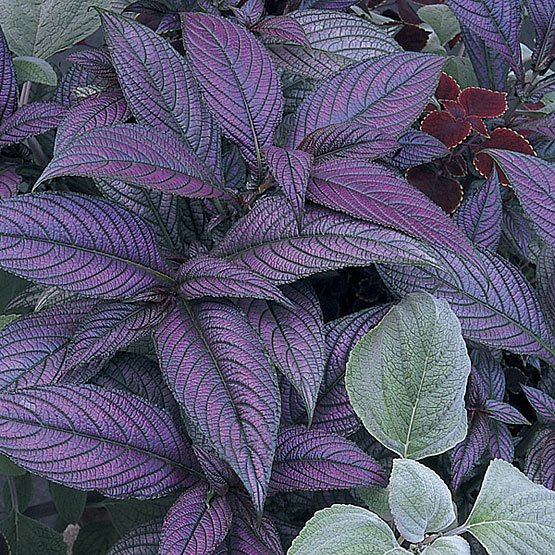
Location: The plant is undemanding and shade-tolerant, but good light is required for bright leaf coloration. In winter keep at 16-18 °C.
Lighting: Bright, diffused light.
Watering: Moderate from spring to autumn; reduced in winter.
Humidity: Moderate. Requires frequent spraying of the leaves.
Care: Most decorative in its young state, therefore requires frequent rejuvenation and pruning.
Propagation: By stem cuttings in spring or summer.
Repotting: As needed in spring into a light, fertile soil.