
Indoor plants
Stephanotis
Stephanotis
Stephanotis (Stephanotis Thouar) – a genus of evergreen semi-shrubby vines in the Apocynaceae family. It was first described in 1806 by the French botanist Louis-Marie Aubert du Petit-Thouars. The name derives from the Greek words "stephanos" – crown and "otos" – ear, named for the resemblance of the flowers to a crown of five petals rolled like an ear on the staminal tube.
In the wild it is found in China, Japan, on Madagascar and in Malaysia. It grows in tropical moist forests.
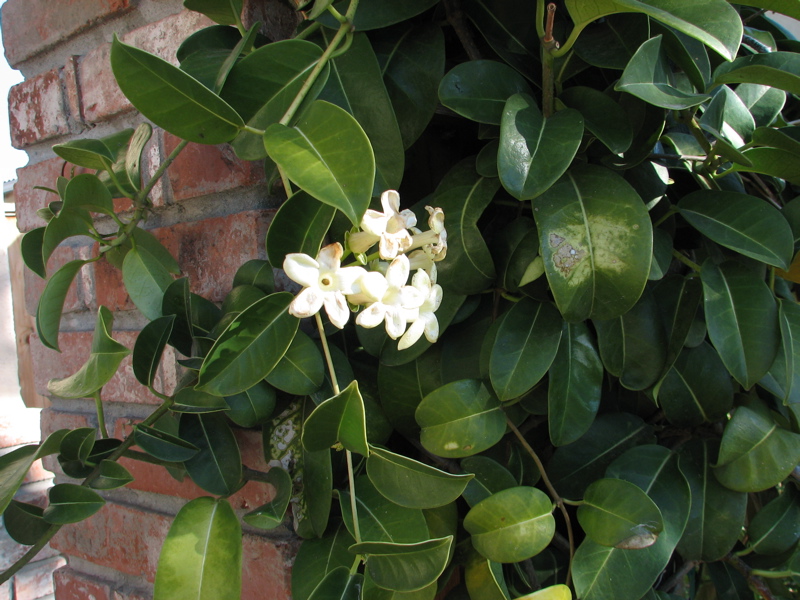
An evergreen vine up to 5 m in length. Leaves leathery, oval, opposite, dark green, 7-9 cm long and 4-5 cm wide, with entire margins, rounded at the base and pointed at the tip.
Flowers fragrant, white, creamy, yellowish or lilac, waxy, funnel-shaped, borne in clusters of 7. In nature flowering lasts up to 10 months.
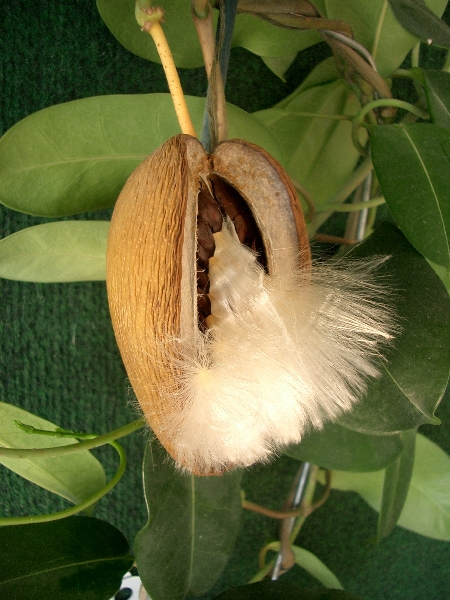
The fruits of Stephanotis are large ellipsoid pods that split open after ripening. Seeds resemble those of dandelions.
The sap of Stephanotis is poisonous.
Species:
- Stephanotis acuminata Brongn.
- Stephanotis grandiflora Decne.
- Stephanotis japonica Makino
- Stephanotis longiflora A.Rich.
- Stephanotis lutchuensis Koidz.
- Stephanotis parviflora Ridl.
- Stephanotis suaveolens (Blume) Benth. & Hook. f. ex K. Schum.
- Stephanotis thouarsii Brongn
- Stephanotis vinciflora Griseb.
Hardiness zone: 11 (5°C)
Light: preferably keep on an east- or west-facing window; hot midday sun can scorch the leaves. In addition, a long photoperiod is required, so during the autumn-winter period supplemental lighting should be provided during dark hours. Stephanotis must not be moved or turned while buds are forming or during flowering.
Temperature: in summer indoor temperature should not exceed +25°C; in winter the optimum is +15°C. With such wintering Stephanotis will bloom more abundantly and for longer.
Watering: use only settled water at room temperature. In summer water abundantly, every 2 days; in winter – once a week.
Humidity: in home conditions it requires increased humidity, so in spring and summer spray daily or wipe the leaves with a damp sponge. It is not recommended to get water on the flowers or buds when spraying, as this may cause them to rot. In winter, when heating is in use, place the pot on a tray with wet pebbles or moss.
Care: it is recommended to alternately apply mineral and organic fertilizer twice a month from March to August. Begin feeding at the first sign of active growth and only if the plant has not been repotted for a long time. For feeding it is preferable to use a potassium fertilizer instead of nitrogen, especially before or at the beginning of flowering. No feeding is done in autumn and winter.
Pruning: Stephanotis blooms on new shoots, so perform moderate pruning in early spring before the start of active growth; in summer pinch the shoots for longer flowering. While plants are young and flexible it is recommended to tie them to a support, since older plants become woody and are more difficult to direct. A special arch for houseplants is recommended as a support.
Repotting: young Stephanotis plants are repotted every 2-3 years at the end of winter; for older plants renewal of the top layer of potting mix is recommended. As the plant prefers heavy soil, prepare a special soil mix for repotting: peat, humus, sand, clay and leaf soil in the ratio 3:3:2:1:1. Soil pH should be 5.5-6.5. Choose a roomy pot and place a substantial layer of drainage at the bottom.
Propagation: Stephanotis is best propagated by terminal cuttings several nodes long – such material is obtained during spring pruning. Rooting takes quite a long time – a month or one and a half. Before planting, treat the lower cuts of the cuttings with a rooting stimulant (for example Kornevin), then insert them halfway into a container with a mixture of peat and sand. A propagator should be placed over the container and kept in a location protected from direct sunlight. The optimal temperature for rooting is 27-30°C; it is also desirable to use bottom heat. Daily ventilation of the propagator is essential. After rooting, several cuttings are planted together into a container with fertile loose soil and trained as they grow. When shoots reach 0.5 m, to enhance branching they are recommended to be cut back by one third of their length. Stephanotis can also be propagated by seeds, but this is a rather lengthy and difficult process.
Pests: aphids (treatment with Akarin, Actellic or Fitoverm), scale insects (treatment with Akarin, Actellic or Fitoverm), spider mite (treatment with Kleshchevit), mealybugs (spraying with 2% emulsions of phosphamide).
Diseases: powdery mildew (use Khom 4 ml per 1 liter of water). Leaves of Stephanotis may turn yellow due to improper care, transplanting or lack of nutrients. Leaves drop with insufficient light.
Uses: in Ukraine it is cultivated as a houseplant. Ideal for framing large window displays. Flowers are used to adorn wedding dresses and bridal bouquets.