
Flowering shrubs
Spiraea Vanhouttei
Spiraea vanhouttei
Synonyms: Spiraea Van-Guta, Spiraea Van-Gutta, Tavolga Vangutta, Spiraea vanhouttei, Spiraea aquilegifolia var. vanhouttei Briot
Spiraea Vanhouttei (Spiraea × vanhouttei (Briot) Zabel) – an interspecific hybrid, a deciduous shrub from the Rosaceae family. A hybrid between Spiraea cantoniensis and Spiraea trilobata. The first description was published in «Revue Horticole» in 1876 by the French botanist Élie-Abel Carrière. Under the name Spiraea × vanhouttei the description was first published in «Garten-Zeitung. Monatsscchrift für Gartner und Garten-Freunde. Berlin» in 1884 by Pierre Louis Briot and Hermann Zabel. It was found in France, near Paris, in 1862. In cultivation since 1868.
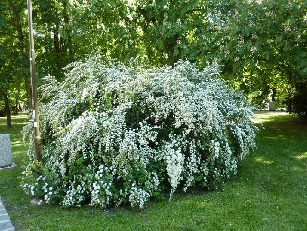
It is an ornamental, fast-growing deciduous shrub up to 2 m in height. The crown reaches 2 m in diameter, dense, broadly spreading, graceful. Branches are arching, thin, numerous, rod-like, drooping to the ground, smooth, brown. Shoots hang in a cascade under the weight of the inflorescences, long, thin, smooth, brownish.
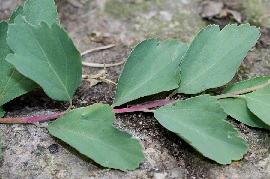
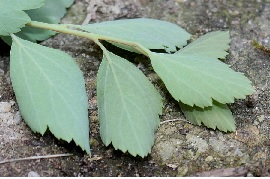
Photo V. Kudelya
Leaves rhombic to obovate in shape, with a cuneate base, 3–4 cm long, coarsely toothed, acute, 3–5-lobed, dark green above, glaucous beneath. In autumn they acquire yellow to red-purple tones.
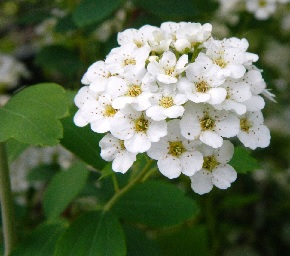
Photo E. Spivakovsky
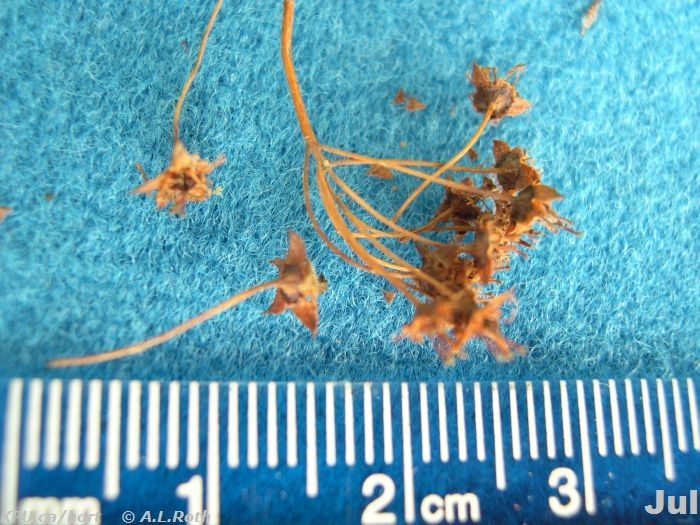
Flowers 0.8 cm in diameter, white, fragrant, collected into numerous umbel-like many-flowered dense hemispherical clusters 2.5–5 cm in diameter, borne densely on the tips of sparsely leaved lateral short shoots located along the entire length of the stems. Flowers abundantly in May–June for several weeks. It may sometimes rebloom in July–early August. Begins flowering at 2–3 years. Fruits ripen in October.
Varieties: 'Pink Ice' ('Catpan'), 'Renaissance', 'Snow White'.
Hardiness zone: 4a (-25°C). In harsh winters it may suffer some frost damage but recovers quickly.
Location: prefers open sunny sites with soil rich in organic matter. Tolerant of urban conditions.
Planting: Planting hole size: 50x50 cm. Soil mix: turf or leaf soil, peat and sand in a 2:1:1 ratio. Drainage of crushed brick and sand, 15 cm thick, is recommended at planting. For group plantings, spacing between plants should be at least 1.5 m. Planting can be done in autumn (before leaf fall ends) or in early spring, before the onset of vegetation.
Care: in hot weather, watering is recommended at a rate of 1 bucket per shrub twice a month. In the first years after planting, loosen the root circle and mulch with a 7 cm layer of peat.
Pruning: tolerates trimming and pruning well and has good shoot-forming ability. Prune in summer, shortening the shoots that have already finished flowering. 2-year-old shoots are shortened by half. It is recommended to thin the crown once every 2–3 years, removing old and diseased shoots (shoot lifespan – 6 years). To rejuvenate the shrubs, cut all shoots to a height of 25–30 cm from the ground.
Propagation: propagated by cuttings (rooting success of cuttings 95%). Seed germination 5%.
Diseases: practically unaffected.
Pests: spider mite (phosphamid (0.2%) or karbofos (0.3%)), aphids (pyrimor (0.1%)), rose tortrix, leaf miner.
Uses: used as solitary specimens, including on lawns, for creating hedges, in landscape compositions with other shrubs, near industrial enterprises, along roads and city streets.