
Flowering shrubs
Japanese spirea
Spiraea japonica L.f.
Synonyms: Spiraea bumalda Burv., Spiraea japonica var. alpina Maxim, Japanese spirea
Spiraea japonica (Spiraea japonica L.f.) – a species of shrubs in the Rosaceae family. It was first described by Carl Linnaeus in his "Suppl. Pl." in 1781. It was first introduced into cultivation in North America in the 1870s.
In nature it grows in forests, on forested slopes, forest glades, in shrub thickets, on grassy slopes, in mountain valleys, ravines, on riverbanks, alpine steppes, rocky and stony places. It rises to the mountains at elevations of 700-4000 m above sea level. It grows in Anhui, Fujian, Gansu, Guangdong, Guangxi, Guizhou, Henan, Hubei, Hunan, Jiangsu, Jiangxi, Shaanxi, Shandong, Sichuan, the Tibet Autonomous Region, Yunnan, Zhejiang (Japan, Korea).
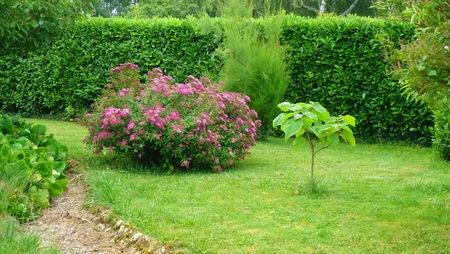
It is an upright deciduous shrub up to 1.5 m high. Crown compact, 1.5-2 m in diameter, rounded or obovoid in shape. Branches stiff, spreading or erect, straight. Shoots cylindrical or grooved, pubescent, later glabrous, covered with purple-brown or brown bark.
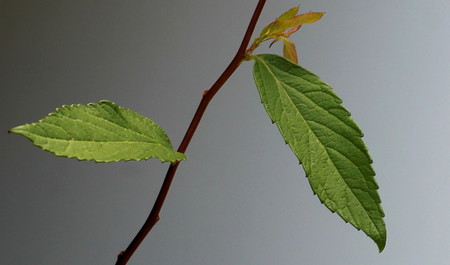
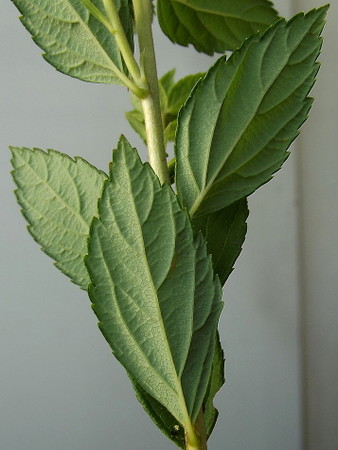
Photo V. Kudelya
Buds ovate, 3-5 mm, with an acute tip. Petiole 1-3 mm long, pubescent. Leaves lanceolate to oblong-ovate, 2-16 cm long and up to 14 mm wide, with a cuneate base, acute or cuneately attenuate, acuminate, coarsely or sharply, often doubly serrate-saw-toothed at the margin. When unfolding the leaves are reddish-brown, pubescent; in summer the upper surface of the blade is light green, glabrous, the lower surface is glaucous, often yellow-pubescent along the veins. In autumn the leaves take on yellow-orange to purple tones.
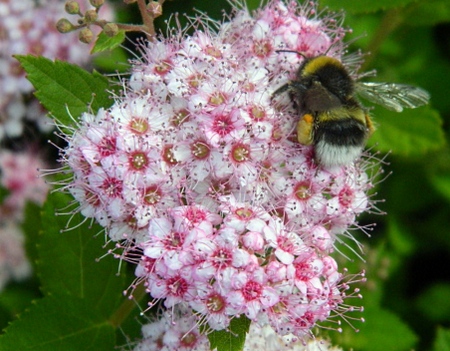
Photo E. Spivakovsky
Flowers 4-7 mm in diameter, from bright pink to carmine, less often white, gathered in compound, branching, dense and flat, rarely shortly pubescent corymbiform inflorescences 15-30 cm in diameter, consisting of individual flat corymbs which are located in the axils of the upper leaves at the top of the current year's shoot. Pedicels densely pubescent, 4-6 mm long, bracts lanceolate to linear-lanceolate, up to 1 cm long, sparsely pubescent. Hypanthium campanulate, sparsely pubescent. Sepals triangular, 1.5-2 mm long. Petals 2.5-3.5 mm long, with a blunt tip. Stamens 25-30, much longer than the petals. Disk barely noticeable, sparsely lobed. Flowers in June-July, with a repeat flowering in August-September.
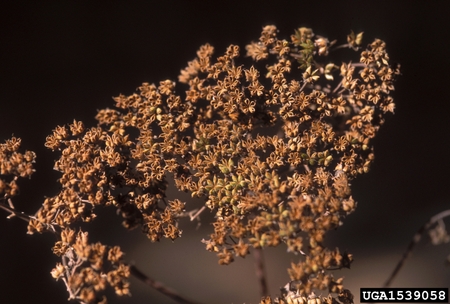
Fruits ripen in October. Seeds up to 2.5 mm long, located in small shiny capsules.
Natural varieties (according to Wikipedia):
- Spiraea japonica var. acuminata Franch. (Spiraea bodinieri H. Lev., Spiraea bodinieri var. concolor H. Lev., Spiraea esquirolii H. Lev.)
- Spiraea japonica var. fortunei (Planch.) Rehder (Spiraea fortunei Planch., Spiraea japonica var. fortunei Koidz.)
- Spiraea japonica var. glabra (Regel) Koidz. (Spiraea callosa var. glabra Regel)
- Spiraea japonica var. japonica (Spiraea callosa Thunb.)
Cultivars: var. glabra (Regel) Koidz., 'Alpina', 'Crispa', 'Candlelight' (AGM), 'Darts Red' ('Dart`s Red') (AGM), 'Genpei' ('Shirobana'), 'Golden Carpet', 'Golden Princess', 'Gold Mound', 'Green Carpet', 'Goldflame', 'Little Princess' (AGM), 'Makrophylla', 'Magic Carpet' (AGM), 'Nana' (AGM), 'Froebelii', 'Ruberrima', 'Shirobana'.
Hardiness zone: 4a (-25°C). In severe winters it may suffer frost damage but recovers quickly.
Site: prefers open sunny locations with soil rich in organic matter. Tolerant of urban conditions.
Planting: Planting hole size: 50x50 cm. Soil mix: topsoil or leaf mold, peat and sand in a ratio of 2:1:1. When planting it is recommended to use drainage of crushed brick and sand, 15 cm thick. In group plantings maintain at least 1.5 m between plants. Planting can be done in autumn (before the end of leaf fall) or in early spring, before the start of vegetation.
Care: In hot weather water at a rate of 1 bucket per shrub twice a month. In the first years after planting it is recommended to loosen the planting circle and mulch with a 7 cm layer of peat.
Pruning: tolerates clipping and pruning well, has good shoot-forming ability. In spring shoots are shortened to 15-20 cm, in summer spent shoots are shortened. Every 2-3 years it is recommended to thin the crown, removing old and diseased shoots (shoot lifespan – 6 years). For rejuvenation of the shrubs all shoots should be cut to a height of 25-30 cm from the ground.
Propagation: propagated by cuttings; seed germination is low.
Diseases: practically not affected.
Pests: spider mite (phosphamide (0.2) or carbophos (0.3%)), aphids (pirimor (0.1%)), rose leafroller, leaf miner.
Uses: used for creating hedges and shrub compositions. Dwarf forms are used for borders or as groundcovers.