
Flowering shrubs
Grey spirea
Spiraea ×cinerea Zabel
Synonyms: ash-gray spirea
Spiraea sерая (Spiraea ×cinerea Zabel) – a species of shrubs in the Rose family (Rosaceae). A hybrid bred in Norway as a result of crossing Spiraea hypericifolia and Spiraea cana. The species was first described by the German botanist Hermann Zabel and Ludwig Wittmack in their work "Garten-Zeitung ill." in 1884. In cultivation since 1880.
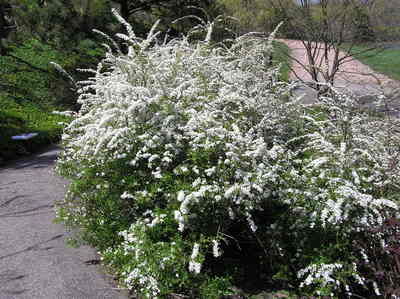
It is a densely branched shrub up to 2 m in height. Growth rate medium. Crown broadly rounded, spreading, branched, graceful. Branches spreading or arching, thin, brown in color. Shoots weakly angled, thin, nearly round, marked with brown streaks, finely and densely felted with grayish hairs.
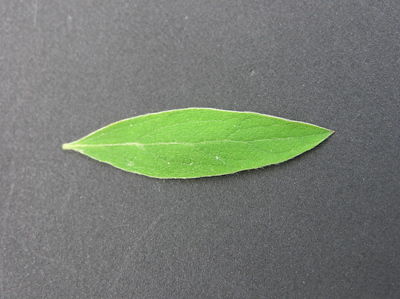
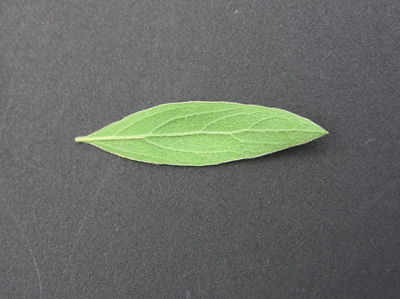
Leaves 2.5-3.5 (5) cm long, oblong, base narrowly cuneate, tapering into a thin short petiole, acuminate at the apex with a short downcurved point. Margins usually entire, less often with 1-2 teeth near the tip, covered on both sides, especially beneath, with a dense gray silky pubescence. In autumn the leaves turn golden-yellow.
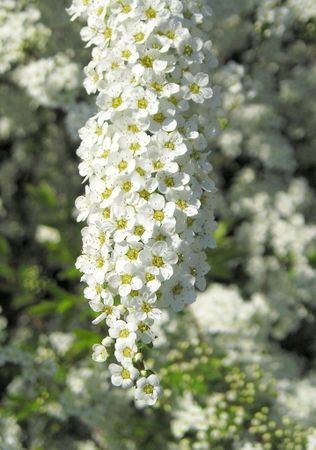
Flowers small, 0.6 cm in diameter, white, gathered in many-flowered, simple, small, dense umbels. Terminal umbels are sessile, arising from the axils of the lower leaves of shoots, often with several small bracts, and are distributed along the length of the shoots. Stamens are the same length as the petals. Flowers from mid-May to mid-June. Fruits ripen at the end of June.
Cultivars: 'Grefsheim', 'Graciosa'.
Hardiness zone: 4b-7a (−29°C).
Site: prefers open sunny locations with organically rich soil. Prefers light soils and loams but can grow in any garden soil (pH 6.6-7.5). Resistant to urban conditions. Tolerates heat well. Requires protection from north winds.
Planting: Planting hole size: 50x50 cm. Soil mix: turf or leaf soil, peat and sand in a ratio of 2:1:1. A drainage layer of broken brick and sand 15 cm thick is recommended at planting. In group plantings keep at least 1.5 m between plants. Planting can be done in autumn (before leaf fall ends) or in early spring, before the start of the growing season.
Care: during hot periods water at a rate of 1 bucket per shrub twice a month. In the first years after planting it is recommended to loosen the root circle and mulch with a 7 cm layer of peat. Preferably protect the root system for winter with dry leaves and wrap the shrub with kraft paper.
Pruning: tolerates trimming and pruning well, has good shoot-forming ability. In spring shoots are shortened to 15-20 cm; in summer prune the shoots after flowering. Every 2-3 years thin the crown by removing old and diseased shoots (shoot lifespan approx. 6 years). For rejuvenation cut all shoots to a height of 25-30 cm from the ground.
Propagation: not propagated by seed. Rooting of spring and summer cuttings without treatment about 40%.
Diseases: practically not affected.
Pests: spider mite (phosphamide (0.2%) or carbofos (0.3%)), aphids (Pirimor (0.1%)), rose leafroller, leaf miner.
Usage: effective as a specimen planting, also used in group plantings on lawns. Flowering shoots are used for bouquet arrangements.