
Flowering shrubs
Spirea or Tavolga
Spiraea
Synonyms: Eleiosina Raf., Pentactina Nakai, tavolga
Spiraea (Spiraea L.) – a genus of deciduous shrubs in the Rosaceae family. It was first described in 1753 by Carl Linnaeus in his "Species Plantarum 1" p. 489. The genus name comes from the ancient Greek word «σπειρα» — "spiral" (the plant was used for garlands). In cultivation since the mid-17th century.
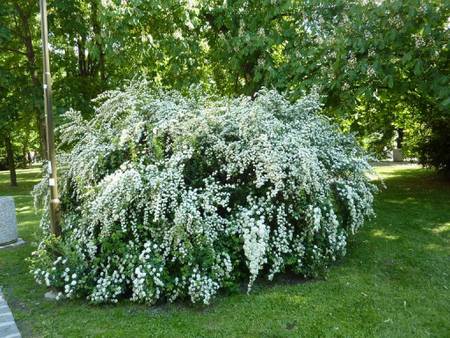
Spiraea Vanhouttei
Members of the genus grow in forest-steppe, steppe and desert zones, and are also found in the subalpine belt of the Northern Hemisphere. In Asia they range to the Himalayan mountains, and in North America to Mexico; four species are endemic to China.
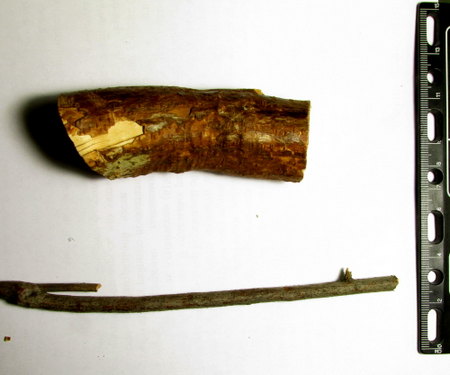
Spiraea Sozykina. Photo N. Stepanov
They are decorative deciduous shrubs 15-250 cm in height. They grow quickly. The crown is variable – hemispherical, pyramidal, weeping, cascade-like, or prostrate. Branches may be straight or curved, thin, spreading, ascending or prostrate. Bark on the branches ranges from light to dark brown, peeling longitudinally. Young shoots are covered with light green, yellowish, reddish or brown bark, glabrous or pubescent. The root system is fibrous, shallow.
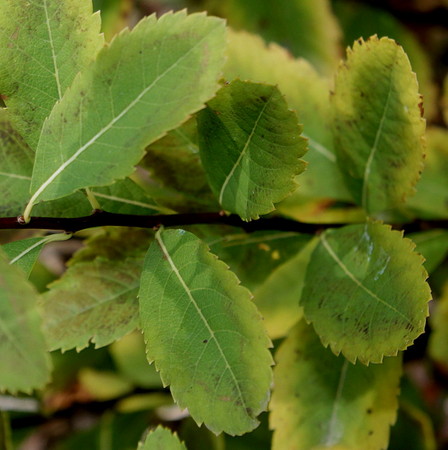
Broad-leaved Spiraea. Photo V. Kudelya
Buds are small, in some species 0.5-1 cm long, solitary or paired, rounded, ovate to acuminate in shape, glabrous or pubescent, with 2-8 scales. Leaves are alternate, on short petioles, simple, without stipules or with very small ones, elliptic, rounded, lanceolate, less often lobed, often serrate or toothed at the margin. Leaves often turn bright colors before leaf fall.
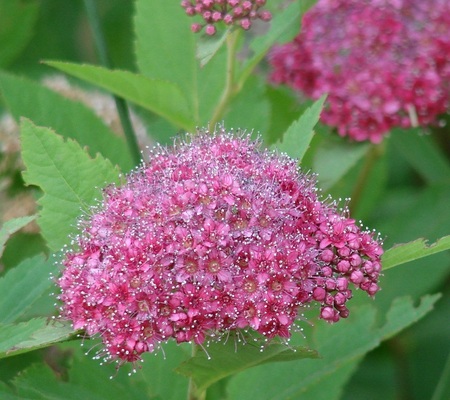
Spiraea japonica. Photo L. Palamarchuk
Flowers are small, often fragrant, hermaphroditic, less often unisexual, 0.4-1 cm in diameter, white, pink, raspberry or carmine in color, arranged in clusters, umbels, half-umbels, corymbs or panicles. Hypanthium is campanulate, cup-shaped or tubular. Five sepals. A lobed, coarsely or finely crenate floral disc grows on the inner part of the calyx. Petals are rounded, usually five in number, oblong, longer than the sepals. Stamens number 15-60; carpels 5, free or fused at the base. Depending on the species, flowering occurs in spring or summer. Begins to bloom in the 3rd-4th year of life.
White Spiraea
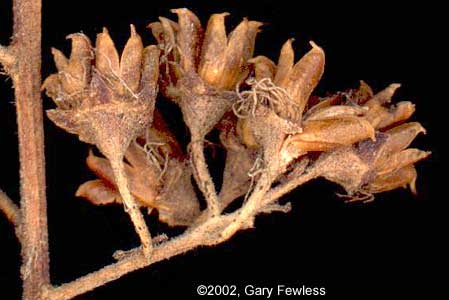
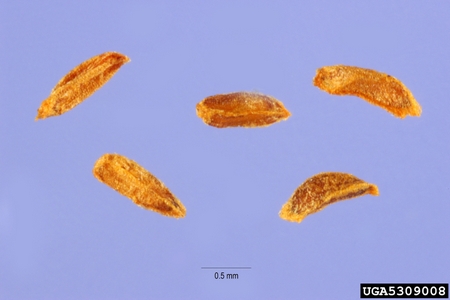
Fruits are many-seeded follicles that open first along the inner suture and later along the outer suture. Seeds are flat, lanceolate, brown, 1.5-2 mm long and 0.5 mm wide, winged. They ripen and are shed 1.5-2 months after flowering.
Species: the genus includes 80-100 species, of which only 60 are used in ornamental horticulture (20 of them are hybrids). Some of them (according to Wikipedia materials):
- Spiraea alba Du Roi — white spirea
- Spiraea albiflora (Miq.) Zabel — white-flowered spirea
- Spiraea alpina Pall. — alpine spirea
- Spiraea arcuata Hook.f. — arched spirea
- Spiraea bella Sims — lovely spirea
- Spiraea betulifolia Pall. — birch-leaved spirea
- Spiraea canescens D.Don — hoary spirea
- Spiraea cantoniensis Lour. — Canton spirea
- Spiraea chamaedryfolia L. — germander-leaved spirea
- Spiraea chinensis Maxim. — Chinese spirea
- Spiraea corymbosa Raf. — corymb-bearing spirea
- Spiraea crenata L. — crenate spirea
- Spiraea decumbens W.D.J.Koch — decumbent spirea
- Spiraea densiflora Nutt. ex Torr. & A.Gray — dense-flowered spirea
- Spiraea douglasii Hook. — Douglas spirea
- Spiraea flexuosa Fisch. ex Cambess. — flexuous spirea
- Spiraea gemmata Zabel — gemmed spirea
- Spiraea henryi Hemsl. — Henry's spirea
- Spiraea hypericifolia L. — hypericum-leaved spirea
- Spiraea japonica L.f. — Japanese spirea
- Spiraea lasiocarpa Kar. & Kir. — hairy-fruited spirea
- Spiraea longigemmis Maxim. — long-budded spirea
- Spiraea lucida Douglas ex Greene — shining spirea
- Spiraea media F.Schmidt — medium spirea
- Spiraea micrantha Hook.f. — small-flowered spirea
- Spiraea miyabei Koidz. — Miyabe's spirea
- Spiraea mollifolia Rehder — soft-leaved spirea
- Spiraea mongolica Maxim. — Mongolian spirea
- Spiraea nipponica Maxim. — Nippon spirea
- Spiraea salicifolia L. — willow-leaved spirea (type species)
- Spiraea splendens Baumann & K. Koch
- Spiraea stevenii Rydb. — Steven's spirea
- Spiraea thunbergii Siebold ex Blume — Thunberg's spirea
- Spiraea tomentosa L. — woolly spirea
- Spiraea trichocarpa Nakai — hairy-fruited spirea
- Spiraea trilobata L. — three-lobed spirea
- Spiraea veitchii Hemsl. — Veitch's spirea
- Spiraea virginiana Britton — Virginia spirea
- Spiraea wilsonii Duthie — Wilson's spirea
- Hybrids: produce stable hybrids.
- Spiraea ×arguta Zabel (S. × multiflora × S. thunbergii) — sharp-toothed spirea
- Spiraea × billiardii (S. douglasii × S. salicifolia) – Billiard's spirea
- Spiraea × blanda (S. nervosa × S. cantoniensis)
- Spiraea × brachybotrys (S. canescens × S. douglasii)
- Spiraea × bumalda (S. japonica × S. albiflora)
- Spiraea ×cinerea Zabel — gray spirea
- Spiraea × conspicua (S. japonica × S. latifolia)
- Spiraea × fontenaysii (S. canescens × S. salicifolia)
- Spiraea ×foxii hort. ex Zabel — Fox's spirea
- Spiraea × gieseleriana (S. cana × S. chamaedryfolia)
- Spiraea × macrothyrsa (S. douglasii × S. latifolia)
- Spiraea × multiflora (S. crenata × S. hypericifolia)
- Spiraea × notha (S. betulifolia × S. latifolia)
- Spiraea × nudiflora (S. chamaedryfolia × S. bella)
- Spiraea ×pikoviensis Besser — Pikovia spirea
- Spiraea × pyramidata (S. betulifolia × S. douglasii) - pyramidal spirea
- Spiraea × revirescens (S. amoena × S. japonica)
- Spiraea ×sanssouciana K.Koch — Sanssouci spirea
- Spiraea × schinabeckii (S. chamaedryfolia × S. trilobata)
- Spiraea × semperflorens (S. japonica × S. salicifolia)
- Spiraea × vanhouttei (Briot) Zabel — Vanhoutte spirea
- Spiraea × watsoniana (S. douglasii × S. densiflora)
Varieties: Hardiness zone: 5a (-23°C).
Location: Most species are drought-tolerant, winter-hardy, and demanding of soil fertility. They prefer light but can grow in light partial shade. Prefer moderately moist, loose, more or less fertile, neutral to slightly acidic loams (recommended pH 6.0-7.0). Undemanding and hardy, can tolerate waterlogging but lose ornamental value on swampy soils. Resistant to urban conditions.
Planting: Soil mix: turf or leaf mold, peat and sand in a 2:1:1 ratio. Drainage of crushed brick and sand in a 15 cm layer is recommended when planting.
Care: In hot weather, water at the rate of 1 bucket per shrub twice a month. In the first years after planting, loosening the root circle and mulching with a 7 cm layer of peat is recommended. Most species used in gardening winter in Ukraine without shelter; some require it in the first years after planting.
Pruning: Tolerates clipping and pruning well and has good shoot-producing ability. Spring-flowering spireas are pruned in summer, shortening the already flowered shoots. Every 2-3 years it is recommended to thin the crown, removing old and diseased shoots (shoot lifespan – 6 years). Summer-flowering ones are pruned in spring, shortening shoots by 1/3 and removing old shoots completely. For rejuvenation, all shoots should be cut back to a height of 25-30 cm above the ground.
Propagation: by seeds, cuttings, or division of the bush. Some species form root suckers. Bushes are divided in spring or late summer. Green cuttings are taken in early summer from shoot tips and planted in hotbeds. Semi-hardwood cuttings are planted in a hotbed at the end of summer and in open ground in spring. Cultivars are propagated only vegetatively.
Diseases: Gray mold, powdery mildew, rust, wilt, ascochytosis, septoria leaf spot.
Pests: nematodes, spider mite, beet aphid, scale insects, bugs, slugs and snails, rodents (field mouse, brown rat).
Companion plants: lilac, mock orange (Philadelphus), bulbs, lily of the valley, primroses, astilbes, Begonia gracilis, flowering tobacco, garden balsam (Impatiens), periwinkle, shade saxifrage, variegated and many-flowered lungwort (Pulmonaria), spotted dead-nettle (Lamium maculatum), Cerastium, daffodils, fritillaries, tulips, Scilla, Chionodoxa, Muscari, Bergenia, Viola cornuta (horned violet).
Uses: Decorative deciduous shrubs with dense foliage, attractive flowers and abundant flowering. Used for group and solitary plantings on lawns, for creating low shrub borders, in groups with shrubs and trees, at forest edges, for creating flowerbeds and borders or freely growing hedges. Can be used for cutting and spring forcing.