
Fruit trees
Siebold's Hazel
С. sieboldiana Blume
Synonyms: Corylus sieboldiana Blume, Asian Beaked Hazel
\r\nSiebold's Hazel – a species of deciduous shrubs of the genus Hazel (Corylus) of the birch family (Betulaceae). In cultivation since 1882 (1904). Native to Japan. In the wild its range includes Japan, Korea, the Russian Far East, Eastern Siberia, China (provinces Hebei, Gansu, Heilongjiang, Liaoning, Jilin, Shaanxi, Shanxi, Shandong, Sichuan), where it can be found on forest edges, in mountain forests and on open slopes.
\r\nIt is a branched large deciduous shrub 2–5 m tall, branches reach 15 cm in diameter. The plant is fast-growing. Young shoots are hairy, less often glandular; one-year-old shoots bear conspicuous numerous lenticels. Bark brown or brownish-gray, fissured.
\r\n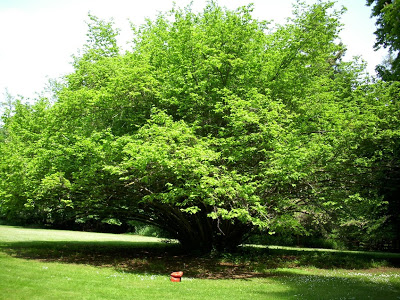
Leaves from elliptic and oblong-obovate to broadly obovate in shape, 5.3-13 cm long and 3-8 cm wide, with a rounded or almost cordate base and an acuminate tip, with a doubly serrate margin and lobed teeth in the upper half. Leaf color deep green, often rust-colored in the center, turning orange-golden in autumn. Petioles pubescent, often glandular, up to 2 cm long.
\r\n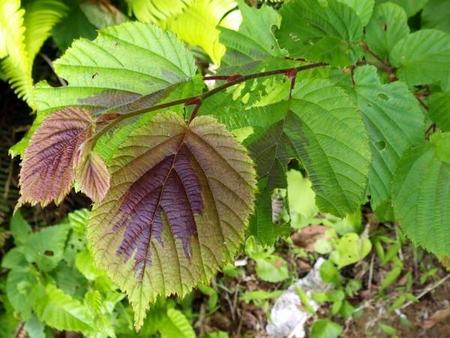
Male catkins reach up to 14 cm in length, arranged in groups of 2-5, pendulous, with acute silky scales. Flowers in late April – early May.
\r\n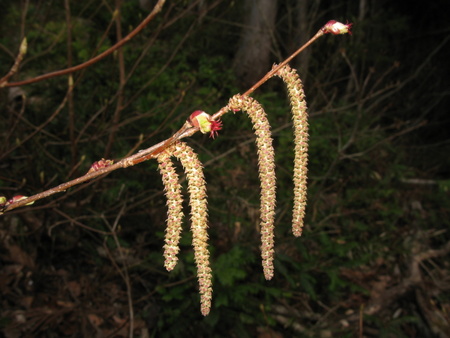
Fruits clustered in groups of 1-4, with a tubular densely brownish-bristly-hairy involucre that tightly envelops the nut, less often with a mixture of glandular hairs. Involucre 1-2.8 cm long, constricted over the nut into a pubescent or almost smooth tube, which is 2-3 times larger than the nut and tapers towards the end. Nut oval, grooved, 1-,5 cm in length, with a thin shell, edible.
\r\n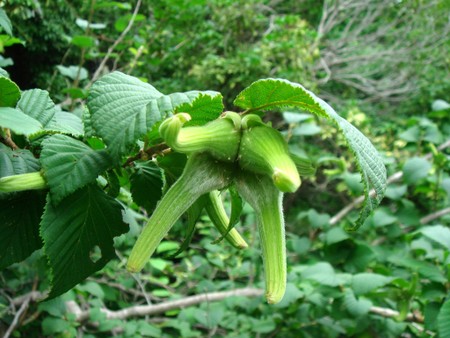
Forms: var. mandshurica (Siebold's hazel var. mandshurica or Corylus mandshurica Maxim.), Corylus sieboldiana var. brevirostris C.K.Schneid., Corylus sieboldiana var. Sieboldiana.
\r\n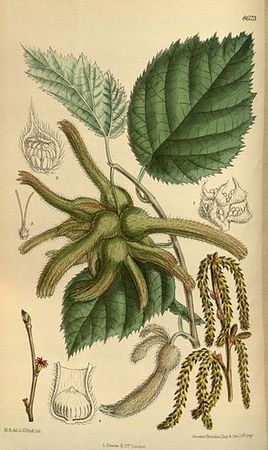
Corylus sieboldiana var. mandshurica J.N.Fitch lith. - Curtis's Botanical Magazine, London
\r\nHardiness zone: 6-8 (-23°C).
\r\n\r\nLocation: undemanding regarding soil and moisture, but grows well on humus-rich soil. Does not tolerate salinity and waterlogging. Shade-tolerant, but fruits poorly in full shade. Tolerates urban conditions well.
\r\nPlanting: The optimal age of the seedling is 2 years. Planting is best carried out in autumn. Planting hole size 50x60 cm. Into the hole add 10-15 kg of humus, 200 g superphosphate, 50 g potassium salt and mix with the top layer of fertile soil. Before planting, seedlings should be pruned to 20-25 cm, and the roots dipped in a slurry of clay and manure. Distance between plants 4-5 m from each other, slightly closer in a hedge. For good pollination it requires several pollinator varieties.
\r\nCare: care consists of shallow loosening of the soil around the trunk and mulching (for example, with mown grass). Watering is recommended during dry periods.
\r\nPruning: should be carried out in early spring before the sap flow begins. Only sanitary pruning is required.
\r\nPropagation: rooting of cuttings without treatment is about 10%. For seed propagation stratification at 0 - 5°C for 2 - 3 months is necessary.
\r\nPests: hazel leaf-beetle, nut weevil, hazel leafroller, bud mite, rodents.
\r\nDiseases: anthracnose, gray rot and fruit rot.
\r\nUses: planted for obtaining valuable nuts. Attractive in solitary and group plantings. Can be used for creating hedges and in avenue plantings, and for urban landscaping.
\r\n