
Conifers
Sequoia
Sequoia
Synonyms: California pine, mammoth tree, giant Washingtonia, giant Wellingtonia, redwood, Redwood, Coastal Redwood, California Redwood.
Sequoia (Sequoia Endl.) – a monotypic genus of evergreen coniferous plants in the Cypress family (Cupressaceae). It was first described by the Austrian botanist Stephan Ladislaus Endlicher in 1847 in his «Synopsis Coniferarum» (Syn. Conif.). The genus was named after the Cherokee leader Sequoyah, who invented the Cherokee syllabary. In cultivation since 1843 or 1846.
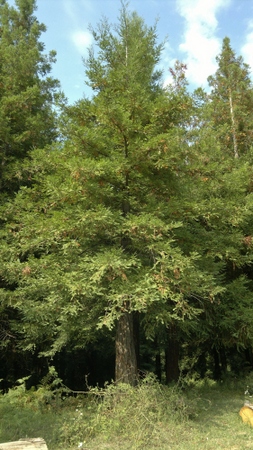
In the wild it grows on the Pacific coast of North America along a strip about 750 km long and 8-75 km wide from California to southwestern Oregon. It is cultivated in British Columbia (Canada), in the southeastern United States from Texas to Maryland, on the Hawaiian Islands, in New Zealand, the United Kingdom, Italy, Portugal, South Africa, and Mexico. They mainly grow at altitudes of 30-750 m above sea level, more rarely reaching up to 920 m. The oldest trees grow in canyons and ravines with humid air and fog.
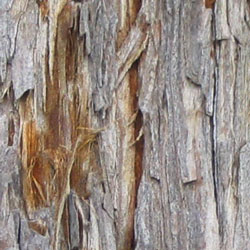
It is an evergreen monoecious tree with a conical crown. It reaches on average up to 60 m in height; the tallest sequoia ("Hyperion") reaches 111, 661 m in height. It grows rapidly and can live up to 6000 years. Branches are dense and whorled in young trees; in mature trees they grow horizontally or slightly pendulous; with age branches from the ground to halfway up the trunk may fall off. Young shoots are unevenly forked, glabrous, at first green, later becoming brown; lateral shoots bear flat two-ranked needles. Bark very thick, up to 30 cm thick, soft, fibrous, immediately after peeling reddish-brown, later darkening, with deep longitudinal fissures. Root system shallow, consisting of widely spreading lateral roots.
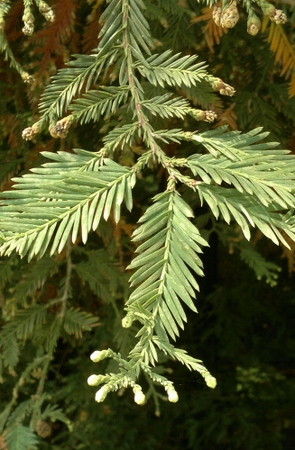
Leaves of two types: scale-like, arranged spirally on long shoots in the upper parts of old trees, appressed or spreading, 5-10 mm long; and linear-lanceolate or narrowly oblong, flat, 15-25 mm long and 2.5 mm wide, shortly pointed, spiral, on curved short petioles and short twigs, clearly two-ranked in one plane, dark green or bluish-gray, glossy, with two distinct whitish or gray stomatal bands on the underside.
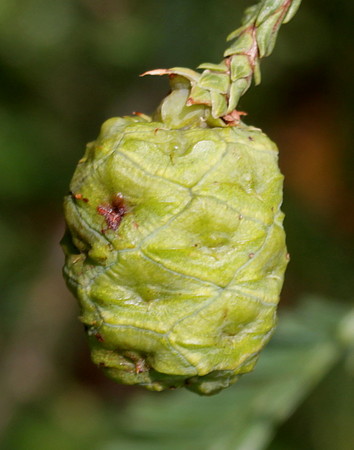
Microstrobili small, up to 2 mm long, yellow, occurring at the tips of young shoots. Female cones 2-3.5 cm long and 1-2 cm in diameter, oblong-ovoid, rounded or oval in shape, dark brown at maturity, borne on the tips of old twigs. Seed scales shield-shaped, arranged spirally, rigid, 0.7-1 cm in diameter at the apex. At maturity the cones open widely. Seeds light brown, with a very narrow wing, weighing 3.3-5.0 mg. Seeds appear from 10-15 years.
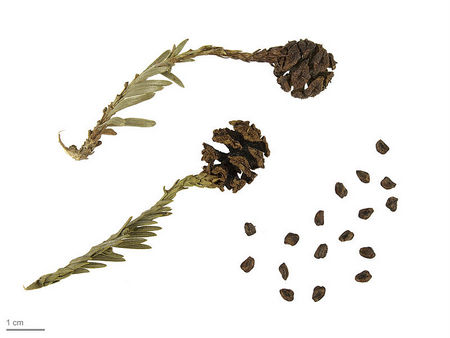
Species: the genus includes only one species Sequoia sempervirens (D.Don) Endl.
Varieties: adpressed (var. adpressa), glaucous (var. glauca).
Hardiness zone: 7b (-15°C)
Location: requires humid air, prefers bright, diffused light; in summer an ideal position is a north-facing windowsill. In winter it is preferable to place it on a south-facing windowsill.
Soil: does not tolerate dry or waterlogged soil. Requires good drainage.
Indoor temperature: prefers moderate temperatures. In winter not below 0°C, optimal +8-10°C. From late May to August it can be kept outdoors, shaded from bright midday sun and protected from drafts. Does poorly with hot air from radiators.
Watering: water abundantly from spring to autumn; in winter moderate watering (at +8°C water once every 10 days, at +12-14°C once every 5-7 days).
Air humidity: needs regular spraying in spring and summer. In winter in a warm room spray in the morning and evening.
Care: in May-August apply liquid mineral fertilizer for houseplants at half the recommended dose. Feed once a month.
Transplanting: Transplant annually in April-May – transfer the root ball from one pot to another and add soil. Soil mix: turf soil, leaf mold, peat and sand in the ratio 1:2:1:1.
Pruning: tolerates pruning well.
Diseases and pests: practically not affected.
Propagation: by seeds (seed viability below 15%), by root suckers, by stump shoots. Produces abundant suckering.
Uses: can be grown in bonsai style.