
Flowers for the garden
Houseleek
Sempervivum
Synonyms: liveforever, stone rose, hare's cabbage, «Hens and Chickens», Diopogon Jord. & Fourr.
Houseleek (Sempervivum L.) – a genus of plants in the Crassulaceae family (Crassulaceae). The genus was first described by Carl Linnaeus in his «Species Plantarum» in 1753 and in Gen. Pl. ed. 5, 209. 1754. The name of the genus comes from the Latin words «semper» — always, «vivus» — alive. The Latin name was used in writings by Pliny the Elder. In cultivation since the late 17th century.
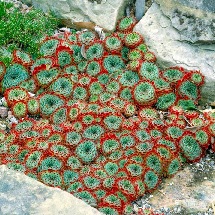
In nature they grow in the mountains of Central and Southern Europe, Asia Minor, and the Caucasus; one species occurs in Africa. They grow on rocky and gravelly sites, often in pinewoods on sand.
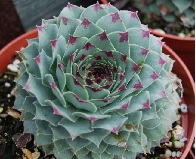
They are evergreen succulent herbaceous plants, glabrous or covered with glandular pubescence. They form a dense, often high, basal rosette of leaves, which is a vegetative shoot with closely spaced alternate leaves. Rosettes reach 1–15 cm in diameter.
Leaves alternate, succulent, entire-margined, usually ovate or oblong in shape, acute or acuminate, with a ciliate (fringed) margin.
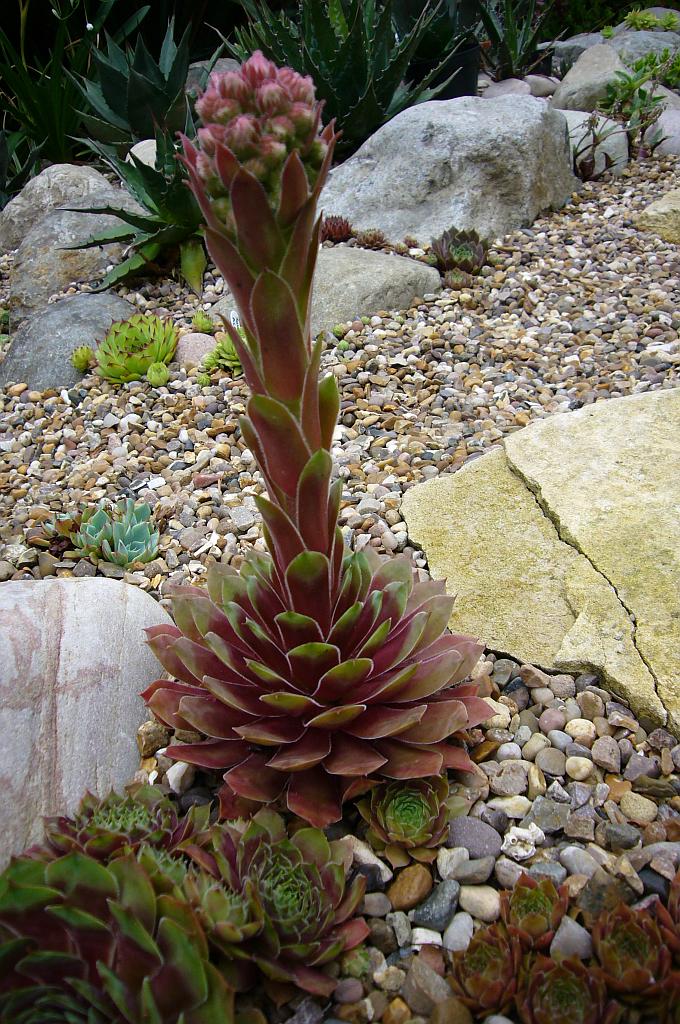
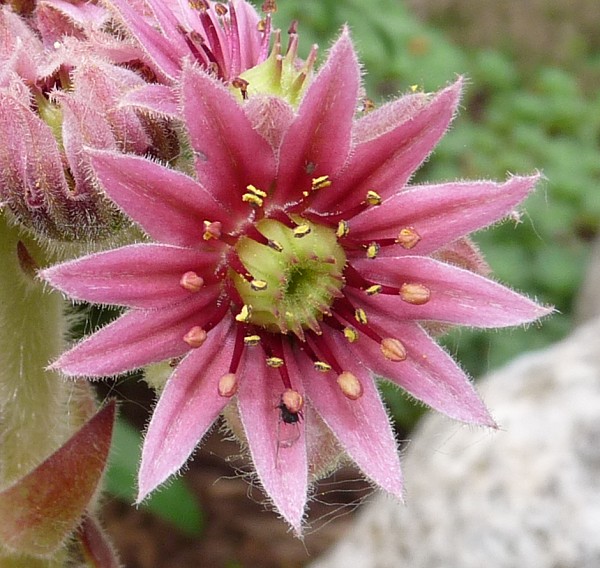
Flowering stems are pubescent with small glandular hairs; they are unbranched and erect. Flowers are terminal, regular (actinomorphic), 8–20-merous, bisexual; some are arranged in monochasial units, almost sessile, gathered into corymbose-panicle inflorescences. The perianth is double. Sepals are fleshy, united at the base, entire, covered with short simple, less often glandular hairs, and sometimes glabrous. Petals are lanceolate, longer than the sepals, star‑spreading, and may be white, yellow, yellow‑green, red or purple. Stamens are twice as numerous as the petals, numbering 16–40; the opposite stamens are adnate to the bases of the petals, the alternate ones are free. Filaments are flattened, often pubescent or glabrous. Anthers are oblong‑ovoid. Nectar glands are located beneath the pistil, plate‑like, small, entire at the apex. The gynoecium is free, composed of 8–20 unequal-sided, oblong‑ovate, often glandular and sessile carpels. Stylodia are slightly shorter than the ovary; they are glabrous and straight. Stigmas are small and capitate. Flowers for more than a month, in the second half of summer.
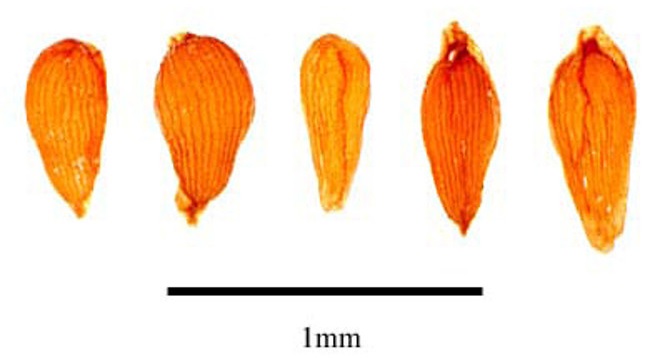
The plant is monocarpic. The fruit consists of 8–20 oblong‑ovate to nearly lanceolate many‑seeded follicles (carpels), pubescent with glandular hairs.
Species: 42 species are recognized, 35 of which are used in horticulture. Notable ornamental species:
- Sempervivum arachnoideum L. - Cobweb houseleek
- Sempervivum calcareum Jordan. - Limestone houseleek
- Sempervivum cantabricum Huber. - Cantabrian houseleek
- Sempervivum caucasicum Rupr.ex Boiss. - Caucasian houseleek
- Sempervivum ciliosum Craib. - Ciliate houseleek
- Sempervivum x funckii C.Sm. - Funck's houseleek
- Sempervivum dolomiticum Facch. - Dolomite houseleek
- Sempervivum erythraeum Velen. - Red houseleek
- Sempervivum grandifolium Haw. - Large‑leaved houseleek
- Sempervivum marmoreum Griseb. - Marble houseleek
- Sempervivum montanum L. - Mountain houseleek
- Sempervivum pittonii Schott, Nym. et Kotschy. - Pitton's houseleek
- Sempervivum pumilum Bieb. - Dwarf houseleek
- Sempervivum tectorum L. - Roof houseleek
- Sempervivum wulfenii Hoppe ex Koch. - Wulfen's houseleek
- Sempervivum zeleborii Schott. - Zelebor's houseleek
Some taxonomists separate out a distinct genus, Jovibarba, from the houseleeks. It includes species with 6–7‑merous flowers and petals with a fringed margin, which are directed upward, and with leaves turned upwards.
Hybrids: readily hybridizes in the wild and in cultivation.
Hardiness zone: 2–9 (6–8 °C).
Exposure: all members of the genus prefer warm, sunny locations. Xerophytic and very drought‑tolerant. Do not tolerate over‑moisture. Require good drainage.
Soil: not demanding as to fertility; grows on any drained cultivated soils. Low‑growing species prefer low humus content and only a small amount of soil (can grow in crevices between stones). Tall species prefer light, sandy soil with a small amount of leaf mold; they like a loose substrate mixed with crushed brick. On very fertile soil the rosettes become loose and pale. In waterlogged soil the lower leaves of the rosette may rot.
Planting: spacing between plants for large species should be at least 10–15 cm, for small species 3–5 cm.
Pruning: after flowering the leaf rosettes that have died should be removed.
Care: consists of removing faded inflorescences with the dead leaf rosette, as well as removing weeds. Every 3–5 years groups can become very crowded and the plants need to be separated.
Planting: planting out into open ground is carried out in mid‑April.
Propagation: easily and naturally propagates by daughter rosettes in spring, less often in summer. Small rosettes are grown on beds. Seed propagation is rather difficult because the seedlings are small and capricious, and species hybridize very easily. Seeds are sown in February–March to a depth of up to 1 cm. Germinate at 20°C. First seedlings appear after 3–5 days. Seedlings are kept in light, protected from hot sun. In late June–July seedlings can be planted in their permanent place.
Pests: magpies, jays, jackdaws and crows; larvae of the May beetle.
Diseases: rots.
Uses: effective in group plantings on the southern side of shrubs, used to create carpet plantings, on slopes or rocky areas, on dry stone walls, for creating borders, and on alpine lawns.