Encyclopedia - Plants for ponds
Lake bulrush
Scirpus lacustris
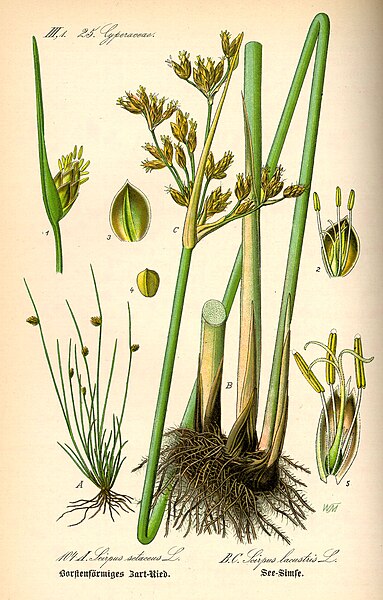
Bulrush (lat. Scírpus) — a genus of perennial and annual shoreline-aquatic plants of the family Cyperaceae.
About 300 species are known, distributed throughout the world but mainly in temperate and subtropical zones. Around 20 species occur in the CIS countries. Perennial, less often annual plants with creeping or shortened rhizomes or without them. Stems almost cylindrical or three-angled, leafy; sometimes leaves reduced to mere scales. Inflorescence composed of many spikelets, branched or made up of several spikelets, or single-spikelet. Spikelets many-flowered. Flowers bisexual; perianth of a few bristles or absent. Fruit plano-convex or rounded-trigonal.

Lake bulrush — Scirpus lacustris L = Shoenoplectus lacustris
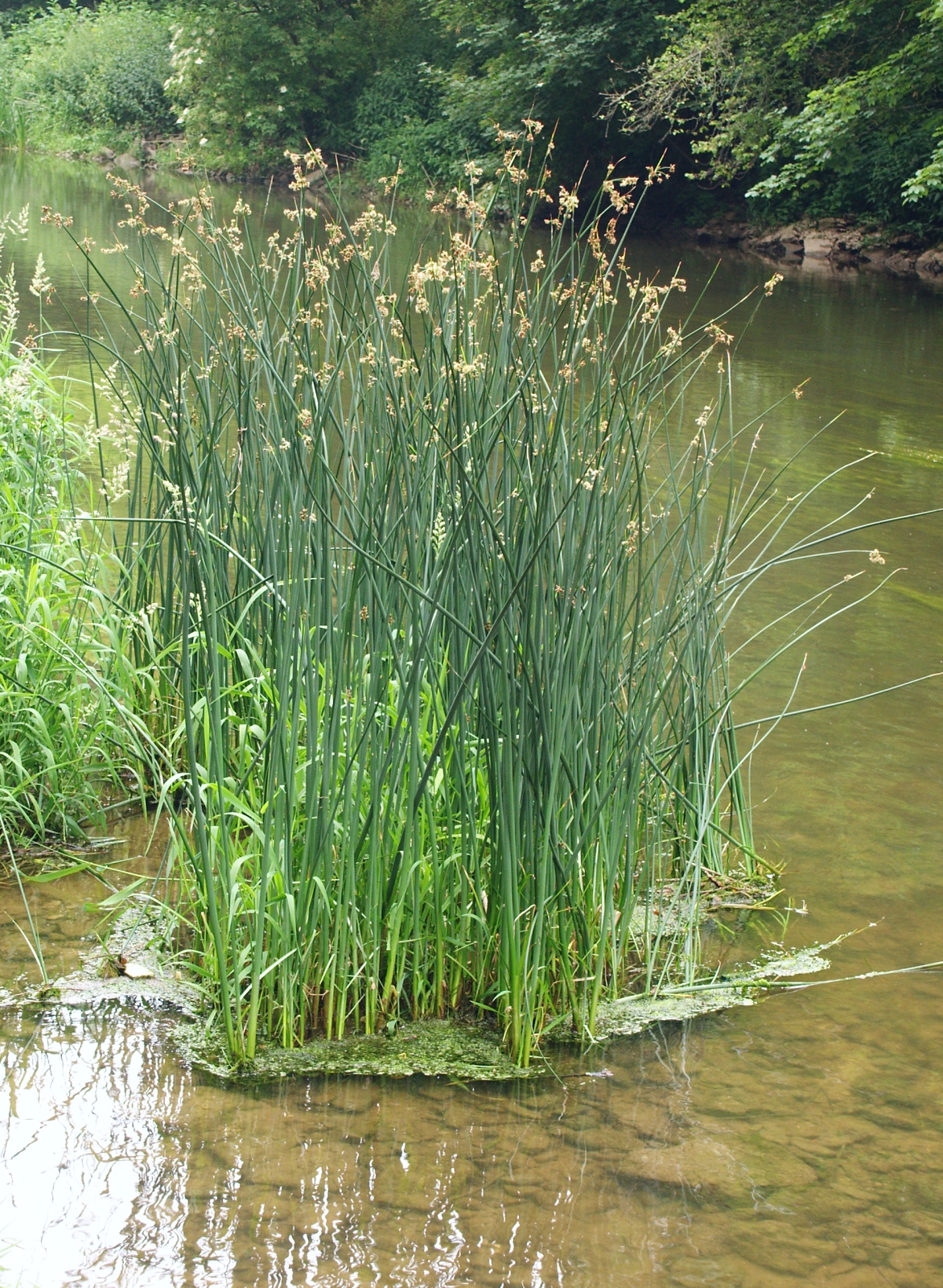
Occurs in water and along the shores of lakes and rivers, in oxbow lakes of the temperate zones of Europe, the Caucasus, Siberia, and North America.
Perennial plants 100—250 cm tall, with a creeping hollow rhizome. Stems cylindrical, with scale-like leaves. Inflorescence corymbose-paniculate, less often compressed. Spikelets 8—12 mm long, brown, clustered by 3—4 (up to 8) at the ends of the flowering stems. Bracts 1—2 in number, awl-shaped, slightly longer than the inflorescence. Glumes smooth or with solitary warts. Flowers in late spring to early summer.
Variegated forms are usually recommended for cultivation in ornamental ponds.
The 'Albescens' has pale-yellow stems 1–1.5 m high with thin vertical stripes, 'Golden Spears' has stems bright yellow in spring and greening by mid-summer, 'Zebrinus' has bright light-yellow horizontal stripes on a dark-green stem background.
Location: bulrush grows best in neutral or slightly acidic wet soil and in shallow water. It develops more vigorously in full sun. Cultivars are more demanding than wild-type plants. They spread more slowly and, if the water level falls too much in temperate regions, may die back from freezing.
Care: bulrushes are very undemanding in cultivation, but can sometimes spread excessively by long rhizomes or self-seed. Cut back for the winter.
Propagation: wild species — by seed or by division of rhizomes. Cultivars are propagated only by dividing clumps in spring or in early autumn.