
Flowers for the garden
Squill, or Scilla
Scilla
Squill, or Scilla (lat. Scilla) — a genus of low perennial bulbous plants. The genus belongs to the family Hyacinthaceae (Hyacinthaceae), although many reference books place it in the family Liliaceae. Relatives of squill include hyacinths and Ornithogalum. It includes about 80—90 species growing on plains and mountain meadows of Europe, Asia, and Africa (17 species in the territory of the former USSR).
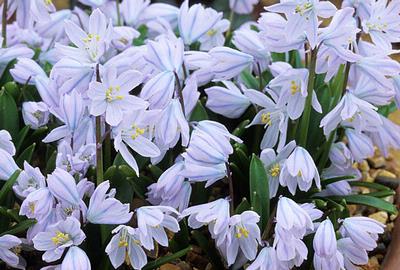
Low perennial bulbous plants that bloom very early. Leaves are linear, basal, appearing simultaneously with the inflorescences or significantly earlier. Flower stalks are leafless. Flowers are gathered in terminal racemose inflorescences or solitary; bluish, purple, white, or pink. The perianth is spreading, composed of six equal segments, free or united at the base. Bulbs are globose, ovoid, or oblong-ovoid. Tunic scales are grayish, dark violet, or brown. Fruit is a capsule with a small number of black seeds of irregular, ovoid shape. Squills are wonderful plants, without which it is hard to imagine a spring garden. The bright blue patches of Scilla look like pieces of spring sky fallen onto a lawn or among shrubs.
In cultivation:
Two-leaf squill — Scilla bifolia
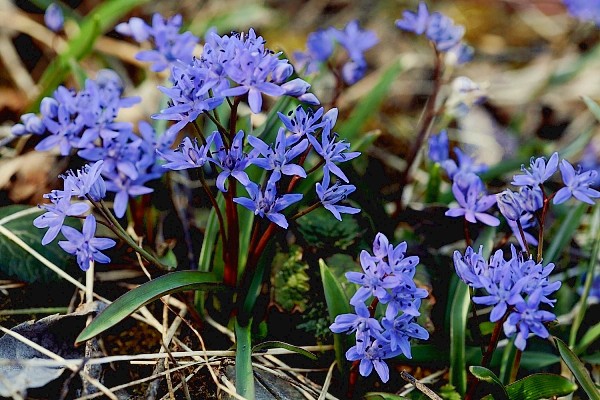
Occurs in the south of the European part of Russia, in the Pre-Caucasus, Crimea, and the Mediterranean. A large population of white-flowered plants exists near Tuapse.
The most profusely flowering and low-growing species. This is a rather rare small perennial bulbous plant with 1—3 scapes up to 15 cm tall, each bearing up to 15 flowers, usually blue, sometimes pink or white. The flowers have a strong pleasant scent, which attracts numerous bees and the first spring butterflies. There are 2 leaves, broad-linear, 10—20 cm long, surrounding the flowering stem at the base.
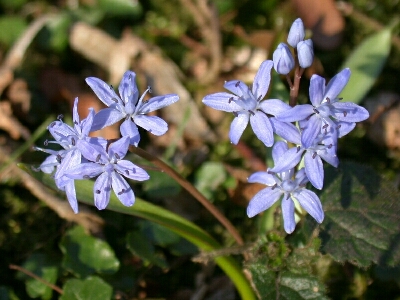
Blooms in the second half of April for 12–15 days. Bulb ovoid, up to 2.5 cm long and 1—2 cm in diameter with light tunic scales. In cultivation since 1568. In its natural habitats it varies greatly in flower color — forms with white and with varying intensities of pink and blue flowers have been distinguished.
Siberian squill — Scilla sibirica
The specific epithet is misleading (it is absent from Siberia), but it has been fixed as the priority name. Native to the south of the European part of Russia, Crimea, the Caucasus, and Central and Southern Europe. It blooms very abundantly and, by spreading, forms blue lawns. It can dominate in spring in nettle-oak groves (up to 268 individuals per 1 m2), occupying a significant place in the spring herb layer of North Caucasian oak woods.
An ephemeroid. Leaves appear on the surface simultaneously with the inflorescences and die back at the beginning of seed ripening. In summer there is a dormancy period; in autumn all bulbs produce new roots and a new shoot with rudiments of leaves and flowers. In winter there is only slow enlargement of these organs. It reproduces practically only by seed. Summer cooling slows development. Three months of summer warmth are necessary. The flowers contain nectar and are pollinated by bumblebees and bees. Flowers open at 10:00 and close at 16:00—17:00; on cloudy and rainy days they remain closed. Capsules ripen on the ground, and seeds are dispersed by ants.
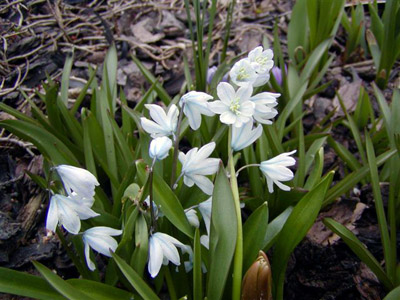
An interesting feature is the change in leaf position depending on light and temperature conditions. At the beginning of the growing season, on cloudy and cold days they lie horizontally and pressed to the litter — this promotes absorption of diffuse radiation; on clear warm days with considerable heating the leaves take an inclined or almost vertical position. On the tips of the leaves there is a hard point consisting of a group of mechanical tissue cells and appearing as a light cap — it helps to overcome frozen soil, a layer of litter compacted by snow, or an ice crust during emergence. Vegetative propagation is a sign of aging; it is not accompanied by rejuvenation of the daughter plants and does not contribute to the species' dispersal.
Location: prefers shady places, but also grows well in sunny sites. Hardy.
Soil: requires loose, moist soil rich in leaf humus. Does not tolerate acidic or marshy sites.
Care: in open sites needs light winter covering. Transplanting and dividing should be carried out every 3–4 years. Although all Scilla species do not require special care, they respond with abundant flowering and good propagation to nitrogen and potassium fertilization in early spring.
Propagation: in cultivation Scilla is propagated by seed and by bulbs — offsets; during the growing season adult bulbs produce 1—2 offsets.