
Climbing plants
Schizandra
Schizandra
Schizandra (lat. Schizandra) — a genus of perennial subshrubs or lianas of the family Schizandraceae; in some sources it is placed in the family Magnoliaceae. The genus includes about 14, in some sources 25 species, occurring mainly in the Far East, China and Japan.
The Latin name of the plant Schizandra comes from the Greek words 'schizen' — to split and 'aner','andros' — man, which is related to the structure of the flower.
In cultivation:
Chinese schisandra - Schizandra chinensis
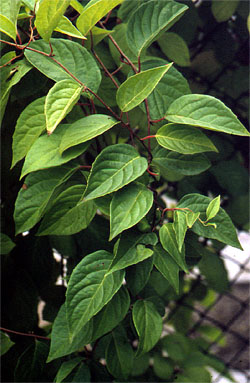
A perennial climbing vine with a woody, peeling stem, reaching 10–15 m in length and 1–2 cm in diameter. Stems most often originate from cord-like brownish rhizomes. The rhizomes have adventitious roots and scale-like leaves; they can reach 10–20 m in length. The root system of Schizandra is located close to the soil surface, and the rhizome has many dormant buds. The root system and the plant as a whole are very vigorous and hardy. Young vegetative shoots, as they grow, twine around trunks and branches of trees and shrubs clockwise, climbing 1–1.5 m in one growing season.
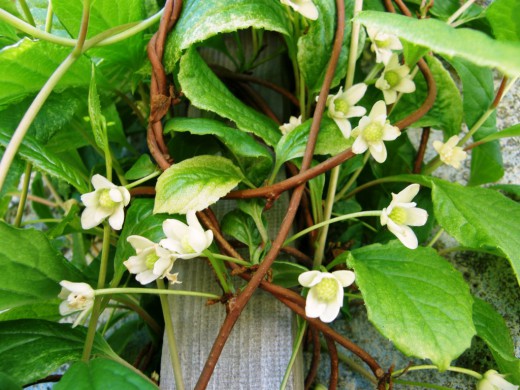
Leaves are petiolate, slightly fleshy, dark green and glabrous above, lighter beneath. Schizandra leaves unfold early, so it is susceptible to late frosts. Schizandra is monoecious, with unisexual — male (staminate) and female (pistillate) — flowers occurring on the same vine. Flowers appear in the axils of fruiting or growth shoots. Flowers are small, white-pink, very pleasantly fragrant. The vine blooms in late May — June, and fruits ripen in late August — September and even October. The plant is pollinated by small beetles, less often by bees and flies.
Scientists have also noted the ability of Schizandra to change the sex of its flowers. The tendency for such changes depends on the age of the vine (young plants predominantly bear male flowers, female flowers appear later), the conditions of the growing season and the site of growth.
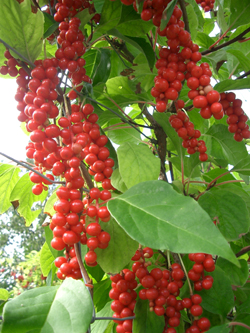
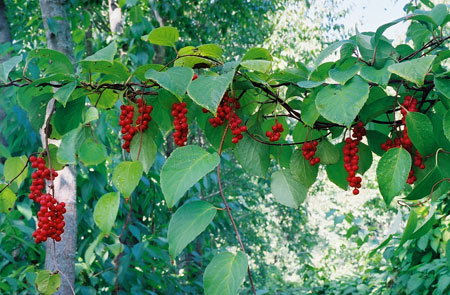
The fruit consists of many spherical, red, two-seeded berries. The berries are juicy, sour, with a lemon scent, edible. Seeds are kidney-shaped and remain viable only until spring.
Location: prefers sites protected from direct sun, quite shade-tolerant, especially when young. Frost-hardy.
Soil: prefers light, humus-rich, sufficiently moist and well-drained soil.
Care: requires annual application of fertilizers. Fertilizers are applied superficially as mulch; loosen the soil shallowly since roots are located at a depth of 8–10 cm. Pruning is carried out in winter and late autumn. Crown diameter should not exceed 1 m. Abundant autumn watering and mulching with peat or dry leaves protect the roots from deep freezing.
Propagation: regenerates by seed and root suckers. It propagates well by seed, by layering and by division of the clump. Vegetatively propagated Schizandra will be the same sex as the parent. Observations show that plants grown from seed are monoecious. They will have timely pollination of female flowers by male flowers and will set fruit.