
Flowers for the garden
Scabiosa
Scabiosa
Scabiosa (Latin: Scabiosa) is a genus of perennial herbaceous plants of the teasel family (Dipsacaceae). The genus comprises about 100 species occurring in the temperate regions of Eurasia and in the mountains of East and Southern Africa. Some species are separated into the distinct genus Knautia (Knautia).
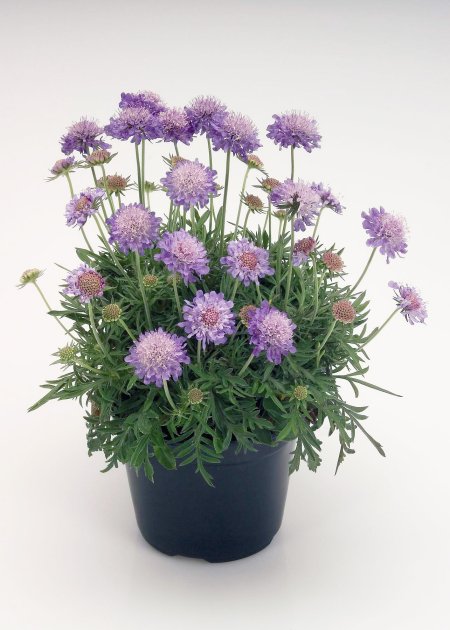
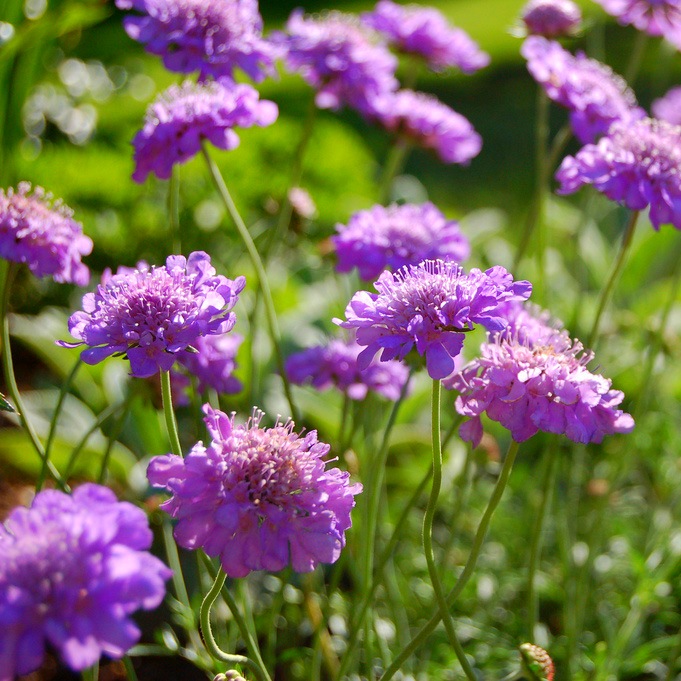
The name comes from the Latin word 'scabies' — scabies, which the leaves of one species were supposedly used to treat. According to another version, from the word 'scabiosus' — rough, and is related to the involucre of rough bracts.
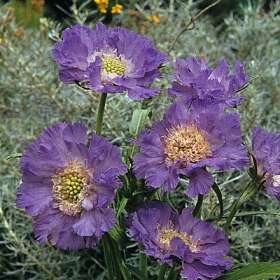
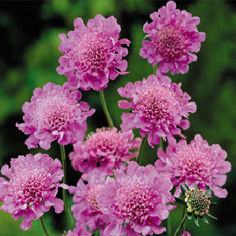
Perennial plants, sometimes with a woody base of the stems, less often biennials and annuals. Stems simple or branched, erect, sturdy, from 10 to 100 cm tall. Leaves arranged oppositely, entire, pinnately lobed or pinnately dissected.
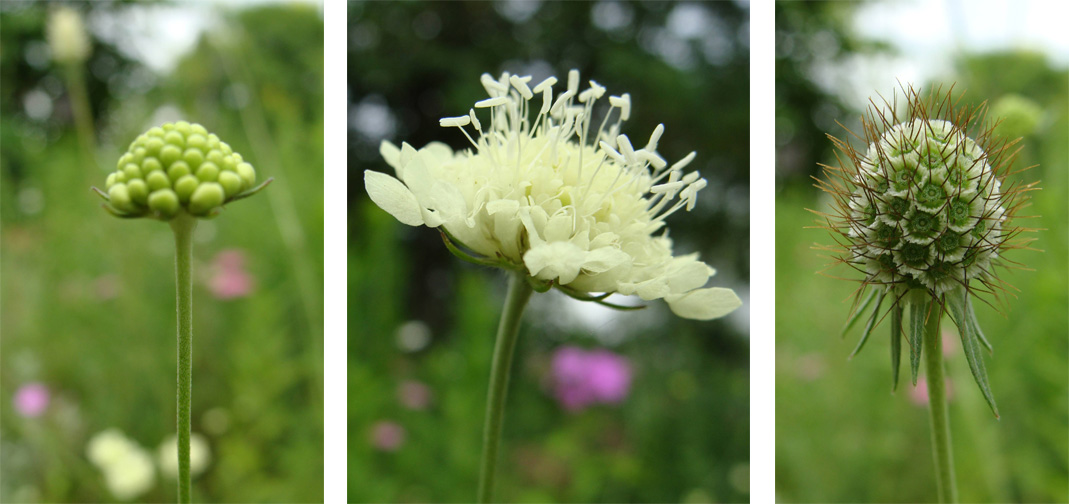
The flowers are gathered in dense, head-like inflorescences, flattened-spherical or spherical, borne at the ends of long peduncles and surrounded by an involucre of bracts. The corolla is funnel-shaped, composed of five fused petals; the marginal flowers in the inflorescence are larger. The pale anthers of the long stamens stand out strikingly against the petals. The fruit is an achene; the seeds are small, oval, light brown.
In cultivation:
Pigeon scabious - Scabiosa columbaria
A montane species, widely distributed in Western Europe, and also in the west and southwest of the European part of Russia, in Crimea, and in the Caucasus. It grows singly or in groups of several plants on meadows, scrubby slopes, among shrubs along stream banks, on fairly rich and moist soils, on isolated sites. A very rare relict species.
A biennial or perennial herbaceous plant 10—100 cm tall. Stem erect, sometimes pubescent, slightly branched in the upper part. Basal rosette leaves simple, ovate-oblong, serrate or pinnately lobed. Stem leaves pinnately lobed or bipinnate. Inflorescence head-like, receptacle chaffy. Calyx with bristles 5-10 mm long, red-brown in color. Corolla red-violet, marginal flowers larger than the others. Blooms from mid-July to the end of September.
The flowers in the inflorescence open gradually, and insects visiting them for the nectar located in the tube of the corolla transfer pollen from a flower where the stamens have matured to a flower where the pistil has matured. Self-pollination is impossible in this plant, since the stamens mature significantly earlier than the pistil. It reproduces by seeds, easily dispersed by wind and animals (the hard and prickly calyx of the flower remains with the fruits and easily attaches to fur). A good honey plant.
Starry scabious — Scabiosa stellata
Native to southern Europe. The plant is annual. Stems erect, 15-45 cm tall. Leaves opposite; lower leaves entire, toothed at the margin, upper leaves deeply divided. Flowers pale blue, gathered in terminal, head-like inflorescences of spherical shape on long, sturdy peduncles.
Blooms from June until autumn. Fruits. The fruit is a white-pubescent achene with a large bell-shaped covering. Seeds remain viable for 2-3 years.
Caucasian scabious — Scabiosa caucasica
Distributed in the Caucasus and Central Asia. A perennial plant, sometimes grown as an annual, 70-80 cm tall. Stems erect, sturdy, slightly branched, pubescent. Basal leaves linear-lanceolate, petiolate, slightly glaucous; stem leaves sessile, pinnately dissected. Flowers small — blue, light blue, white, pink, dark purple — gathered in a head-like inflorescence up to 10 cm in diameter. Blooms in June-July for 30-35 days. Fruits in August. In cultivation since 1803. It has highly ornamental hybrid forms and cultivars differing in plant height and inflorescence color.
Dark purple scabious — Scabiosa atropurpurea
Originating from southern Europe. The plant is annual or biennial. Stems erect, branching, 30-100 cm tall, grooved, green, rarely pubescent. Basal leaves broadly lobed, coarsely toothed; stem leaves pinnately divided with oblong lobes. Flowers small, white, pinkish, bluish, dark purple, gathered in solitary, dense, elongated head-like inflorescences up to 7 cm in diameter, on long flexible peduncles.
Blooms from July to October. Fruits in September. Seeds remain viable for up to 3 years. In cultivation since 1629. It has numerous garden varieties and cultivars, which are divided into several groups: tall — 60-100 cm, bushy — 40-60 cm and dwarf — up to 25 cm high. Flowers of the main varieties are white, bright red, large, double. Examples of cultivars: 'Blue Moon' — inflorescences pale blue; 'Rose Cackade' — inflorescences pink; 'Monarch Cockade' — a mix, inflorescences large, double, of various colors.
Location: require a sunny position; in shade they develop poorly and do not flower.
Soil: sites with fertile, light soil rich in humus. Scabiosa caucasica does not tolerate wet soils!
Care: the use of phosphate-potash fertilizers increases the brightness of flower color. Watering is moderate. Scabiosa caucasica in the temperate zone requires light winter protection with leaves.
Propagation: annual species are propagated by sowing seeds in open ground in early May or, for seedling production, in a cold frame in late March — early April. At a temperature of 16-18 °C, seedlings appear for Scabiosa stellata in 14-18 days, for Scabiosa caucasica in 20-25 days, for Scabiosa atropurpurea in 8-14 days. Seedlings are pricked out and planted in their permanent place in early June, keeping a distance between plants of 25-30 cm. Perennial species are propagated by sowing seeds and by dividing the clump. When propagated by seed, young plants flower in 2-3 years. Division of the clump is carried out early in spring before growth begins. They can grow in one place for at least 5 years.