
Flowers for the garden
Soapwort, or Saponaria
Saponaria
Soapwort, or Saponaria (lat. Saponaria) — a genus of annual, biennial and perennial herbaceous plants of the Carnation family (Caryophyllaceae). The genus name comes from the Latin "sapo" — soap, due to the ability of the roots to produce foam. About 30 species are distributed in Eurasia (especially in the Mediterranean). Around 10 species occur in the territory of the former USSR.
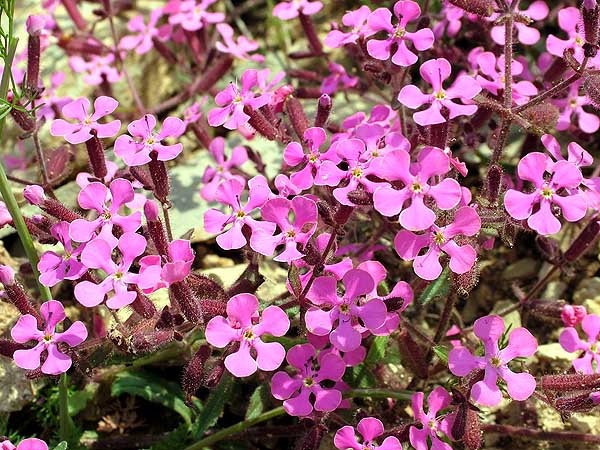
Herbaceous annual, biennial, or perennial plants with entire-margined opposite sessile leaves without stipules. Stems 10 to 90 cm tall. Inflorescence paniculate. Flowers large, white, pink, or red. Five petals, usually with long claws and with a corona (crown) at the base of the limb, entire or only notched at the apex. Fruit — a many-seeded capsule, oblong, dehiscing with 4 teeth. Seeds almost black, finely bluntly tuberculate.
In cultivation:
Common soapwort — Saponaria officinalis
Distributed in Europe, the Caucasus, Western Siberia, the Mediterranean, Asia Minor and the Balkans.
A perennial herb 30–90 cm tall, growing as a loose, spreading shrub. Leaves acute, ovate-lanceolate or elliptic, 5–12 cm long, with three veins. Flowers large, on short pedicels, white or pink, petals with an entire or emarginate limb, up to 3 cm in diameter, fragrant. Inflorescence a loose corymbose panicle. Flowers all summer. Fruit — a capsule. In cultivation since 1629. Hardy to -29 °C. Has a double-flowered form (var. flore plena hort.). Plant up to 100 cm tall, with double light-pink flowers up to 2.5 cm in diameter, gathered in inflorescences up to 15 cm long. Flowers in July for 30–50 days.
Tufted soapwort — Saponaria caespitosa
A densely growing perennial with a woody base up to 5–15 cm high. Leaves linear-lanceolate, smooth. Flowers in mid-summer with pale-pink flowers with oval petals. Rarely seen in cultivation, though of particular interest. The plant is planted on a sunny, dry spot in the crevices of a rock garden. The soil should be poor, well-drained, and rich in calcium. Protection from moisture is required for the winter. Seeds are sown in winter on the soil surface, left uncovered in light. Seedlings appear over 1–3 months at 18–21 °C.
Woodland/ocymoides soapwort — Saponaria ocymoides
Native to the mountains of southern Europe, the Alps. Sunny slopes and limestone rocks.
A profusely flowering, low-maintenance perennial. Soft cushions up to 20 cm high, formed by long prostrate shoots. Leaves narrow, ovate to linear, matte green. Inflorescences pink-red, fragrant, small, star-shaped, forming numerous umbels at the tips of branched stems. Blooms very abundantly from June to August. Hardy. Soil must contain a large amount of calcium. Good drainage is essential for winter. The plant quickly rots in wet conditions. In cold climates it behaves as a short-lived perennial but easily renews by self-seeding.
Location: prefers a sunny position, tolerates light shade, overwinters without cover.
Soil: moderately dry, fresh. Sufficiently loose, moderately fertile, limed. Does not tolerate wet and heavy soils! Good drainage is necessary. Common soapwort is not demanding regarding soil.
Care: Saponaria ocymoides should be cut back by one-third after flowering to keep the plant compact. New, weaker inflorescences will appear in September. Common soapwort should be pruned for winter.
Propagation: by seeds, division of the clump in autumn, and by softwood cuttings in spring and summer. Use the tips of young shoots for cuttings. Plants can remain in one place for 6–8 years.