Encyclopedia - Plants for ponds
Floating salvinia
Salvinia natans
Floating salvinia lat. Salvínia nátans— a small fern floating on the surface of bodies of water from the family Salviniaceae (Salviniaceae).
The distribution of floating salvinia is very wide: it is found in the waters of Africa, the tropical and temperate regions of Asia, and the central and southern parts of Europe.
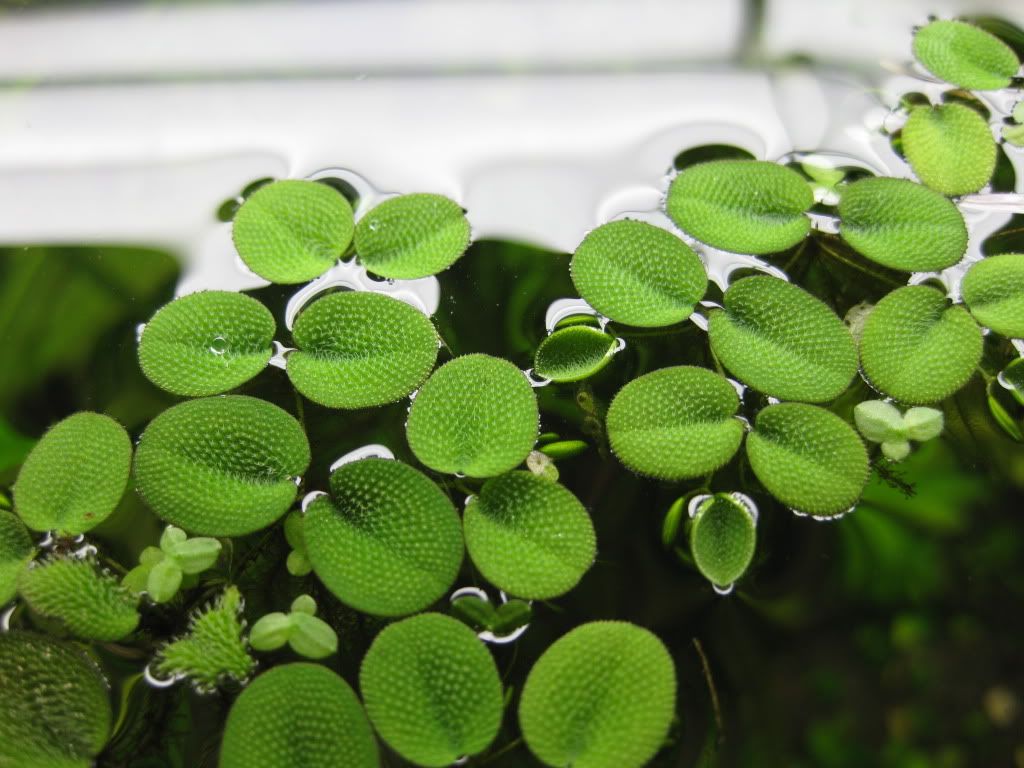
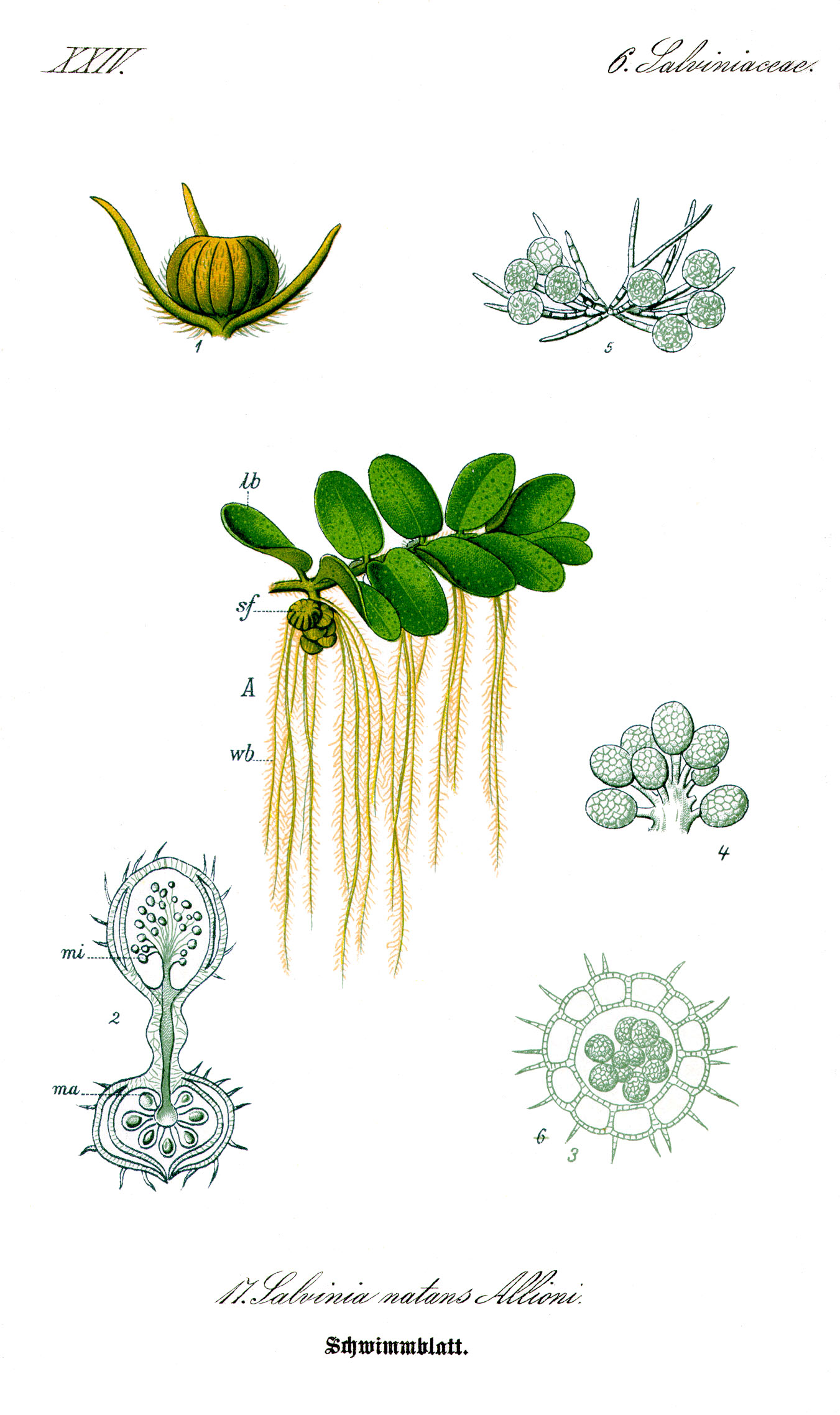
An annual plant with a thin stem floating on the water surface up to 15 cm long, at each node of which there are whorls of three leaves. Two leaves are entire, ovate-elliptic in shape, with a slightly cordate base. On the upper surface they are covered with warts, at the tips of which there is a tuft of short thick hairs, and the lower surface is densely covered with brown hairs that retain air bubbles, allowing the salvinia to stay on the water. The third leaf — underwater; it is divided into threadlike lobes covered with hairs, very similar to roots and performing their functions: absorption of water and nutrients, as well as stabilizing the plant.

At the base of the underwater leaves there are clusters of 4—8 globular sori, some of which contain micro- and macrosporangia, from which, respectively, male and female gametophytes subsequently develop. In each megasporangium four megaspores are formed, of which only one develops. Sori usually fall to the bottom of the body of water in autumn and overwinter there; by spring their covering decomposes, and the sporangia float to the surface and germinate.
All_HeHai.jpg)
Habitat: Salvinia colonizes bodies of water with still or slowly flowing water. It does not tolerate water with an alkaline reaction. Fresh concrete and limestone rocks, especially crushed stone, alkalize the water, so such material should not be used to fill the bottom of a pond for plants.
Care: in winter keep in an aquarium or in a conservatory under artificial lighting with fluorescent or special grow lamps. With insufficient light the fern's leaves become small and pale.
Reproduction: by spores. The spores are contained in special organs attached to the base of the underwater leaf. The small balls with spores fall to the bottom of the waterbody in autumn and overwinter there. In spring they give rise to new plants. In summer they reproduce vegetatively: lateral shoots grow from buds at the stem nodes, which, when detached, begin independent existence.