
Deciduous shrubs
Creeping willow
Salix repens
Synonyms: Salix reptans Rupr.
Creeping willow (Salix repens) – a species of the genus Salix (Salix L.) in the willow family (Salicaceae). It occurs naturally in Europe, Asia Minor, and is found in North America and in the Arctic regions of the European part of Russia. Grows on sparsely vegetated dune sands, on wet meadows and at the edges of bogs.
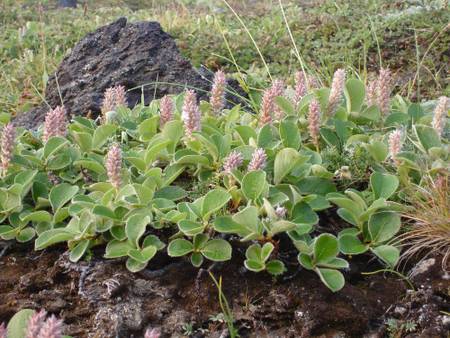
It is a small shrub with a creeping crown. Much of the stem is underground. Branches are glabrous, ascending, prostrate, rooting, vine-like, 25–50 cm long; the subterranean part is coral-purple. Shoots are brown-green or yellow-brown, densely covered with thin long white hairs.
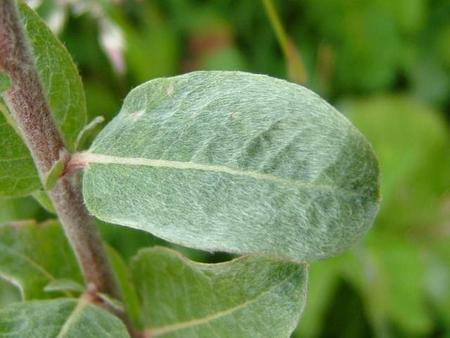
Petiolules (stipules) are lanceolate or elliptic, 1–3 mm long, entire, often absent. Leaves are ovate, elliptic, obovate or lanceolate, with rounded or acute tips, with slightly narrowed or blunt bases, more rarely cordate, 2–3 cm long and 0.5–2.5 cm wide, with entire or finely and glandular-toothed margins, matte green above, paler, grey-green beneath, with 4–6 pairs of veins, on both sides densely covered with shiny silky hairs, later becoming glabrous or nearly glabrous above. Petioles very short, 1–3 mm long, hairy.
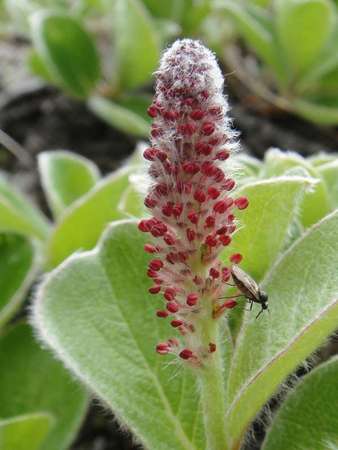
Flowers in April–May. Flower buds 3–6 mm long, ovate, with a blunt tip, not markedly flattened, more or less white-pubescent. Catkins oval-cylindrical or cylindrical, dense, borne on lateral shoots, reaching 0.5–1.5 cm in diameter. Male catkins up to 2 cm long, female 2–4.5 cm. Bracts 1.5–2 mm long, obovate or broadly ovate, with a black-brown long-haired apex. Ovary densely woolly-pubescent, borne on a short stalk. Nectaries single or paired, more rarely 3, 1–2 mm long, with 3–5 lobes of unequal length. Staminal filaments 2 in number, glabrous, free. Style 0.5 mm long, split to the base, with reflexed lobes. Stigmas two-part, up to 1 mm long, with curved lobes.
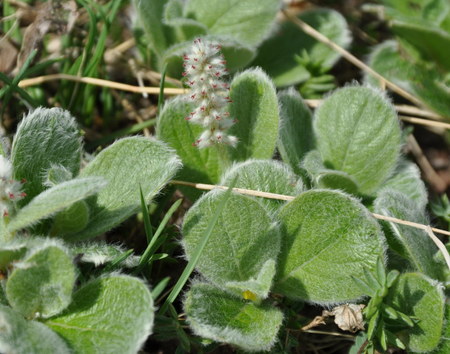
Fruits ovoid-conical, sessile, 7–9 mm long, densely covered with hairs, with 12 seeds.
Forms: Salix repens 'Jona', Salix repens 'Arenaria' ('Argentea', 'Nitida'), Armando.
Hardiness zone: 5b (-23°C)
Exposure: light-loving, very moisture-loving, requires drainage. Undemanding and very resilient, tolerates urban conditions well.
Soil: grows well on sandy soils, also tolerates calcareous soils.
Planting: Planting is best carried out in spring before bud break. The topsoil layer should be turned upside down. Recommended spacing between seedlings should be no less than 0.6–2 m, depending on the variety. Planting depth – 40–70 cm. Transplanting is recommended up to 3–4 years. On heavy soils drainage of crushed stone or sand 20–30 cm thick is recommended.
Pruning: sanitary pruning is recommended.
Care: requires practically no maintenance.
Propagation: readily propagated by cuttings.
Pests: Cecidomya saliciperda, Cecidomya salicis, Tortrix (Helias) Chlorana, Agrotis vallugera, Bombyx Salicis, Curculio crux, Phratora vulgarissima, Phratora vitellinae, Galer ucacapreae, Galer lincola, Arvicola terrestris. Flowers and leaves are eaten by reindeer.
Diseases: affected by fungal diseases – fungi of the genera Melampsora, Rhytisma, Erysiphe.
Uses: used in solitary and group plantings, for decorating rockeries, rock gardens, and single-species groups over large areas. Can be grown on balconies in containers and in inner courtyards (patios).