
Deciduous shrubs
Purple willow
Salix purpurea L.
Synonyms: Salix caesifolia Drobow, yellow osier
Purple willow (Salix purpurea L.) – a species of the genus Salix (Salix L.) in the family Salicaceae. In the wild it occurs in North Africa and in temperate regions of Eurasia (from Spain to Japan and Ireland, including Scandinavia and extending to Central Asia). Introduced to North America. Found along the banks of water bodies, in ditches, wet meadows, on sands, and among shrubs. Lives up to 30 years.
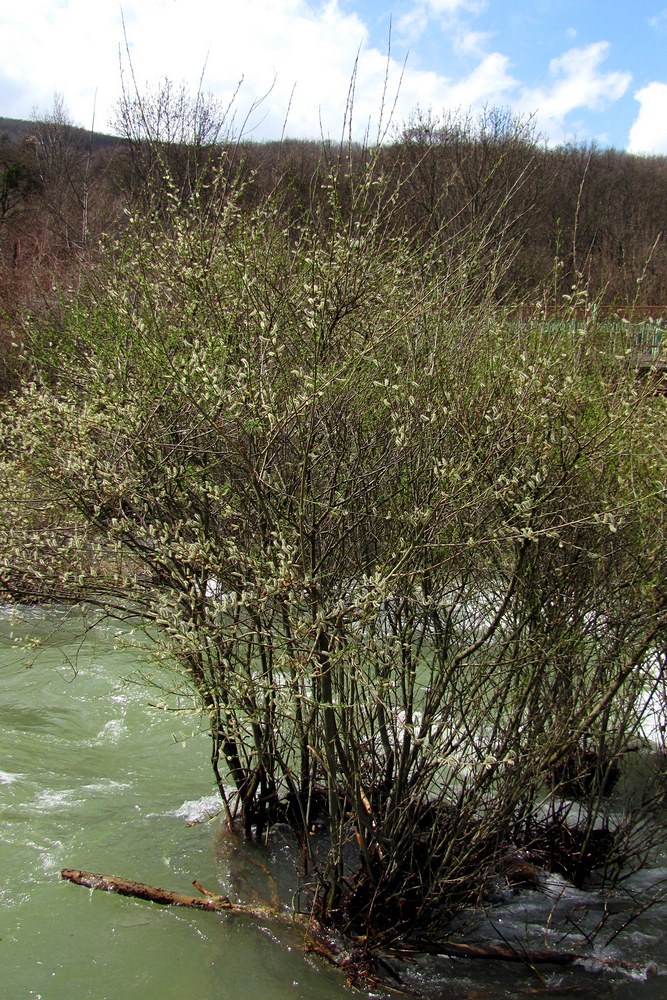
It is a graceful, much-branched shrub 2-4 (10) m tall, less often a small tree. Crown dense, rounded, 3-5 m in diameter. Bark light gray or light brown, bitter, with a glaucous bloom. Branches thin, flexible, numerous, red-brown. Shoots pubescent, grayish-yellow, very thin, later becoming shiny, glabrous, bright reddish-purple, covered with a waxy bloom. Wood white, smooth, does not yellow in the sun.
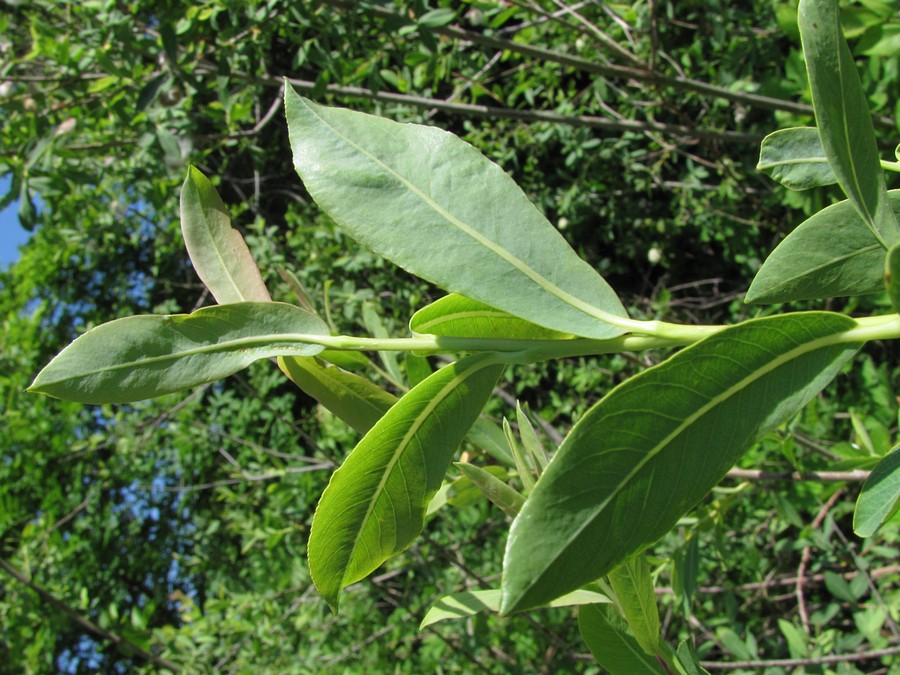
Buds appressed, 3-5 mm long, red-brown or yellow (floral), glabrous, often opposite. Stipules linear-lanceolate, 1.5-1.8 cm long, with a serrated margin, early deciduous. Leaves arranged alternately or oppositely, less often verticillate in threes, dense, 3-12 cm long and 0.8-1.5 cm wide, narrowly obovate or obovate-lanceolate in shape, with a spinose acute tip, thin, delicate bluish-gray or glaucous-green in color, less often green on both sides, entire-margined, on petioles 3-6 mm long. When unfolding leaves are pubescent, later smooth.
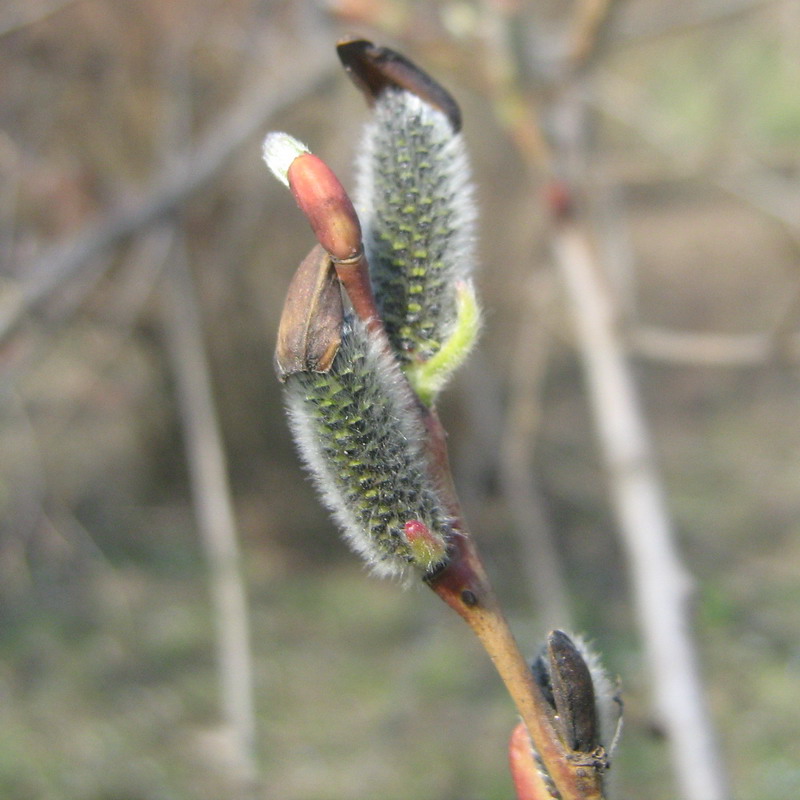 | 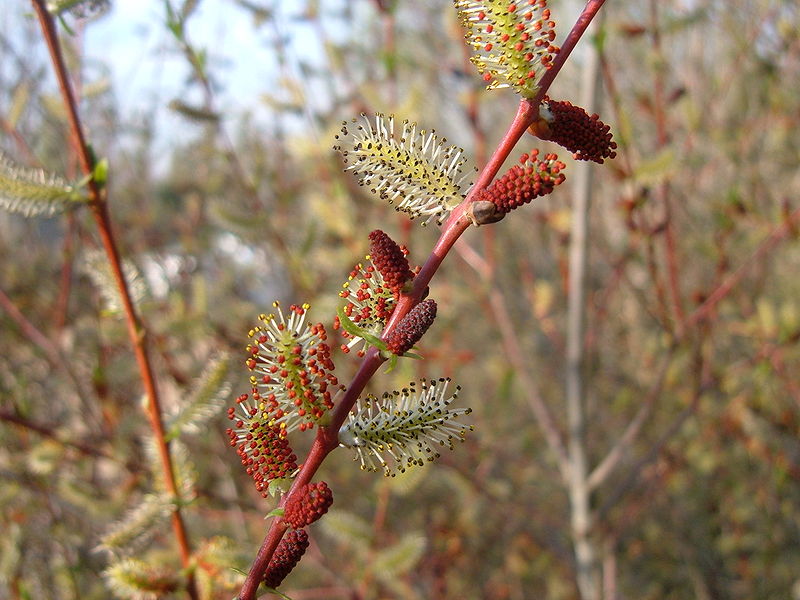 |
| Branch with opening inflorescences | Branch with male and female inflorescences |
Catkins sessile, lateral, cylindrical, densely flowered. Male catkins erect, 2-3 cm long, narrowly cylindrical, arcuately curved, less often straight, with 2-3 small leaves. Bract scales obovate, pale, darker above. Anthers large, bright, red-purple, later purple-black. Stamens 2, with fused hairy filaments 3.5 mm long; anther purple, four-celled, blackening; nectary solitary, elongated, posterior, oblong-ovate. Female catkins cylindrical, less often narrowly cylindrical, 2.8-3 cm long and 2-4 mm in diameter. Bract scales oblong, reddish, almost black at the top, covered with silky hairs. Ovary sessile, short, semi-pendent, curved or straight, gray, later dark red, ovoid. Stigmas red, very short, initially two-parted, then 4-parted, spreading. Flowers before leafing or simultaneously with leaves, in March-May. Fruits in May-June.
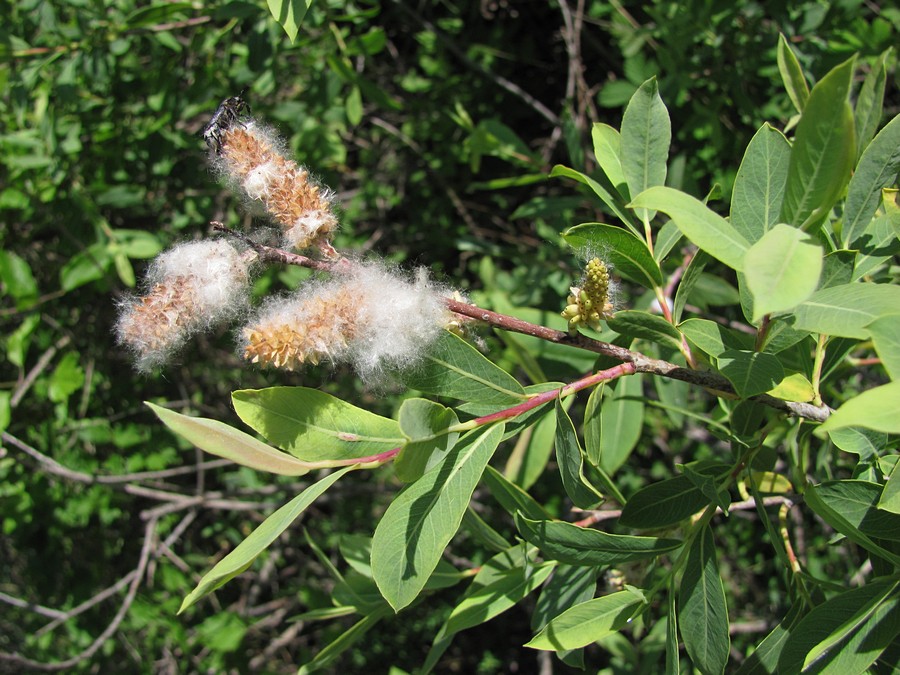
Forms: 'Nana' ('Gracilis), 'Pendula', 'Canyon blue', 'Eugenii', 'Uralensis'
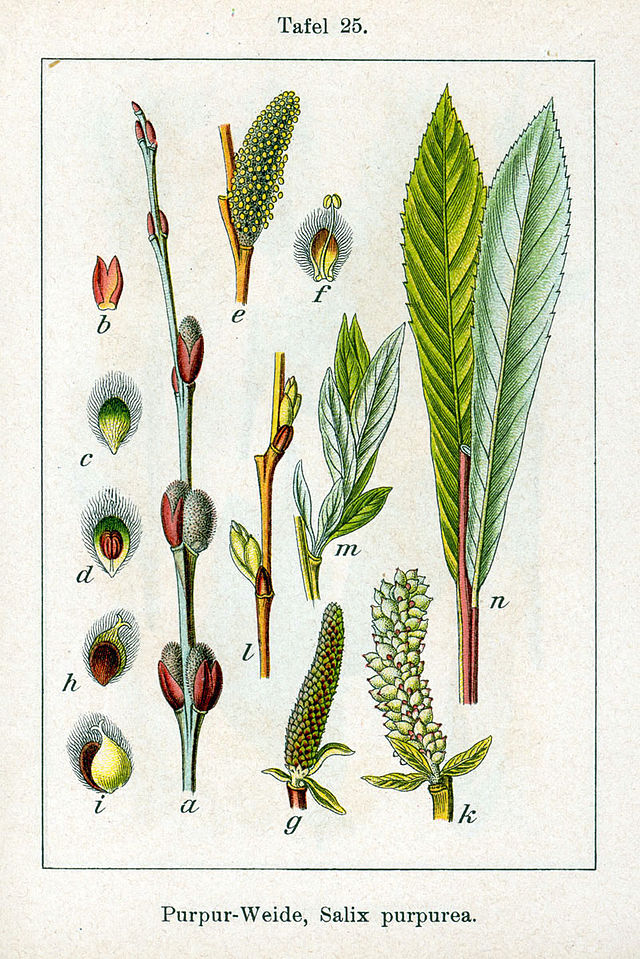
Johann Georg Sturm (Illustrator: Jacob Sturm) «Deutschlands Flora in Abbildungen»
Hardiness zone: 5b (°С -23°С)
Site: prefers light but tolerates shade, very moisture-loving, requires drainage. Undemanding and very hardy, tolerates urban conditions well.
Soil: grows well on sandy soils, also grows on calcareous soils.
Planting: Best planted in spring before bud break. When establishing a "willow stand" it is recommended to cultivate the soil in autumn to a depth of 30-80 cm, depending on its fertility and dryness. The top organic layer should be turned upside down. Recommended spacing between seedlings should be no less than 0.6-2 m, depending on the species. Planting depth – 40-70 cm. Transplanting is recommended up to 3-4 years. On heavy soils drainage of crushed stone or sand 20-30 cm thick is recommended.
Pruning: tolerates clipping and pruning better than other species.
Care: practically requires no maintenance.
Propagation: by cuttings and seeds. Seeds lose viability after 10 days. Winter cuttings practically do not root; green cuttings, when treated with (Корневином), root 100%. Pests: Cecidomya saliciperda, Cecidomya salicis, Tortrix (Helias) Chlorana, Agrotis vallugera, Bombyx Salicis, Curculio crux, Phratora vulgarissima, Phratora vitellinae, Galer ucacapreae, Galer lincola, Arvicola terrestris.
Diseases: affected by fungal diseases – fungi of the genera Melampsora, Rhytisma, Erysiphe.
Uses: used in solitary and group plantings, near water bodies, as a specimen on the lawn, in compositions with other shrubs, annual and perennial flowers. Can be grown as a standard.