
Deciduous shrubs
Spear-shaped willow
Salix hastata L
Synonyms: ива хастата, ива головатая, Salix barclayi auct., Salix hastata ssp. psiloides Flod., Salix psiloides (Flod.) Kom.
Spear-shaped willow (Salix hastata L.) – a species of deciduous shrubs of the genus Salix (Salix) in the willow family (Salicaceae). The name comes from Latin «hasta» - spear, dart (the leaf shape is spear-like). The range covers all of Europe, Siberia, the Caucasus, Kazakhstan, Tajikistan, China and Mongolia, the eastern part of Russia, and North America. It is found in the forest-tundra and forest zones in the subalpine and alpine belts of mountains. Grows on plains and in mountains, on river and lake banks. In cultivation since 1780.
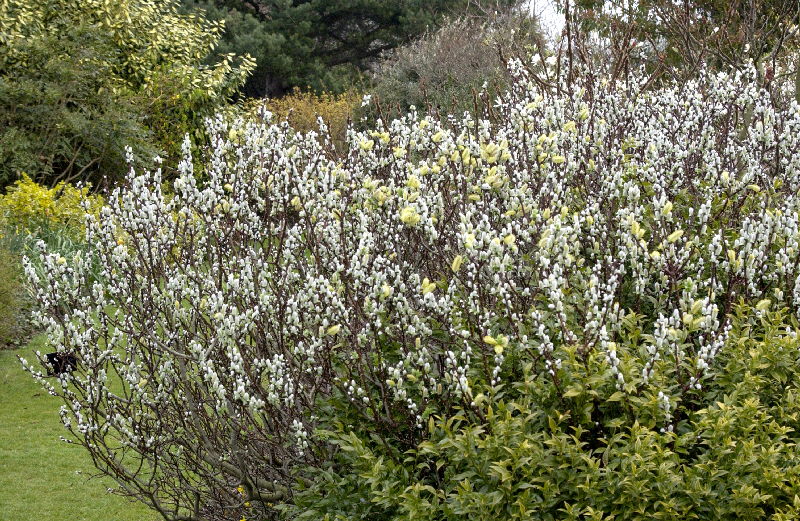
It is a shrub 1.5-2 m high and 1.5 m in diameter. Crown oval-rounded, dense, in the subalpine belt almost prostrate. Branches knobby, erect, red-brown in color. Shoots densely and yellowishly hairy (hairs curved), later glabrous, greenish. One-year-old branches yellow- or dark-brown, almost glabrous, densely leaved. Exposed wood without ridges. Buds ovoid, obtuse, hairy at the apex.
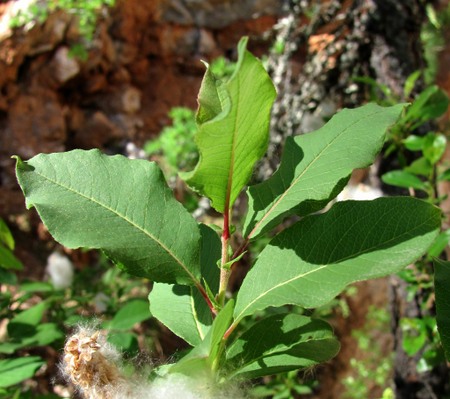
Stipules obliquely ovate, semi-cordate, reniform, rarely lanceolate-acuminate, serrate. Leaves 1.5-7 cm long and 1.5-3.5 cm wide, broadly ovate, elliptic or obovate-elliptic in shape, base cordate or rounded, with a shortly acuminate triangular tip and with finely or rather frequently toothed margin, less often entire, rather thick; veins yellowish, reticulate, the midrib especially noticeable, broad and prominent. When unfolding leaves are pubescent, later becoming glabrous; the lamina dull green above, glaucous beneath. Petioles glabrous, hairy beneath, 2-7 (9) mm long, purple in color.
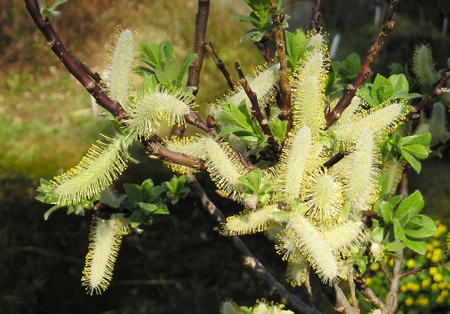 | 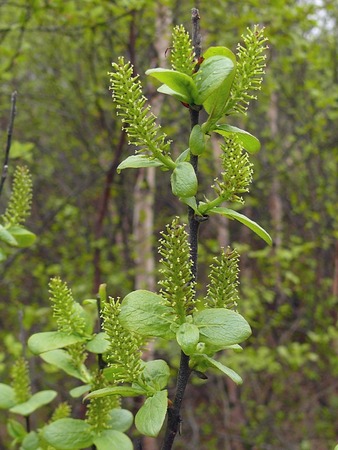 |
| Male inflorescence | Female inflorescence |
Flowers in April-May. In the forest belt it flowers before leafing, in higher belts simultaneously with leafing. Catkins dense, cylindrical, 3-5 cm long, erect, silvery, during flowering light golden-yellow. Bract scales oblong or oblong-spathulate, acute or obtuse, covered with white hairs, light-brown. Stamens free, number 2, in rare cases partly fused, up to 7 mm long, glabrous, with yellow anthers. Ovary up to 4 mm long, conical, glabrous, obtuse, green or brown-green; stigma short, two-lobed, 0.2-0.3 mm long.
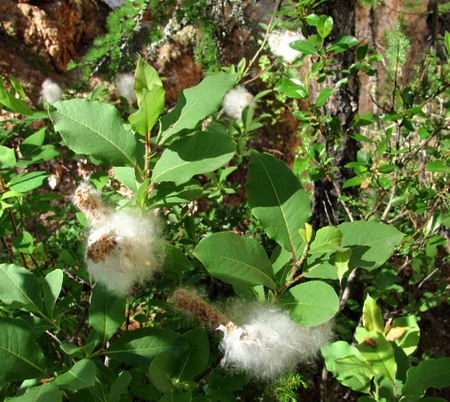
Fruits up to 8 mm long, bluntly conical, brown or reddish-green, glabrous. Seeds 18-24. Fruits in July.
Chromosome number 2n=38
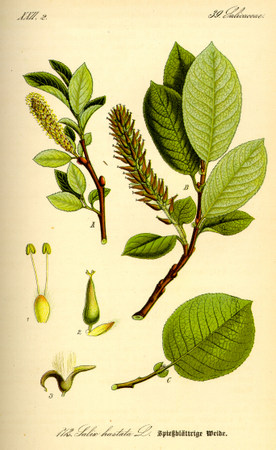
Flora von Deutschland, Österreich und der Schweiz (1885) Otto Wilhelm Thomé.
Cultivars: ‘Wehrhahnii’, 'Tobi', 'Finsko', ‘Thyre’,
Varieties: S. hastata var. hastata L., S. hastata var. subintegrifolia Flod., S. hastata var. subalpina Anderss., S. hastata var. alpestris Anderss.
Hardiness zone: 5b (-23°C)
Location: light-loving but shade-tolerant, moisture-loving, easily tolerates waterlogging and temporary flooding, can grow on swampy soil. Undemanding and very hardy, tolerates urban conditions well. Does not like urban conditions and river floodplains.
Soil: does not like calcareous soils. Prefers acidic, poor podzolic or sandy soil.
Planting: Planting is best done in spring before bud break. When establishing a "willow stand" it is recommended to cultivate the soil in autumn to a depth of 30-80 cm, depending on its fertility and dryness. The top vegetative layer should be turned down. Recommended spacing between seedlings should be no less than 0.6-2 m, depending on the species. Planting depth – 40-70 cm. Transplanting is recommended up to 3-4 years. On heavy soils drainage of gravel or sand in a layer of 20-30 cm is recommended.
Pruning: tolerates trimming and pruning well. Regular pruning of dead shoots and shaping of the stem and crown is recommended. To create hedges, annual cutting to the stump is necessary.
Care: practically requires no maintenance.
Propagation: by cuttings and seeds. Seeds lose viability after 10 days. Winter cuttings practically do not root; green cuttings treated with Kornevin root at 100%. Can also be propagated by grafting onto other willow species.
Pests: Cecidomya saliciperda, Cecidomya salicis, Tortrix (Helias) Chlorana, Agrotis vallugera, Bombyx Salicis, Curculio crux, Phratora vulgarissima, Phratora vitellinae, Galer ucacapreae, Galer lincola, Arvicola terrestris.
Diseases: affected by fungal diseases – fungi of the genera Melampsora, Rhytisma, Erysiphe.
Conservation status: listed in the Red Book of the Ivano-Frankivsk region.
Uses: popular in Europe. Shoots are used for basket weaving, for making bows and arrows. Leaves are used in medicine.