
Deciduous shrubs
Slender-stemmed Black-Catkin Willow
Salix gracilistyla var.melanostachys
Synonyms: Kurome, Kuroyanagi, Salix melanostachys, Black Pussy Willow, patio salix kurome
Salix gracilistyla Miq. – a striking form of the slender-stemmed willow. Native to Japan. Awarded the Royal Horticultural Society's Award of Garden Merit (AGM).
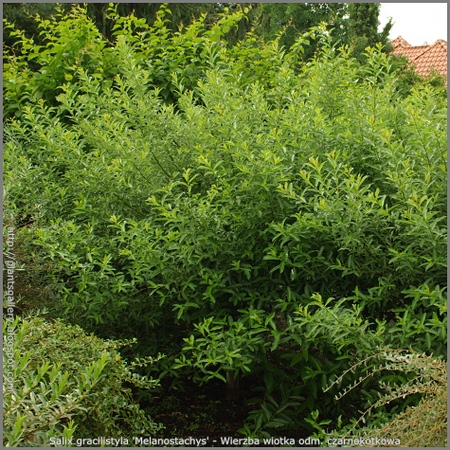
It is a fast-growing multi-stemmed shrub reaching 3–7 (9) m in height and width. The crown is oval and spreading. Young shoots range from red to black, greening by spring.
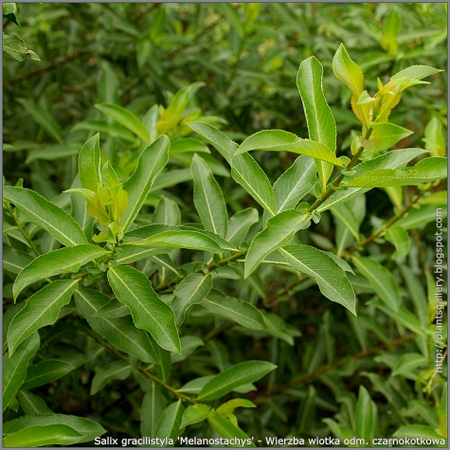
Leaves are ovate, up to 10 cm long, finely serrated at the margin, dark green above and silvery-green beneath, at first covered on both sides with white hairs, later glabrous and glossy.
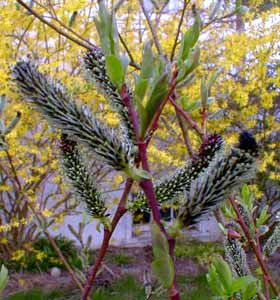
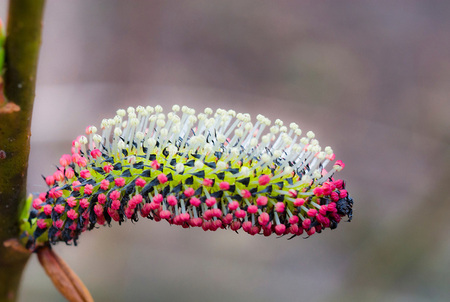
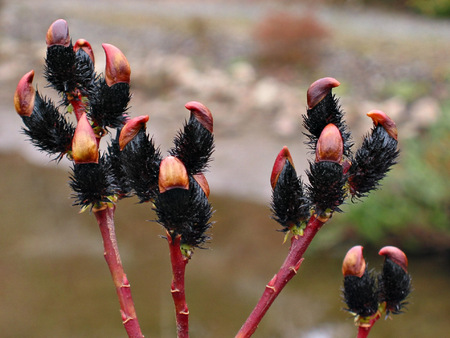
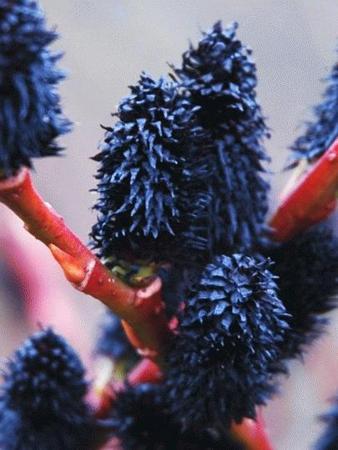
Flowers before leafing, in March–April. Male catkins are very showy, up to 4 cm long, purple-black with red anthers, gradually turning yellow as the pollen fully matures. Female catkins are more rounded, up to 2 cm long, black. Catkins remain on the shrubs until early April.
Hardiness zone: 8b–9 (−10°C). In most of Ukraine it requires winter protection.
Position: sun-loving but tolerates partial shade. Grows well in urban conditions. Not demanding regarding growing conditions. Requires a site protected from strong winds.
Soil: not demanding; grows on any sufficiently moist soil with good drainage. Prefers fertile soil, although it can grow on poor and dry soils.
Planting: Best planted in spring before budburst. When establishing a "willow-bed" (stands of willow) it is recommended to cultivate the soil in autumn to a depth of 30–80 cm, depending on its fertility and dryness. The top vegetative layer should be turned upside down. Recommended spacing between seedlings should be no less than 0.6–2 m, depending on the species. Planting depth – 40–70 cm. Transplanting is recommended up to 3–4 years of age. On heavy soils a drainage layer of crushed stone or sand 20–30 cm thick is recommended.
Pruning: every 3–4 years fairly severe pruning is necessary to ensure abundant flowering. It is also recommended to regularly remove damaged and diseased branches.
Care: requires little maintenance.
Propagation: propagated by summer (softwood) and hardwood cuttings.
Pests: longhorn beetles, the willow leaf beetle (Lochmaea caprea), Crepidodera aurata, hymenopteran larvae (Trichiosoma sibiricum), lepidopteran caterpillars (Acleris cristana, Teleiodes notatella, etc.).
Diseases: susceptible to fungal diseases – fungi of the genera Melampsora, Rhytisma, Erysiphe, Phytophthora ramorum.
Uses: an ornamental shrub for small landscape gardens. Used in solitary and group plantings. Attractive as a screen, in low-lying areas, and near water bodies.