
Deciduous trees
Goat willow 'Kilmarnock'
Salix caprea 'Kilmarnock'
Synonyms: Salix caprea var. pendula, Salix caprea 'Pendula'
Goat willow 'Kilmarnock' (Salix caprea 'Kilmarnock') – a popular form of goat willow. It was found on the bank of the river Er (Yorkshire, Great Britain) in the early 19th century by Thomas Lang from Kilmarnock (Kilmarnock, Ayeshire, Scotland), and first appeared in nurseries in 1853.
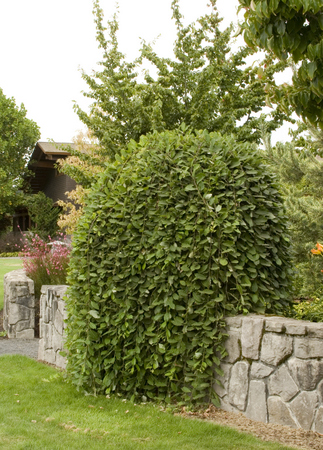
It is a small tree, less often a shrub, 1.5-1.8 m in height and 1.5 m in diameter. Above the grafting point the shoots rise up to 50 cm and then drop steeply. The crown is weeping, umbrella-shaped, with thin pendulous branches hanging to the ground. Young shoots are dark red-brown, later becoming grey-green; the bark is grey.
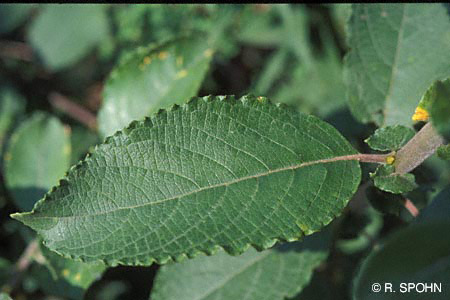
Leaves dark green, glossy above, duller beneath, covered with grey-white hairs, slightly wrinkled, oblong-elliptic with a wavy margin and small stipules. In autumn they turn yellow.
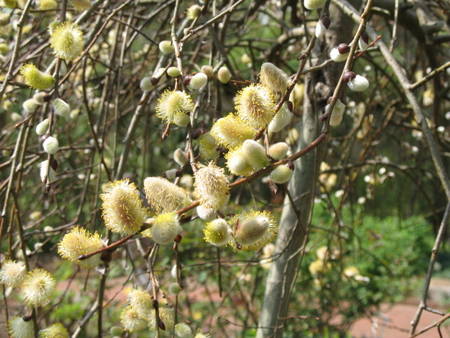
Flowers in March-April, before leaf emergence. Male clone. Catkins soft, fluffy, grey-green, later golden-yellow, densely arranged along last year’s shoots. They have a delicate fragrance.
The female clone of the form is called ‘Weeping Sally’, was obtained in 1880, but named in 1976. It is more vigorous in growth but not as spectacular in flowering.
Hardiness zone: 4b-8(-29°C).
Position: light-loving. Grows well in urban conditions. Not demanding on growing conditions. Needs a site protected from strong winds. Tolerates urban conditions well.
Soil: undemanding; grows on any sufficiently moist soil with good drainage. Prefers fertile soil, although it can grow on poor and dry soils.
Planting: Best planted in spring before budburst. When establishing a "ivnyak" (stands of willow) it is recommended to work the soil in autumn to a depth of 30-80 cm, depending on its fertility and dryness. The topsoil should be turned downwards. Recommended spacing between seedlings should be no less than 0.6-2 m, depending on the species. Planting depth – 40-70 cm. Transplanting is recommended up to 3-4 years of age. On heavy soils a drainage layer of crushed stone or sand 20-30 cm thick is recommended.
Pruning: requires formative pruning
Care: practically requires no maintenance.
Propagation: propagated by grafting onto goat willow. Can also be propagated by green cuttings.
Pests: longhorn beetles, willow leaf beetle (Lochmaea caprea), Crepidodera aurata, sawfly larvae (Trichiosoma sibiricum), lepidopteran caterpillars (Acleris cristana, Teleiodes notatella, etc.).
Diseases: affected by fungal diseases – fungi of the genera Melampsora, Rhytisma, Erysiphe, Phytophthora ramorum.
Partners: Coreopsis grandiflora 'Walocrep', Paeonia x 'Pink Parfait', Lonicera heckrottii 'Goldflame', Iris siberica 'Ruffled Velvet'
Uses: used in solitary plantings, in parks, for decorating walkways, near water bodies, effective in floral compositions.